Collision Repair: The Complete Owner's Guide
Everything that happens between a crash and driving away in a properly fixed car: the steps, the costs, the decisions you get to make and the questions worth asking. Written by an independent guide, not a shop.
Key takeaways
- Collision repair restores a car's structure, panels, paint and safety systems after a crash. A complete repair ends with scans, calibrations and a road test, not just fresh paint.
- The average repairable claim was $4,818 in 2025 (CCC). Mitchell's 2025 figure for gas cars was $5,105. Half of all collision claims are under about $5,000 (HLDI).
- Estimates grow after teardown. That is normal. Ask to see photos of anything added.
- In North Carolina you choose the shop, and the insurer must total the car once repairs reach 75% of its pre-accident value.
Typical costs at a glance
| Scenario | Typical range (estimate) | What drives it |
|---|---|---|
| Average repairable claim, all vehicles | $4,818 average (CCC, 2025; single-source estimate); $4,821 average (CCC, first half 2026; single-source estimate) | Insurance-paid repairs. |
| Average repairable claim, gas vs electric | $5,105 gas, $6,395 battery electric (Mitchell, 2025; single-source estimate) | Mitchell's averages run higher than CCC's. |
| Self-paid repair | $1,941 average; more than 71% under $2,000 (CCC, first half 2026; single-source estimate) | Smaller jobs paid without a claim. |
| Where most collision claims fall | About 55% between $2,000 and $9,999 (HLDI, 2024 claims; single-source estimate) | After the deductible. |
| Driver-assistance parts in a minor front-end repair | $1,540 average added (AAA, Dec 2023); +$500–$1,900 to replace front-bumper sensors and cameras (Consumer Reports, RepairPal data, Jan 2020) | On top of body work. |
| Frame damage repair | $600–$10,000 (Experian, Aug 2022; Caliber Collision, checked Nov 2026) | Severity is the biggest factor. |
| Bumper repair or replacement | $100–$2,000 (Experian, Aug 2022); commonly $1,000 or more (Synchrony, Apr 2023) | Sensors push it to the top. |
Ranges are estimates from the sources listed on this page, not quotes. Rows marked single-source estimate rest on one publication. Your price depends on the vehicle, the damage and local labor rates.
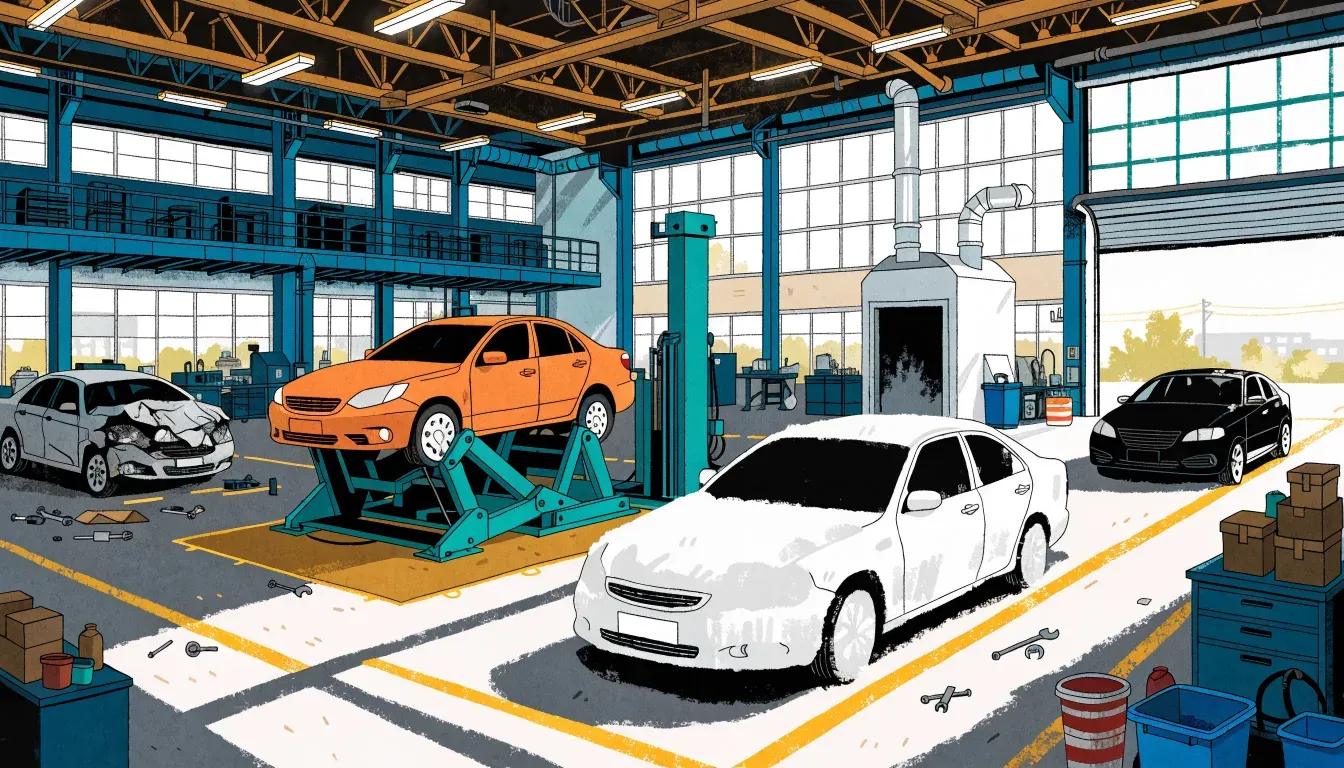
Collision repair is the work that puts a car back to its pre-crash condition: structure, panels, paint and the electronic safety systems that now sit behind bumpers, grilles and windshields. A complete repair runs from estimate and teardown through structural and body work, paint, sensor calibration and a final scan and road test. The average repairable claim was $4,818 in 2025, according to CCC Intelligent Solutions, and the price swings with labor, parts, paint, sensors and hidden damage.
Auto Body Wilson is an independent guide. We do not repair cars or give estimates. This guide explains what happens and what to ask, with links to a full guide on each topic.
How collision repair works
Most repairs follow nine steps: estimate, pre-repair scan, teardown, supplement, structural repair, body repair, paint, reassembly with calibration, and final checks. The estimate almost always changes after teardown, because damage behind the bumper or panels only shows once parts come off.
Two technical points separate a complete repair from a cosmetic one. First, I-CAR, the industry’s training body, says carmaker repair procedures “are service specifications, not recommendations.” Second, scans and calibrations are part of the job. I-CAR’s industry definitions treat the pre-repair scan as part of damage analysis and the post-repair scan as a quality-control step. CCC found 74.8% of repairable appraisals in early 2026 included a scan.
Full guide: the collision repair process, step by step. For how long it takes, see how long collision repair takes.
What collision repair costs
Industry averages put a typical repairable claim close to $5,000. CCC reports $4,818 for 2025 and $4,821 for the first half of 2026. Mitchell’s 2025 figure is $5,105 for gas-powered cars and $6,395 for battery electric vehicles. The spread is wide: HLDI found about 30% of 2024 collision claims were under $3,000, while 5% were $25,000 or more.
The biggest drivers are labor hours and rates, parts prices, paint and blending, and driver-assistance sensors. AAA found those sensors added $1,540 on average to a minor front-end repair. Newer cars cost more to fix: CCC found vehicles six years old or newer averaged $2,039 more per repair than older ones.
Full guide: collision repair cost: what drives the bill. For every price guide on the site, see the repair cost index.
The first 48 hours after a crash
What you do at the scene shapes the claim and the repair. Stop, check for injuries, get to safety, call the police, swap information, photograph everything and report the claim quickly. North Carolina law requires you to stop at any crash and to call police right away when there is an injury or $1,000 or more in damage.
Full guide: what to do after a car accident: the first 48 hours.
Frame and structural damage
Frame damage means the structure that holds the car together has moved. Most modern cars are unibody, with frame and body as one structure. Trucks and many SUVs still have a separate frame. Both can often be repaired. Published estimates put frame damage repair at $600 to $10,000. The repair must follow the carmaker’s procedures, and some high-strength steel parts must be replaced rather than straightened.
Full guide: frame damage repair: cost, safety and when it’s not worth fixing. Related topics: is it safe to drive with frame damage? and unibody vs body-on-frame repairs.
Parts: OEM, aftermarket and used
Your estimate will list new carmaker (OEM) parts, aftermarket parts or used parts. They differ in price and sometimes in fit. In North Carolina, an insurer cannot require aftermarket parts unless they equal the original in fit, quality, performance and warranty, according to the NC Department of Insurance. See OEM vs aftermarket vs used parts.
Sensors and calibration
Cameras, radar and parking sensors sit inside bumpers, grilles, mirrors and windshields. When those parts are removed or damaged, the sensors often need calibrating. CCC found calibrations on 28.3% of repairable estimates in 2025. This is one of the most common reasons an estimate grows. See ADAS calibration after a collision and, for the related wheel work, do you need an alignment after an accident?
Hidden damage and supplements
Teardown finds what an outside inspection cannot: crushed absorbers, bent brackets, damaged wiring. The shop adds it on a supplement and, on a claim, waits for the insurer to approve it. CCC’s mid-year 2026 data shows fewer than half of calibrations were on the first estimate. See hidden damage after an accident, and for a common case, rear-end collision damage.
Total loss: when the car isn’t worth fixing
Insurers total a car when repairs cost too much compared with its value. In North Carolina, the Department of Insurance says that happens when repairs equal or exceed 75% of the pre-accident actual cash value. CCC flagged a record 23.1% of claims as total losses in 2025, mostly on older cars. See is my car totaled?, and if airbags deployed, airbag replacement cost.
Other common situations
- Deer strikes are usually a comprehensive claim, not collision. See hit a deer? damage, repair costs and the claim.
- Not sure whether you need a collision shop or a general body shop? See collision repair vs auto body repair.
Choosing a collision repair shop
You can usually choose your own shop. In North Carolina that right is spelled out by the Department of Insurance. Compare at least two written estimates line by line, ask whether the shop follows carmaker repair procedures and does scans and calibrations, and get the warranty in writing. Start with how to find a good auto body shop and how to choose an auto body shop. If you are in North Carolina, see the North Carolina guide. For the money side, see insurance claims and body shops.
Shop terms such as R&I, blend and supplement are defined in our auto body glossary.
What to do next
- If the crash just happened, follow the first 48 hours checklist.
- Get written estimates from two shops and compare them using the collision repair cost guide.
- Before you approve the work, read the repair process so you know which steps to ask about.
- If the car is older or the damage is heavy, ask your insurer early whether it may be a total loss.
Frequently asked questions
What is collision repair?
Collision repair is the work that restores a car after a crash: straightening or replacing damaged structure, repairing or replacing panels, painting and blending, and putting back lights, trim and sensors. On modern cars it also includes computer scans before and after the repair and calibrating driver-assistance cameras and radar so they work as designed.
Full guide: The Collision Repair Process, Step by Step
How much does collision repair cost?
CCC's claims data puts the average repairable claim at $4,818 for 2025, and Mitchell's puts gas cars at $5,105. Most claims are smaller: HLDI found about half of 2024 collision claims were under $5,000. Your cost depends on labor rates, parts, paint, sensors and hidden damage found after teardown.
Full guide: Collision Repair Cost: What Drives the Bill
Is collision repair the same as auto body repair?
They overlap. Auto body repair covers any work on panels and paint, including dents, scratches and rust that have nothing to do with a crash. Collision repair is body work after a crash, and it more often includes structural, mechanical and electronic work such as frame straightening and sensor calibration.
Full guide: Collision Repair vs Auto Body Repair: Is There a Difference?
Can I pick my own collision repair shop?
In North Carolina, yes. The NC Department of Insurance says the insurer may recommend a shop, but you have the right to choose, and the insurer pays the amount it owes under the policy either way. Rules vary in other states, so check with your own state's insurance department.
Full guide: North Carolina: Your Right to Choose a Repair Shop
Other guides
How to choose a shop, compare estimates, and tell cheap from good.
Paint costs, paint types, color matching and custom work.
Dents, scratches, rust, bumpers, fenders and panels.
Claims, shop choice, low estimates and total-loss payouts.
Classic car restoration and custom body work.
What you can safely fix yourself, and when to stop.

Wilson and Raleigh guides and NC consumer rules.
Calculators that show a range and the method behind it.
Sources
- CCC Intelligent Solutions, Crash Course 2026: Complexity Compounds (Mar 2026) — accessed November 24, 2026
- Insurance Journal, CCC 2026 Crash Course Mid-Year Update coverage (19 Oct 2026) — accessed November 24, 2026
- Mitchell, Plugged-In: EV Collision Insights 2025 Year in Review (19 Feb 2026) — accessed November 24, 2026
- Highway Loss Data Institute, Collision coverage: distribution of claims by claim size (Dec 2025) — accessed November 24, 2026
- AAA Newsroom, ADAS repair costs study (14 Dec 2023) — accessed November 24, 2026
- Experian, What's the Average Cost of an Auto Repair After an Accident? (17 Aug 2022) — accessed November 24, 2026
- Caliber Collision, Car Frame Straightening: A Complete Guide — accessed November 24, 2026
- I-CAR Repairability Technical Support, Always follow vehicle maker procedures — accessed November 24, 2026
- I-CAR Repairability Technical Support, Collision Repair Diagnostics Definitions — accessed November 24, 2026
- Repairer Driven News, CCC mid-year collision repair trends update (19 Oct 2026) — accessed November 24, 2026
- North Carolina General Statutes § 20-166, Duty to stop in event of a crash — accessed November 24, 2026
- North Carolina General Statutes § 20-166.1, Reports and investigations required in event of accident — accessed November 24, 2026
- North Carolina General Statutes § 20-4.01, Definitions (reportable crash) — accessed November 24, 2026
- North Carolina Department of Insurance, After an Accident — accessed November 24, 2026
- Consumer Reports, The Hidden Cost of Car Safety Features (Jan 30, 2020; RepairPal data) — accessed November 24, 2026
- Synchrony, How Much Does It Cost to Replace or Repair a Car Bumper? (Apr 11, 2023) — accessed November 24, 2026