Frame Damage Repair: Cost, Safety and When It's Not Worth Fixing
Frame damage sounds like the end of a car, but much of it can be repaired properly. Here is what it costs, how unibody cars and body-on-frame trucks are fixed, and when the numbers point to a total loss instead.
Key takeaways
- Published estimates put frame damage repair cost at $600 to $10,000 (Experian, Aug 2022; Caliber Collision, checked Nov 2026). The extent of the damage is the biggest factor.
- Most modern cars are unibody: the frame and body are one structure. Trucks and many SUVs still use a separate frame. Both can be repaired, by different methods.
- A safe repair follows the carmaker's published procedures. I-CAR says those procedures are specifications, and some high-strength steel parts must be replaced, not straightened.
- Frame damage on an older car often tips it into a total loss. In North Carolina that happens when repairs reach 75% of the car's pre-accident value.
Cost by scenario
| Scenario | Typical range (estimate) | What drives it |
|---|---|---|
| Frame damage repair or straightening, all severities | $600–$10,000 (Experian, Aug 2022); $600–$10,000 (Caliber Collision, checked Nov 2026) | Caliber says the extent of the damage is the biggest factor in where a job lands. |
| Suspension damage found with frame damage | $1,000–$5,000 (Experian, Aug 2022); $1,000–$5,000 for suspension repairs (SoFi, Oct 2025) | Listed separately from frame work in Experian's figures. |
| Airbag replacement, if bags deployed | $1,000–$1,500 per bag (Experian, Aug 2022); $1,000–$2,000 per bag (SoFi, May 2025) | Only if airbags deployed. |
| Driver-assistance parts in a front-end repair | $1,540 average added (AAA, Dec 2023); +$500–$1,900 to replace front-bumper sensors and cameras (Consumer Reports, RepairPal data, Jan 2020) | Radar and cameras behind the bumper and grille, plus calibration. |
| Average repairable claim, vehicles 6 years old or newer | $5,721 average (CCC, 2025; single-source estimate) | All collision repairs, not only frame jobs. For context. |
Ranges are estimates from the sources listed on this page, not quotes. Rows marked single-source estimate rest on one publication. Your price depends on the vehicle, the damage and local labor rates.
Frame damage repair cost runs from about $600 to $10,000 in published estimates. Experian’s August 2022 guide and Caliber Collision’s frame straightening guide, checked in November 2026, both give that range. Caliber says the extent of the damage is the biggest factor in where a repair lands, and suspension, airbag and sensor work can add to the bill on top of the structure. On an older car, frame damage is often what turns a repair into a total loss.
Auto Body Wilson is an independent guide, not a repair shop. Every cost and technical claim below is linked to its source.
What counts as frame damage
“Frame damage” is any damage to the structure that holds the car together, not just the rails under it. Caliber’s guide lists strut towers, pillars, firewalls, rocker panels, rear support structures and aprons as places structural damage shows up. Crumple zones are designed to collapse in a crash, and that collapse is itself structural damage that needs repair.
Caliber lists the kinds of frame damage a technician looks for: a sagging or twisted frame, “sway damage that makes the car lean to the side,” and crushed crumple zones.
You cannot rule it out by eye. I-CAR points out that minor damage to one side of a car “may not be noticeable when visually comparing it to the other side,” which is why shops measure specific points instead of relying on looks (I-CAR).
Unibody vs body-on-frame
How a car is built decides how it is repaired.
| Unibody | Body-on-frame | |
|---|---|---|
| What it is | Frame and body made as one structure | Separate full frame with the body mounted on top |
| Common on | Most modern cars | Trucks and many SUVs |
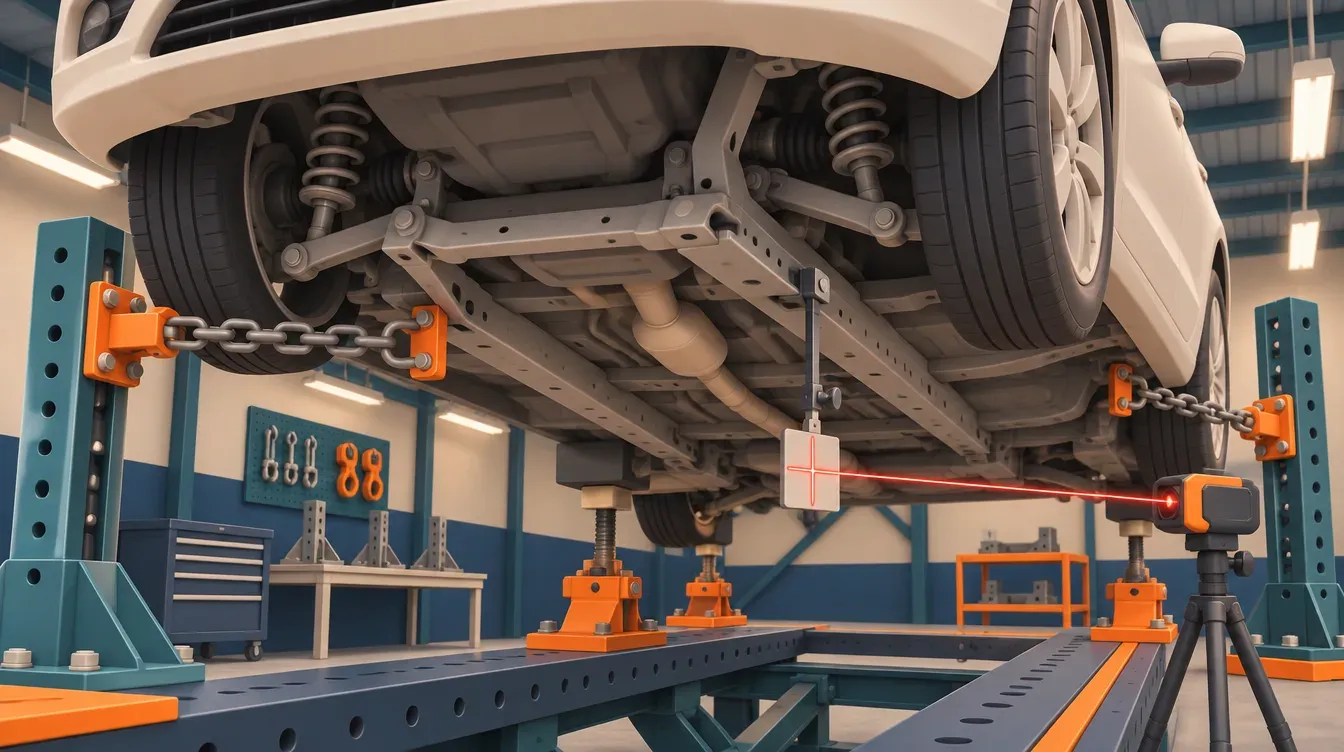
| Typical repair | Pull and measure the structure, section or replace damaged parts | Pull the frame, replace brackets or sections, or replace the whole frame |
MOTOR notes that “most modern vehicles are now built on a unibody frame,” while “many modern SUVs and trucks still feature a full-frame.” Repairing a unibody can mean “straightening and aligning the unibody structure, cutting out damaged sections, and replacing them,” and those steps “must be performed exactly as manufacturers recommend.”
For full frames, an article written by I-CAR for FenderBender says “a frame is far more rigid than a unibody,” and when the frame and body are both damaged “multiple pulls may be necessary.” Carmakers offer sectioning and replacement of frame parts at factory seams, and a full frame can be replaced as a complete assembly. Unibody vs body-on-frame goes deeper.
How frame damage is repaired properly
Measure first
The structure is measured at set points and compared with the carmaker’s dimensions or, where those are not available, with the undamaged side. I-CAR says three-dimensional measuring lets technicians “repeat and verify specific measurements so they can be documented both before and after repairs are complete” (I-CAR). Ask for those before and after records.
Follow the carmaker’s procedures
I-CAR, the collision industry’s training body, says the procedures carmakers publish “are service specifications, not recommendations.” Shops should use the carmaker’s body repair manual and position statements first, and fall back to I-CAR best practices only when the carmaker publishes nothing (I-CAR).
Know what cannot be straightened
Modern structures use high-strength steels that do not tolerate being pulled back. I-CAR’s best practice says parts made of ultra-high-strength steel over 600 MPa “should NOT be straightened, part replacement would be the only option,” unless the carmaker says otherwise. For conventional frames, I-CAR’s kink vs. bend rule is a guide: “if a part is kinked, it should be replaced and if it is bent, it may be repairable.” I-CAR adds that the rule “does not always provide a definite repair vs. replace answer.”
Check everything the structure carries
The structure carries the suspension and many of the driver-assistance sensors. After structural work, expect a post-repair scan and calibration of any sensors whose mounting points were damaged, and ask whether the car needs a wheel alignment. I-CAR lists “damage/trauma to the mounting location(s)” among the triggers for calibration. See the collision repair process for how these steps fit together.
What moves the cost
- Extent of damage. Caliber calls this the biggest factor. More severe damage means more work, and parts that must be cut out and replaced add parts cost on top of labor.
- Make and model. Caliber notes that parts for newer or more expensive cars usually cost more.
- Materials. High-strength steel parts that must be replaced instead of straightened add parts cost.
- What else is damaged. Suspension damage alone runs $1,000 to $5,000 in Experian’s 2022 figures, and each deployed airbag $1,000 to $1,500. AAA found driver-assistance parts added $1,540 on average to a minor front-end repair.
- Frame replacement on trucks. I-CAR notes there are “a lot of mechanical details” to replacing a complete frame. It also notes some states, including Texas, Louisiana, Arizona and Oregon, brand the title when a frame assembly is replaced. North Carolina’s branding law, G.S. 20-71.3, has no brand that names frame replacement. A North Carolina car is branded salvage when repair costs pass 75 percent of its fair market value. A separate “reconstructed vehicle” brand in G.S. 20-4.01(33)c covers a vehicle “materially altered from original construction due to removal, addition or substitution of new or used essential parts,” so ask NCDMV how a frame swap on your truck will be titled.
We could not find sourced figures that split frame repair cost between unibody cars and trucks, so we do not give separate ranges.
Is it safe after repair?
I-CAR’s position is that following the carmaker’s procedures “is the best way to achieve complete, safe, quality repairs.” In practice that means a repair measured before and after, repaired to the carmaker’s procedures, with the right parts replaced instead of pulled, and with sensors calibrated. Ask the shop for its measurement printouts, the procedures it followed and the post-repair scan report.
Before repair, treat the car as unsafe. Caliber’s guide notes a structurally unsound car “cannot protect its occupants if another collision occurs.” Is it safe to drive with frame damage? covers the short-term question.
When it’s not worth fixing
The numbers usually decide this. In North Carolina, the Department of Insurance says an insurer must treat the car as a total loss when repairs equal or exceed 75% of its pre-accident actual cash value. State law also defines a salvage vehicle as one where repairs would exceed 75% of its fair retail market value, whether or not an insurer declared it a total loss (G.S. 20-4.01).
Frame damage pushes older cars over that line fast. CCC’s Crash Course 2026 found about 1 in 10 claims on cars three years old or newer ended as total losses in 2025, against 45.3% for cars 13 years or older. Put simply, a $7,000 repair is under the 75% line on a car worth $20,000, but well over it on a car worth $8,000.
If you are paying yourself, the same logic applies. Compare the full estimate, not just the frame line, with what the car is worth. Is my car totaled? explains how insurers value the car and what to do if you disagree.
A rear impact can bend the trunk floor and rear rails as well as the bumper; rear-end collision damage lists what to check.
What to do next
- Do not drive the car far until a shop has measured the structure.
- Get a written estimate after teardown, and ask the shop to show you the measurement results.
- Ask whether the shop will follow the carmaker’s repair procedures and which parts will be replaced rather than straightened.
- Compare the full estimate with your car’s value. If it is near 75% in North Carolina, expect a total loss.
- For the wider picture on costs, read collision repair cost, and for the steps ahead, the collision repair process.
Repair or replace?
Frequently asked questions
How much does it cost to fix frame damage?
Published estimates run from $600 to $10,000. Experian's 2022 guide and Caliber Collision's frame straightening guide both give that range. How severe the damage is decides where a repair lands, and suspension, airbag and sensor work is billed on top. Get a written estimate after teardown.
Is a car with frame damage safe to drive?
Not until a shop has inspected and measured it. Caliber's guide notes that a structurally unsound car cannot protect its occupants in another crash. Damage where sensors mount can also leave driver-assistance systems needing calibration. I-CAR says following the carmaker's procedures is the best way to a safe repair. Until then, have it towed or driven only to the shop.
Full guide: Is It Safe to Drive With Frame Damage?
Will insurance total a car with frame damage?
Only if the full repair cost is high enough compared with the car's value. In North Carolina, the Department of Insurance says the insurer must treat the car as a total loss when repairs equal or exceed 75% of its pre-accident actual cash value. Frame damage often pushes older, lower-value cars over that line.
Full guide: Is My Car Totaled? How Shops and Insurers Decide
What is the difference between frame damage on a car and on a truck?
Most modern cars are unibody, so the frame and body are one structure. Repairs can mean straightening that structure, cutting out damaged sections and replacing them. Trucks and many SUVs have a separate full frame under the body. I-CAR notes a full frame is far more rigid and may need several pulls, or full frame replacement.
Full guide: Unibody vs Body-on-Frame: How Each Gets Repaired
Sources
- North Carolina General Statutes § 20-71.3, Salvage and other vehicles: titles to be branded — accessed November 24, 2026
- North Carolina General Statutes § 20-4.01, Definitions (reconstructed and salvage vehicles) — accessed November 24, 2026
- Experian, What's the Average Cost of an Auto Repair After an Accident? (17 Aug 2022) — accessed November 24, 2026
- Caliber Collision, Car Frame Straightening: A Complete Guide — accessed November 24, 2026
- AAA Newsroom, ADAS repair costs study (14 Dec 2023) — accessed November 24, 2026
- CCC Intelligent Solutions, Crash Course 2026: Complexity Compounds (Mar 2026) — accessed November 24, 2026
- MOTOR Information Systems, Are Your Frame Rail Repair Skills Up to Snuff? (17 May 2023) — accessed November 24, 2026
- FenderBender, Full Frames: On the Rack Again (article submitted by I-CAR) — accessed November 24, 2026
- I-CAR Repairability Technical Support, Back-To-Basics: Comparative Measuring — accessed November 24, 2026
- I-CAR Repairability Technical Support, Three-Dimensional Measuring System Setup and Operation Courses — accessed November 24, 2026
- I-CAR Repairability Technical Support, Always follow vehicle maker procedures — accessed November 24, 2026
- I-CAR Repairability Technical Support, Collision Repair Diagnostics Definitions — accessed November 24, 2026
- North Carolina Department of Insurance, After an Accident — accessed November 24, 2026
- North Carolina General Statutes § 20-4.01, Definitions (salvage motor vehicle) — accessed November 24, 2026
- SoFi, Suspension Repair & Replacement Cost Guide (Oct 20, 2025) — accessed November 24, 2026
- SoFi, How Much Does Airbag Replacement Cost in 2025? (May 13, 2025) — accessed November 24, 2026
- Consumer Reports, The Hidden Cost of Car Safety Features (Jan 30, 2020; RepairPal data) — accessed November 24, 2026