Collision Repair Cost: What Drives the Bill
The average repairable collision claim runs close to $5,000, but most repairs cost less and a few cost far more. Here is what the industry data shows, what pushes a bill up, and how to check the quote in front of you.
Key takeaways
- CCC puts the average repairable claim at $4,818 for 2025 and $4,821 for the first half of 2026. Mitchell puts gas-powered cars at $5,105 for 2025. These are estimates from claims data, not quotes.
- Half of all collision claims are under about $5,000 and 30% are under $3,000 (HLDI, 2024 claims). Self-paid repairs averaged $1,941 in the first half of 2026 (CCC).
- The biggest swing factors are labor hours, parts prices, paint and blending, driver-assistance sensors and hidden damage found after teardown.
- Newer cars cost more to fix. CCC found vehicles six years old or newer averaged $2,039 more per repair than older ones in 2025.
Cost by scenario
| Scenario | Typical range (estimate) | What drives it |
|---|---|---|
| Average repairable claim, all vehicles | $4,818 average (CCC, 2025; single-source estimate); $4,821 average (CCC, first half 2026; single-source estimate) | Insurance-paid repairs only. Labor, parts, paint and sublet work. |
| Average repairable claim by powertrain | $5,105 gas, $5,054 mild hybrid, $5,628 plug-in hybrid, $6,395 battery electric (Mitchell, 2025; single-source estimate) | Mitchell's figures run higher than CCC's for the same year. Both are shown. |
| Self-paid repair (no insurance claim) | $1,941 average; more than 71% under $2,000 (CCC, first half 2026; single-source estimate) | Smaller jobs owners chose to pay for themselves. |
| Where most collision claims fall | About 55% between $2,000 and $9,999; about 30% under $3,000 (HLDI, 2024 claims; single-source estimate) | Insurer-paid amounts, after the deductible. |
| Driver-assistance parts in a minor front-end repair | $1,540 average added (AAA, Dec 2023); +$500–$1,900 to replace front-bumper sensors and cameras (Consumer Reports, RepairPal data, Jan 2020) | On top of normal body work. Radar, camera and their calibration. |
| Single ADAS sensor or camera, part plus calibration | $300–$1,600 depending on the sensor (AAA, Dec 2023; single-source estimate) | Ultrasonic parking sensors at the low end, mirror cameras at the high end. |
| Bumper repair or replacement | $100–$2,000 (Experian, Aug 2022); commonly $1,000 or more (Synchrony, Apr 2023) | Cover repair at the low end, new cover with paint and sensors at the high end. |
| Suspension damage | $1,000–$5,000 (Experian, Aug 2022); $1,000–$5,000 for suspension repairs (SoFi, Oct 2025) | Often found during teardown after a wheel or corner hit. |
| Frame damage repair | $600–$10,000 (Experian, Aug 2022; Caliber Collision, checked Nov 2026) | See the frame damage guide for what drives the spread. |
| Airbag replacement | $1,000–$1,500 per bag (Experian, Aug 2022); $1,000–$2,000 per bag (SoFi, May 2025) | Deployed airbags also mean sensors and often seat belts. |
Ranges are estimates from the sources listed on this page, not quotes. Rows marked single-source estimate rest on one publication. Your price depends on the vehicle, the damage and local labor rates.
Collision repair cost averages a little under $5,000 for a repairable claim, and most repairs cost less than that. CCC Intelligent Solutions, whose platform handles hundreds of millions of claims transactions, puts the average at $4,818 for 2025 and $4,821 for the first half of 2026. Mitchell, another claims-data company, puts gas-powered cars at $5,105 for 2025. These are estimates from insurance claims, checked in November 2026, not a quote for your car.
Auto Body Wilson is an independent guide, not a repair shop. The figures below come from named industry sources so you can judge a real estimate against them.
What the averages mean, and why they differ
Each source measures something slightly different, which is why the numbers do not line up exactly.
- CCC (Crash Course 2026) reports the average total cost of repair across repairable claims: $4,818 in 2025, up 1.7% from 2024. Its mid-year update, reported by Insurance Journal in October 2026, shows $4,821 for the first half of 2026. In 2020 the figure was $3,331.
- Mitchell (2025 year in review) breaks repairable claims out by powertrain: $5,105 for gas cars, $5,054 for mild hybrids, $5,628 for plug-in hybrids and $6,395 for battery electric vehicles.
- The Insurance Information Institute (auto insurance facts) gives $5,489 as the average collision claim in 2024. That counts claims paid under collision coverage, not repair estimates.
An average hides a wide spread. The Highway Loss Data Institute’s 2024 claim-size report found that about 30% of collision claims cost less than $3,000, about half cost less than $5,000, and 75% cost less than $10,000. Only 5% cost $25,000 or more. Those amounts do not include the deductible the owner paid.
Repairs people pay for themselves skew smaller. CCC’s mid-year data shows self-paid repairs averaged $1,941, and more than 71% were under $2,000.
What moves the price
A body shop estimate is built from labor hours, parts, paint materials and sublet work such as alignments or calibrations. Each one can swing the total.
Labor rates and hours
Every repair operation has a labor time. The shop multiplies the hours by its hourly rate, and rates differ by labor type (body, paint, frame, mechanical) and by region. CCC found the average labor rate rose 2.9% in 2025, the smallest increase since 2021, and 1.5% in the first half of 2026. Average labor hours per repair fell by 0.8 hours in 2025, which CCC links partly to the age mix of repaired cars and to more total losses.
We could not find a sourced dollar figure for hourly rates in North Carolina. Ask each shop for its posted rates by labor type.
Parts
Parts are where prices have climbed fastest. CCC found the average price per part rose 6% in 2025, and parts prices ran 8% higher in the first half of 2026. The average repair used 13 parts in 2025.
The type of part matters too. New carmaker (OEM) parts usually cost more than aftermarket or used parts. CCC saw OEM part spending fall and aftermarket part spending rise in 2025. OEM vs aftermarket vs used parts explains the trade-offs. In North Carolina, the Department of Insurance says an insurer cannot require aftermarket parts unless they equal the original in fit, quality, performance and warranty.
Paint and blending
Paint is billed as labor plus materials. To hide the edge between new and old paint, painters often blend color into the panels next to the repair. I-CAR describes blending as extending the color “into an area or panel adjacent to the repair” so the eye sees one color, not two. That adds labor on panels that were not damaged. Materials are usually billed as a dollar rate times the paint hours: the Who Pays for What? survey put the national average at $50 per refinish hour, with 84% of shops using that method charging $40 to $60 (Repairer Driven News, April 2025; survey estimate). I-CAR also notes that color matching is done on every vehicle, black included. See car paint color matching.
Driver-assistance sensors and calibration
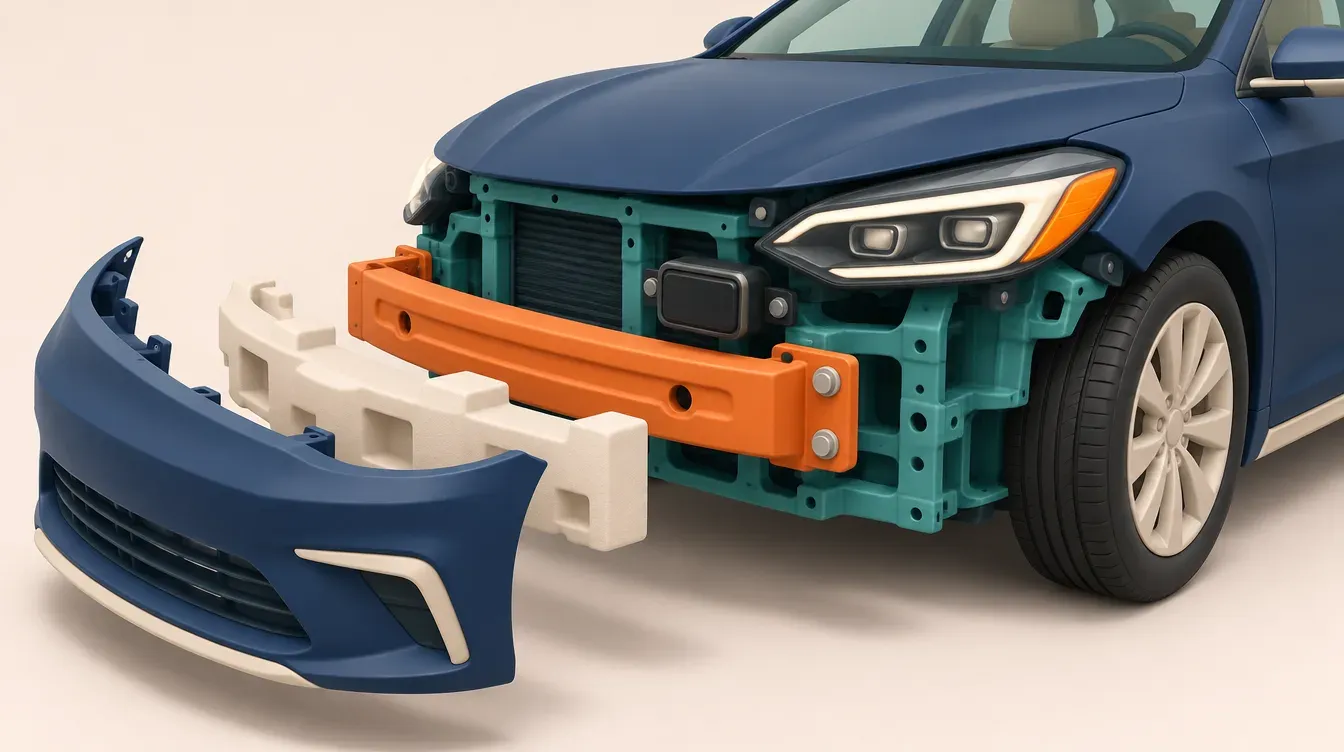
This is the line that surprises most people. Radar, cameras and parking sensors sit behind bumpers, grilles, mirrors and windshields. When those parts are removed or damaged, the sensors often need replacing, recalibrating or both.
- CCC found calibrations on 28.3% of repairable estimates in 2025, up from 21.8% the year before.
- AAA’s December 2023 study found driver-assistance parts can add up to 37.6% to a repair bill. In a minor front-end repair they added $1,540 on average. In a minor rear-end repair they made up $684 of a $1,698 total.
- AAA’s ranges per component, over and above normal body work: front radar $500–$1,300, front camera $600–$800, side mirror camera $740–$1,600, windshield camera $900–$1,200, ultrasonic parking sensors $300–$1,000.
ADAS calibration after a collision explains why the line appears on your estimate.
Hidden damage and supplements
The first estimate is written from the outside. Teardown finds bent brackets, cracked absorbers, damaged wiring and structural damage, and the shop writes a supplement. CCC’s mid-year data shows that 83% of scans but only 47% of calibrations appeared on the first estimate. The rest were added later. Hidden damage after an accident covers what typically turns up.
Vehicle age and type
Newer cars cost more to repair. CCC found vehicles six years old or newer averaged $5,721 per claim in 2025, $2,039 more than vehicles seven years or older. Battery electric vehicles had the highest average in Mitchell’s data, which Mitchell ties to their complexity and a limited supply of aftermarket parts.
Repair or let it go as a total loss
At some point, fixing the car stops making sense. Insurers compare the repair estimate with the car’s actual cash value. In North Carolina, the Department of Insurance says the insurer must treat the car as a total loss when repairs equal or exceed 75% of its pre-accident value. Other states use different thresholds or formulas.
Total losses are now common. CCC flagged 23.1% of claims as total losses in 2025, a record, and 23.5% in the first half of 2026. Age is the main reason. For cars three years old or newer, about 1 in 10 claims were totaled. For cars 13 years or older, 45.3% were.
If your car is older and the damage includes structure, airbags or several sensors, ask early whether it is likely to be totaled. Is my car totaled? covers how the decision is made.
Insurance or out of pocket
Your share on a claim is usually your deductible. More drivers now carry high ones: 28.4% of repairable collision claims in early 2026 had deductibles of $1,000 or more, according to CCC. With a deductible that high, many small repairs are cheaper to pay directly, which is one reason self-pay repairs now make up about a quarter of repair orders.
Things to weigh:
- Estimate vs deductible. If the estimate is close to your deductible, a claim gains you little.
- Premium impact. Ask your agent how a claim would affect your premium before you file.
- Hidden damage risk. A $1,200 bumper estimate on a car with front radar can grow after teardown. Get a full estimate before you decide to pay yourself.
- Who was at fault. If another driver caused the crash, you can claim against their insurer, or claim on your own collision coverage and let your insurer recover the money, as the NC Department of Insurance explains. In North Carolina, contributory negligence can bar recovery if you were even partly at fault.
File a claim or pay out of pocket? goes through the decision, and how to file a collision claim covers the steps.
How to check a collision repair quote
You do not need to read estimating software to spot a weak quote. Check these points:
- Compare operations, not totals. Line up two estimates and check that both list the same parts, labor operations, paint panels and blends.
- Look for scans and calibrations. On a car with driver-assistance features, a pre-repair scan, a post-repair scan and any needed calibrations should be listed. A cheaper quote that leaves them out is not cheaper in the end.
- Check the parts type. Each part line should say OEM, aftermarket or used. Ask why if it is not what you expected.
- Ask about teardown. Ask whether the shop will take the damaged area apart before finalizing, and how it handles supplements.
- Ask for repair procedures. A good shop can tell you it will follow the carmaker’s published repair procedures, especially for structural work.
- Get the warranty in writing. Note what it covers and for how long.
Free body shop estimates explains how to gather and compare three.
What to do next
- Photograph the damage in daylight and note any warning lights on the dashboard.
- Get written estimates from at least two shops, and ask each to list scans, calibrations and parts types.
- Compare the total against your deductible and your car’s value before you decide how to pay.
- If the car is older or the damage is heavy, ask your insurer early whether it may be a total loss.
- Read the collision repair process, step by step so you know what to expect once the car is in the shop.
Repair or replace?
Frequently asked questions
What is the average cost of collision repair?
CCC's claims data puts the average repairable claim at $4,818 for 2025 and $4,821 for the first half of 2026. Mitchell's 2025 data is higher, at $5,105 for gas-powered cars and $6,395 for battery electric vehicles. Both count insurance-paid repairs. Repairs owners paid for themselves averaged $1,941 in early 2026, because those tend to be smaller jobs.
Why did my estimate go up after the shop took the car apart?
The first estimate covers what can be seen from outside. Once the bumper and panels come off, the shop finds brackets, sensors and structure that were hidden. It writes a supplement for that work. CCC reports that more than half of calibrations are added after the first estimate. A higher final bill is normal. Ask the shop to show you photos of each added item.
Full guide: The Collision Repair Process, Step by Step
Should I file a claim or pay for collision repair myself?
Compare the estimate with your deductible and with what a claim might do to your premium. If the repair is only a few hundred dollars above the deductible, paying yourself can make sense. If there is any chance of hidden structural or sensor damage, get a full estimate first, because small-looking hits on newer cars often grow.
Full guide: File a Claim or Pay Out of Pocket? How to Decide
Do newer cars cost more to repair after a collision?
Yes, on average. CCC found that in 2025 vehicles six years old or newer averaged $5,721 per repairable claim, $2,039 more than vehicles seven years or older. Newer cars have more sensors, cameras and high-strength materials, and their parts cost more. Older cars, on the other hand, are more likely to be declared a total loss because they are worth less.
Can I choose my own body shop if insurance is paying?
In North Carolina, yes. The NC Department of Insurance says the insurer may recommend a shop, but you have the right to choose. The insurer pays the amount it decides is owed under the policy either way. Other states have their own rules, so check with your state's insurance department.
Full guide: North Carolina: Your Right to Choose a Repair Shop
Sources
- Repairer Driven News, Inflation playing role in paint and material costs, up by average 7.4% during Q1 (21 Apr 2025) — accessed November 24, 2026
- CCC Intelligent Solutions, Crash Course 2026: Complexity Compounds (Mar 2026) — accessed November 24, 2026
- CCC Intelligent Solutions press release, Crash Course 2026 (31 Mar 2026) — accessed November 24, 2026
- Insurance Journal, CCC 2026 Crash Course Mid-Year Update coverage (19 Oct 2026) — accessed November 24, 2026
- Repairer Driven News, CCC mid-year collision repair trends update (19 Oct 2026) — accessed November 24, 2026
- Mitchell, Plugged-In: EV Collision Insights 2025 Year in Review (19 Feb 2026) — accessed November 24, 2026
- Mitchell, Plugged-In: EV Collision Insights Q3 2025 (11 Dec 2025) — accessed November 24, 2026
- CCC Intelligent Solutions, Crash Course 2025 Q4 — accessed November 24, 2026
- Highway Loss Data Institute, Collision coverage: distribution of claims by claim size (Dec 2025) — accessed November 24, 2026
- Insurance Information Institute, Facts + Statistics: Auto insurance — accessed November 24, 2026
- AAA Newsroom, ADAS repair costs study (14 Dec 2023) — accessed November 24, 2026
- Experian, What's the Average Cost of an Auto Repair After an Accident? (17 Aug 2022) — accessed November 24, 2026
- Caliber Collision, Car Frame Straightening: A Complete Guide — accessed November 24, 2026
- I-CAR Repairability Technical Support, color matching and blending (CRN-2209) — accessed November 24, 2026
- North Carolina Department of Insurance, After an Accident — accessed November 24, 2026
- Consumer Reports, The Hidden Cost of Car Safety Features (Jan 30, 2020; RepairPal data) — accessed November 24, 2026
- Synchrony, How Much Does It Cost to Replace or Repair a Car Bumper? (Apr 11, 2023) — accessed November 24, 2026
- SoFi, Suspension Repair & Replacement Cost Guide (Oct 20, 2025) — accessed November 24, 2026
- SoFi, How Much Does Airbag Replacement Cost in 2025? (May 13, 2025) — accessed November 24, 2026