The Collision Repair Process, Step by Step
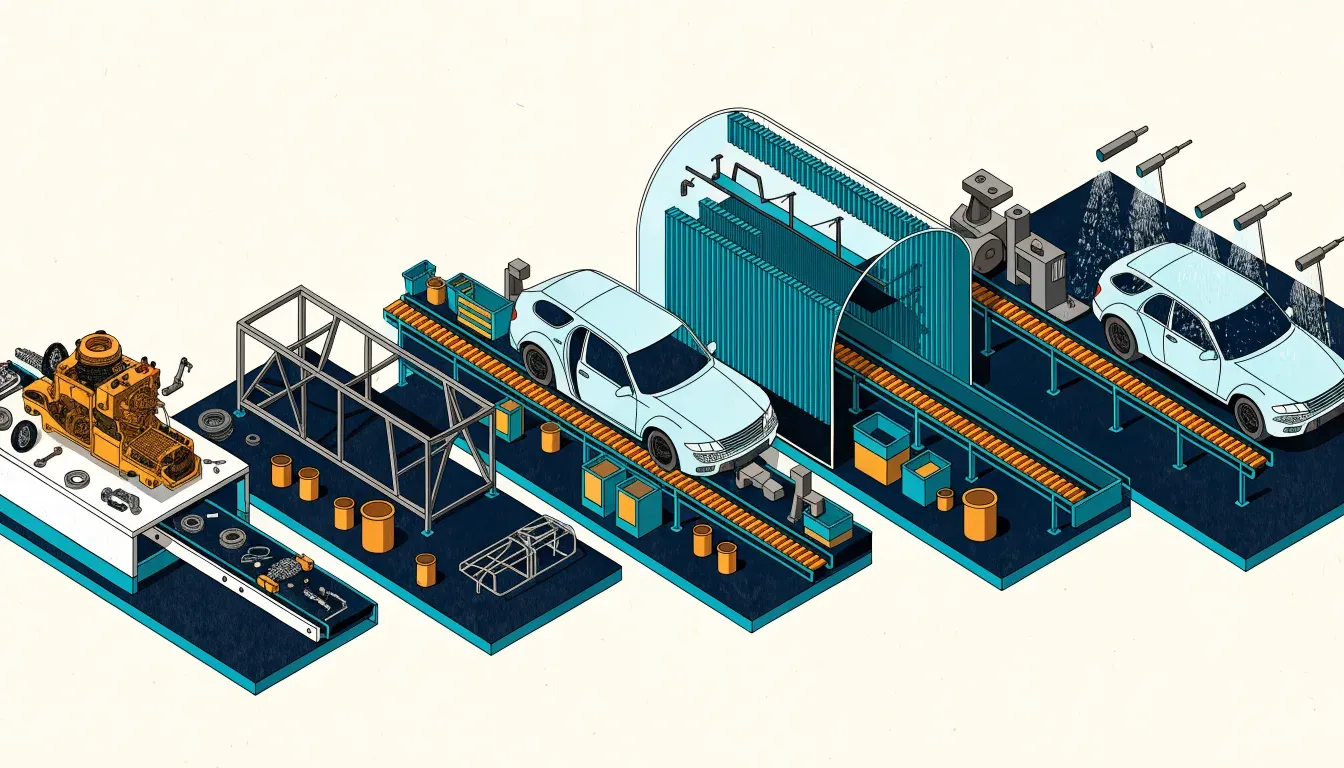
Nine stages take a crashed car from first estimate to a car you can drive away. Knowing them helps you understand why estimates change, why repairs take time and what a complete repair includes.
Key takeaways
- The collision repair process runs in nine stages: estimate, pre-repair scan, teardown, supplement, structural repair, body repair, paint, reassembly with calibration, and final checks.
- Estimates usually grow after teardown. CCC data shows most calibrations are added on supplements, not on the first estimate.
- Carmakers such as Honda and Ford call for scans before and after collision repairs. I-CAR says carmaker repair procedures are specifications, not suggestions.
- Ask the shop to show you the post-repair scan report and any calibration records before you pay.
The collision repair process follows nine stages: estimate, pre-repair scan, teardown, supplement, structural repair, body repair, paint, reassembly with calibration, and final quality checks. The order matters. Each stage either uncovers more damage or depends on the one before it being done right. Here is what happens at each step and what to ask.
Auto Body Wilson is an independent guide, not a repair shop. The technical points below come from I-CAR, the collision industry’s training body, and from carmaker position statements.
The process at a glance
| Stage | What happens | What to ask |
|---|---|---|
| 1. Estimate | Visible damage is written up | Will you tear down before finalizing? |
| 2. Pre-repair scan | Computer codes are read and saved | Can I get a copy of the scan report? |
| 3. Teardown | Damaged parts come off | Will you photograph hidden damage? |
| 4. Supplement | Extra damage is added and approved | How long will approval take? |
| 5. Structural repair | Frame or unibody is measured and repaired | Are you following the carmaker’s procedures? |
| 6. Body repair | Panels are repaired or replaced | Which parts are OEM, aftermarket or used? |
| 7. Paint | Panels are refinished and blended | Which panels will be blended? |
| 8. Reassembly and calibration | Parts go back on, sensors are calibrated | Which calibrations does my car need? |
| 9. Final checks | Post-repair scan, road test, inspection | Can I see the post-scan and calibration records? |
1. The first estimate
An estimator or insurance appraiser writes up the damage that can be seen. On a claim, this is often done from photos: CCC found photo estimating accounted for 26.4% of repairable claim inspections in 2025. The estimate lists each part, each labor operation, paint time and materials.
Treat it as a starting point. Hidden damage is common, so the final bill is usually higher. Collision repair cost explains what each line costs, and free body shop estimates covers how to compare more than one.
2. The pre-repair scan
Modern cars run many systems through computer modules, and a crash can leave fault codes that are not obvious from the outside. I-CAR’s industry definition calls the pre-repair scan “a step in the damage analysis/blueprinting process used to identify errors, faults, and/or damage related, and unrelated, to the collision.” If crash damage stops the scan from running, I-CAR says it should be done as soon as the repair allows.
Carmakers spell this out. Honda and Acura’s position statement calls for “a preliminary diagnostic scan during the repair estimation phase” on all collision vehicles. Ford’s statement says all its vehicles from model year 1996 on that are involved in a collision beyond minor outer-panel damage “are required to undergo both pre-repair and post-repair diagnostic scans.”
Scans are now routine. CCC found that 74.8% of repairable appraisals in the first quarter of 2026 included a scan.
3. Teardown
The technician removes the bumper cover, lights, panels and trim around the damage. This is where bent reinforcements, cracked brackets, crushed absorbers and damaged wiring show up. A careful shop photographs everything it finds. Some shops do a full teardown before the car goes into production to build a complete repair plan, sometimes called blueprinting.
4. The supplement
Damage found at teardown goes on a supplement, an addition to the estimate. On an insurance claim, the shop sends it to the insurer for approval before doing the work.
This step is a main source of delay. CCC’s Q4 2025 report found that while most scans appear on the first estimate, “the majority of calibrations appear on supplements,” which adds review and approval time while the car sits in the shop. CCC also lists supplement handling among the reasons repair times have stayed longer than in 2020. Hidden damage after an accident explains what usually turns up.
5. Structural repair
If the crash bent the frame or unibody, the car goes on a frame bench or rack. The technician measures it against the carmaker’s dimensions, then pulls the structure back into place or replaces damaged sections.
I-CAR is blunt about the rules here. The procedures carmakers publish “are service specifications, not recommendations.” Technicians should look first at the carmaker’s body repair manual and position statements, and use I-CAR best practices only when the carmaker has published nothing. Some damage cannot be straightened at all. I-CAR’s best practice says ultra-high-strength steel parts over 600 MPa should not be straightened, so replacement is the only option.
On body-on-frame trucks, I-CAR’s “kink vs. bend” rule is a starting guide: a kinked part should be replaced, a bent part may be repairable. I-CAR adds that the rule “does not always provide a definite repair vs. replace answer.” Frame damage repair covers cost and safety in more detail.
6. Body repair
With the structure correct, technicians repair or replace outer panels: fenders, doors, quarter panels, hood, bumper covers. Small dents may be pulled or filled. Badly torn or creased panels are often replaced instead. Panel fit and gaps are checked before the car goes to paint.
Parts choice shows up here. New carmaker (OEM) parts, aftermarket parts and used parts differ in price and sometimes in fit. In North Carolina, the Department of Insurance says an insurer cannot require aftermarket parts unless they equal the original in fit, quality, performance and warranty. OEM vs aftermarket vs used parts explains the options.
7. Paint and blending
Panels are primed, sealed, painted and clear-coated in a paint booth. The painter matches the color to your car, not just to the paint code. I-CAR notes that “color matching is done on every vehicle,” black included, because of factory paint variation, different plants and paint suppliers, weathering and earlier repairs.
To hide the edge between new and old paint, painters blend: they extend the color into the panel next to the repair. I-CAR’s definition says blending “deceives the eye into seeing only one color rather than two separate colors.” That is why an estimate may show paint time on a door that was never hit. See car paint color matching.
8. Reassembly and calibration
Lights, trim, glass, sensors and bumper covers go back on. Then come the calibrations, and this is the step most likely to be skipped by a poor repair.
I-CAR defines post-repair calibration as “a required step following the removal, installation, and/or repair of many safety and driver convenience system parts.” It can also be needed when a sensor’s mounting point was damaged, or when a part in front of or behind a camera or sensor was removed. I-CAR adds that checking the carmaker’s information “is mandatory to determine if post-repair calibration is required.”
A scan is not a calibration. I-CAR warns that if a car is sent out with the words “it just needs a scan,” the sensor may never be calibrated. Honda adds that driver-assistance systems “often will not display DTCs during a vehicle scan unless there is damage to the applicable system, so aiming and/or calibration may be required.” CCC found calibrations on 28.3% of repairable estimates in 2025. ADAS calibration after a collision goes into the detail.
9. Post-repair scan, road test and quality check
The last stage confirms the car works. I-CAR defines the post-repair scan as a quality control step that makes sure all trouble codes “have been identified and cleared,” and notes a test drive may be needed first because some codes only appear after driving. Honda’s statement says any repair that disconnected electrical parts, and any repair that replaced body parts, requires a post-repair scan.
A good final check also covers panel gaps, paint color and texture in daylight, lights, doors and the trunk, and a road test for pulling and noises. Ask whether the car needs a wheel alignment. Alignment after an accident explains when.
How long it takes
Length depends on damage, parts availability, supplement approvals and calibration needs. We could not find a sourced average number of days, so we do not give one here. How long collision repair takes covers the factors.
What to do next
- Before you approve the repair, ask the shop whether it will do a pre-repair scan and teardown, and whether it follows the carmaker’s repair procedures.
- Ask to be called, with photos, before any supplement work is done.
- At pickup, ask for the post-repair scan report and any calibration records, and keep them with your repair invoice.
- Inspect the car in daylight before you sign off, and test the warning systems on a short drive.
- If you have not reached a shop yet, start with what to do after a car accident and the collision repair guide.
Frequently asked questions
What are the steps in collision repair?
Most repairs follow the same order: a first estimate, a pre-repair scan, teardown to find hidden damage, a supplement for the extra work, structural repair if needed, body and panel repair, paint and blending, reassembly with any sensor calibrations, then a post-repair scan, road test and quality check before delivery.
What is a pre-repair scan and do I need one?
A pre-repair scan reads the trouble codes stored in the car's computers before work starts. I-CAR defines it as part of damage analysis, to find faults related and unrelated to the crash. Carmakers including Honda and Ford call for scans before and after collision repairs, so on most modern cars the answer is yes.
Is a scan the same as a calibration?
No. A scan reads and clears trouble codes. A calibration re-aims a camera, radar or other sensor after it or the part around it was removed, replaced or damaged. I-CAR warns that mixing up the two can leave sensors uncalibrated. Honda notes driver-assistance systems often show no code at all even when they need aiming.
Full guide: ADAS Calibration After a Collision: Why Your Estimate Has It
Why does the shop need to call my insurer again partway through?
When teardown uncovers damage that was not on the first estimate, the shop writes a supplement and, on a claim, sends it to the insurer for approval. CCC reports that most calibrations appear on supplements rather than the first estimate. Waiting for approval is one reason repairs take longer than expected.
Full guide: Hidden Damage After an Accident and Why Estimates Grow
Sources
- I-CAR Repairability Technical Support, Collision Repair Diagnostics Definitions — accessed November 24, 2026
- I-CAR Repairability Technical Support, The differences between scanning and calibration — accessed November 24, 2026
- I-CAR Repairability Technical Support, Honda/Acura position statement: pre- and post-repair system scanning — accessed November 24, 2026
- I-CAR Repairability Technical Support, Ford/Lincoln position statement: pre- and post-repair system scanning — accessed November 24, 2026
- I-CAR Repairability Technical Support, Always follow vehicle maker procedures — accessed November 24, 2026
- I-CAR Repairability Technical Support, color matching and blending (CRN-2209) — accessed November 24, 2026
- FenderBender, Full Frames: On the Rack Again (article submitted by I-CAR) — accessed November 24, 2026
- CCC Intelligent Solutions, Crash Course 2025 Q4 — accessed November 24, 2026
- CCC Intelligent Solutions, Crash Course 2026: Complexity Compounds (Mar 2026) — accessed November 24, 2026
- Repairer Driven News, CCC mid-year collision repair trends update (19 Oct 2026) — accessed November 24, 2026
- North Carolina Department of Insurance, After an Accident — accessed November 24, 2026