Car Paint Color Matching: Why It's Hard and How Shops Get It Right
Your paint code is only the starting point. The same code can come out in several shades, and your car's paint has aged since it left the factory. Here is how a good shop closes the gap.
Key takeaways
- Car paint matching is hard because factory paint varies by plant, supplier and batch, and because sun and weather change it over time (I-CAR).
- Good shops pick the closest variant of your paint code, spray a test card, tint the formula if needed, and then blend into the next panel.
- Blending hides small differences. It does not fix a bad formula: I-CAR says blending can never take the place of tinting.
- Check the match yourself in daylight, from several angles, before you pay.
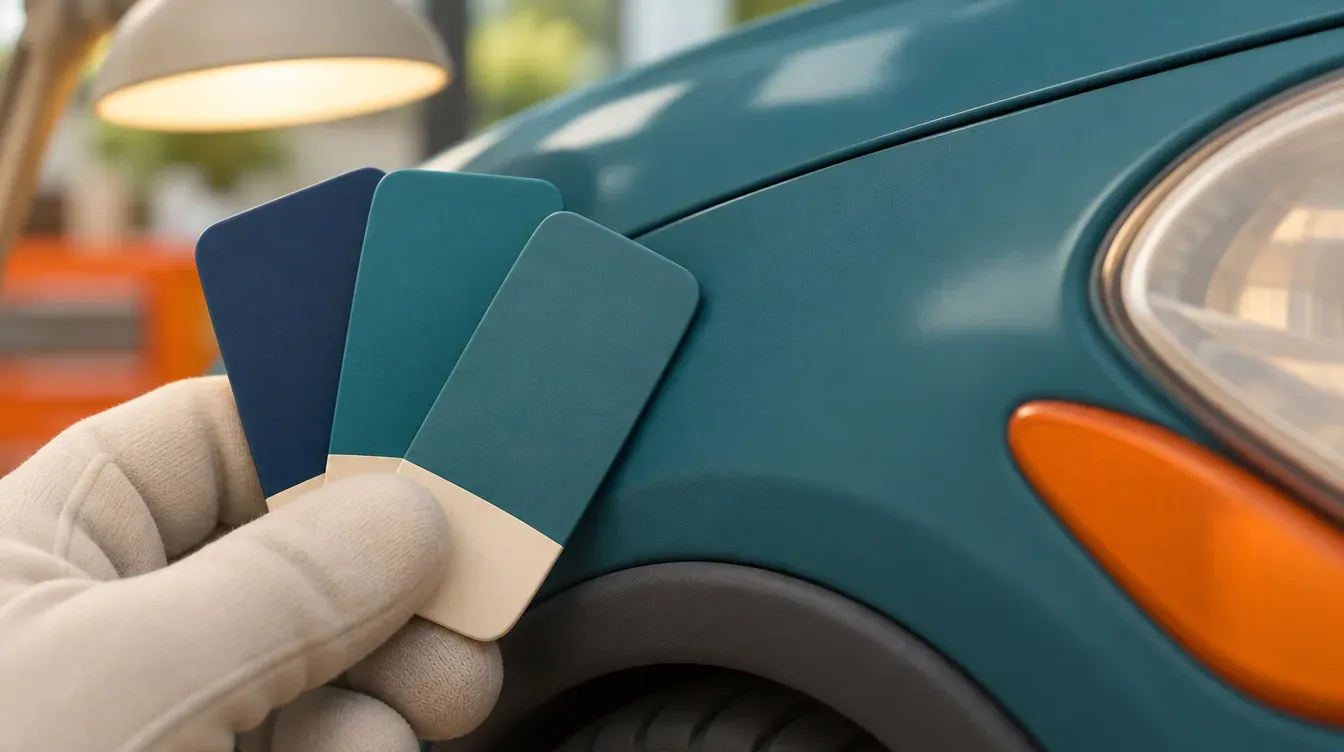
Car paint matching is hard because your paint code does not describe one exact color. The same code can come out of different factories in slightly different shades, and the paint on your car has been changing in the sun since the day it was built. Good shops treat the code as a starting point, then pick the closest variant, test it on a spray-out card, tint it if needed, and blend it into the panels next to the repair.
This guide explains each step, using the paint makers’ own procedures, so you know what to ask and what to check. Auto Body Wilson is an independent guide, not a shop.
Why the paint code is not enough
I-CAR, the collision industry’s training organization, says color matching is done on every vehicle that comes into a repair shop, and adds: “Yes, this includes black.” It lists why the standard formula for a paint code often misses:
- Manufacturing variances when the carmaker applied the paint
- Different production plants and different paint suppliers for the same color
- Color variances the paint makers have not yet identified
- Weathering of the finish
- Panels that were repaired before
- Pigments available to carmakers that differ from those available to repair shops
Two more things change how a color looks, according to I-CAR: spray gun technique and air pressure, and the temperature and humidity in the booth. That is why two painters can spray the same can of paint and get slightly different results.
Metallic and pearl colors add another layer. Axalta notes that effect pigments can shift hue at different viewing angles, and I-CAR says painters use a light orientation coat on metallics and pearls so the flakes lie the right way. PPG says spray-out cards should be judged at three angles, face, flash and flop, and that face and flop matter most.
Step 1: find the paint code and the right variant
The paint code is on the vehicle information sticker, usually in the driver’s door jamb. Maaco says it can also be on the dash or in the trunk, and is often labeled Ext Pt. or C. Our guide to finding your paint code goes deeper.
The shop enters the code into the paint maker’s formula software. Axalta says its ColorNet system can use the VIN to retrieve the factory-applied formula. Then comes the variant check. Paint makers publish more than one formula for many codes: a “prime” formula plus variants, in PPG’s terms. PPG’s procedure is to compare variants from its color deck, or from spray-out cards, against the car near the area to be painted. PPG also says to polish the neighboring panels first, so you compare against clean paint, not oxidized paint, and to check whether the area has been refinished before.
Step 2: measure with a spectrophotometer
Many shops now use a handheld spectrophotometer, a color camera that reads the paint. Axalta’s 2016-2017 report says its Acquire Quantum EFX reads color from several angles on a clean, undamaged area and works with ColorNet to refine the formula when the paint has aged. Axalta’s newer Irus Scan measures sparkle, hue-shifting effect pigments and gloss, and Axalta says those readings reduce the need for spray-outs.
Note the word “reduce.” A scanner speeds things up and narrows the choice. It does not replace a painter’s eye, and I-CAR still lists user-made spray-out panels and paint maker technical reps among a shop’s color-matching tools.
Step 3: spray a test card
A spray-out card is a test panel sprayed with the mixed color before the car is. PPG’s procedure is strict about it:
- Spray the card over the recommended gray primer or a gray test card chosen for that color code.
- Use the same spray gun and technique as on the car. Holding the card in one hand can change the color.
- Record how many coats it takes to cover.
- Let the base dry, then apply two coats of clear.
- Judge it in natural sunlight, ideally between 10 AM and 2 PM, and also in shade.
- Give solid colors two to four hours of drying before deciding. Give tri-coats eight hours or more.
For tri-coats, Axalta’s procedure adds a let-down panel. The painter sprays one to five coats of mid-coat in strips on one panel, then compares it to the car in daylight to see how many mid-coats match.
If the card looks off, the painter goes back a step: a different variant, or tinting.
Step 4: tint for a blendable match
Tinting means adding small amounts of toner to adjust the formula. At an I-CAR color-matching panel at SEMA 2024, paint makers agreed that when no variant gives a blendable match, tinting is the best option. The goal is not a perfect match on its own. It is a match close enough that a blend will hide the rest.
Step 5: blend into the next panel
Blending extends the new base coat into the panel next to the repair, fading it out so some of the original color shows through. I-CAR describes it as a technique that “deceives the eye into seeing only one color rather than two.”
PPG’s blending procedure calls for a blend area of at least 12 inches for special-effect colors, and at least 24 inches for tri-coat and quad-coat colors. PPG lists a blend area that is too small as one cause of poor color match.
Blending takes real labor. A 2022 study by the Society of Collision Repair Specialists found that blending a panel took about 31.6% more time than fully refinishing the same panel. When a quote leaves blending out, that is often the reason it is cheaper.
Our position: blending is worth paying for on metallic, pearl and tri-coat colors, and on any panel that sits right next to an unpainted one, such as a door beside a fender. I-CAR is clear on the limit, though: “Blending can never take the place of tinting.” If the formula is wrong, blending just spreads the wrong color farther.
Special cases
- Matte paint. Nissan’s matte bulletin, summarized by I-CAR, says a refinish needs a spray-out panel that matches both the color and the gloss level of the clear coat.
- Bumpers with sensors. I-CAR notes that some carmakers do not recommend repainting parking sensors because too much paint thickness can affect how they work. Others allow it with limits. A good shop checks the carmaker’s procedure.
- Previously repainted cars. The car may not match its own paint code anymore. The shop has to match what is on the car, which is what spray-out cards are for.
How to check the match when you pick up the car
- Go outside. Look in daylight, not only under shop lights.
- Walk around it. Look at each repaired panel straight on, then from a sharp angle along the side. Metallics and pearls show mismatches at the angles.
- Compare across gaps. Check the door against the fender, the bumper against the quarter panel, the hood against the fenders.
- Look at texture. The new paint should have the same orange-peel texture and gloss as the old.
- Ask what was done. Which variant, whether it was tinted, and which panels were blended.
If you see a clear step in color, say so before you sign off and ask the shop to put any agreed fix in writing.
Picking a shop that matches well
When you call shops, ask how they choose a formula. A shop that mentions variants, spray-out cards, tinting and blending, or a spectrophotometer, is describing the process the paint makers publish. A shop that says it just mixes the paint code is skipping steps.
Related guides: how much it costs to paint a car explains why blending adds to the bill. hood repaint cost covers a common blend case. custom car paint covers candy, pearl and matte, and mobile car paint repair explains why a driveway job struggles with matching. The car paint guide has the full shop checklist.
What to do next
- Find your paint code on the door jamb sticker and photograph it.
- Ask each shop how it picks the variant and whether it sprays a test card.
- Ask which panels the estimate blends, and why.
- Inspect the finished work in daylight from several angles before you pay.
Frequently asked questions
Can a body shop match my car's paint exactly?
A good shop can get a match your eye cannot tell apart, but usually not by mixing the paint code formula and spraying. It picks the closest variant, sprays a test card, tints if needed, and blends into the neighboring panels. I-CAR says color matching is done on every vehicle, including black ones, because the standard formula is not always the answer.
Where do I find my car's paint code?
Usually on the vehicle information sticker in the driver's door jamb, and on some cars on the dash or in the trunk. Maaco says the code is often labeled Ext Pt. or C. If the sticker is missing, Maaco suggests asking a dealer to look up the code from your VIN.
Full guide: How to Find Your Car's Paint Code
Why does my new bumper not match the car?
A new bumper is painted fresh while the rest of your car has weathered, and I-CAR lists weathering, factory variances and different paint suppliers among the reasons a standard formula misses. A bumper sits next to fenders and quarter panels, so any difference shows. Ask the shop which variant it used, whether it tinted, and whether it blended.
Do shops have to blend paint into the next panel?
Not always, but it is common. PPG lists a blend area that is too small as a cause of poor color match, and calls for a blend area of at least 12 inches on special-effect colors and 24 inches on tri-coats. Solid colors with a verified match may need less. Ask which panels the estimate blends.
Full guide: How Much Does It Cost to Paint a Car?
Sources
- I-CAR, Color Match: Blending And Tinting (Apr 25, 2025) — accessed November 24, 2026
- PPG Refinish, PD-0631 Identify Color Formula — accessed November 24, 2026
- PPG Refinish, PD-0632 Creating Sprayout Card — accessed November 24, 2026
- PPG Refinish, PD-0706 Basecoat Blending - Solvent — accessed November 24, 2026
- PPG Refinish, Poor Color Match (Common Paint Defects Guide) — accessed November 24, 2026
- Axalta, Irus Scan spectrophotometer — accessed November 24, 2026
- Axalta, Getting the Color Right (Sustainability Report 2016-2017) — accessed November 24, 2026
- Axalta Cromax, Tri-Coat Repair Procedure (technical sheet) — accessed November 24, 2026
- SCRS research on blend time, via Repairer Driven News (Nov 2, 2022) — accessed November 24, 2026
- Maaco, How to Find Your Car's Paint Code (Feb 13, 2024, updated Oct 20, 2026) — accessed November 24, 2026
- I-CAR, Refinishing Park Assist Sensors (Jun 2020) — accessed November 24, 2026
- I-CAR, Nissan Releases Caring For Matte Paint Finish Bulletin (Oct 2014, validated 2024) — accessed November 24, 2026