Mobile Car Paint Repair: What a Mobile Painter Can and Can't Do
A mobile painter can fix small scuffs, chips and scratches where you park. Whole panels, full resprays and tricky colors still need a shop with a booth, because paint needs clean air, the right temperature and time to cure.
Key takeaways
- Mobile paint repair suits small areas: bumper corner scuffs, short scratches and chip clusters on otherwise sound paint.
- Paint makers set temperature limits. PPG says not to apply urethane coatings below 55°F, and Axalta rates its clear coat activators for set temperature bands.
- Without a booth, dust, humidity and cold are the painter's enemies. I-CAR warns that humidity can cause blistering and poor curing.
- For whole panels, metallic or tri-coat colors, or anything near a parking sensor, choose a shop with a paint booth.
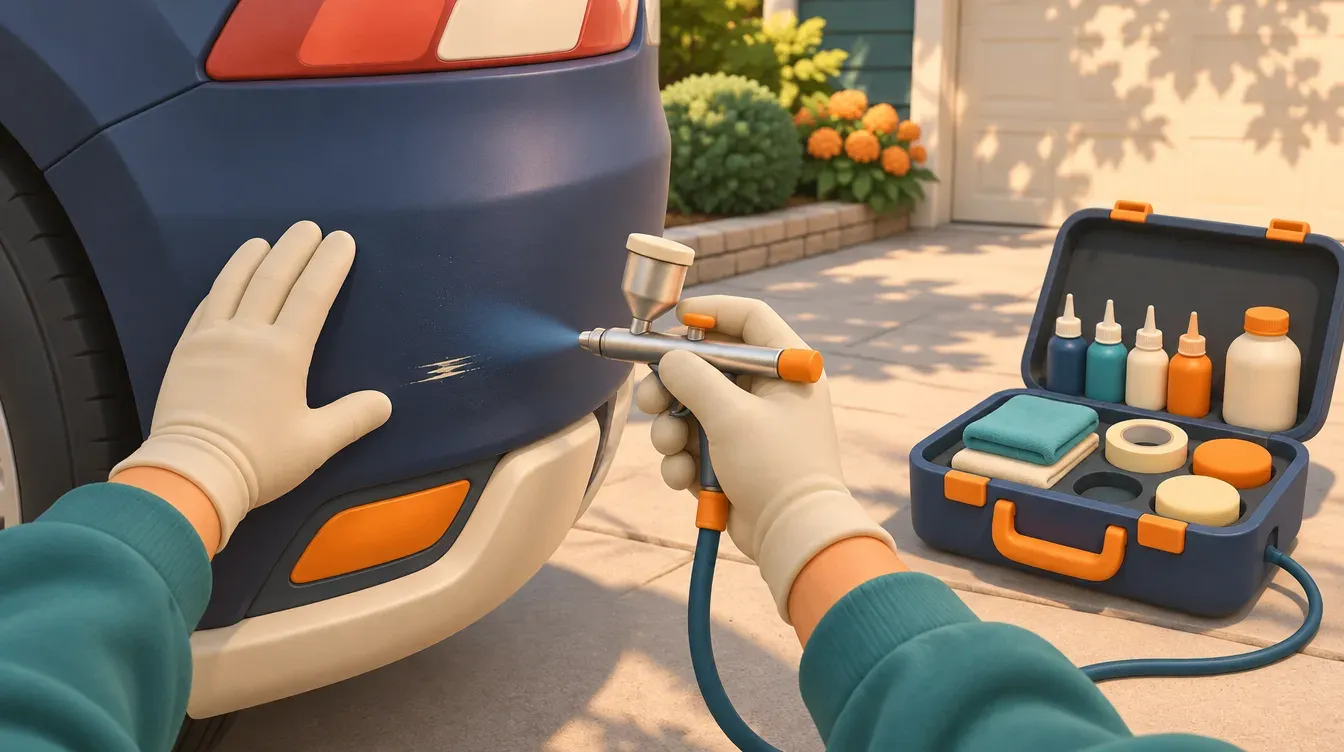
A mobile car paint repair technician can fix small paint damage where you park: a scuffed bumper corner, a short scratch, a cluster of chips. What a mobile painter cannot do well is anything that needs a paint booth: whole panels, full resprays, hard-to-match colors and jobs in cold or humid weather. The limits come from the paint itself, which needs clean air, the right temperature and time to cure.
This guide explains where the line sits, using paint makers’ technical data, so you can tell whether a driveway job will hold up. Auto Body Wilson is an independent guide, not a repair service.
What a mobile painter does well
Mobile paint repair is spot repair. The painter works on a small area, sprays a little color and clear with a small gun, and blends it into the surrounding paint. Good fits:
- Bumper corner scuffs where the plastic is not cracked
- Short scratches that reach the color coat but are small in area
- Chip clusters on a sound panel
- Small clear coat blemishes that can be sanded and recleared in a small area
- Touch-ups before selling or returning a lease
These jobs work because the area is small: there is less wet surface for dust to land on and less color to match.
What a mobile painter can’t do well
A shop’s paint booth does three jobs a driveway cannot: it keeps dust out, it controls temperature and airflow, and it can bake the paint. Here is what that means in practice.
Dust and dirt. PPG’s defect guide lists the causes of dirt in clear coat: dust attracted during application, contaminated compressed air, static on the vehicle and dirty booth filters. Its prevention steps include changing booth filters regularly and keeping the booth doors closed. Outdoors, there are no doors to close.
Temperature. PPG says not to apply urethane coatings below 55°F, and lists spray conditions that are too cold as a cause of slow drying. Axalta’s clear coat data sheets list different activators for different temperature bands. For its LE5400S clear, those bands run from 60–70°F up to 75–90°F. A painter who does not match the product to the weather gets problems either way. I-CAR says heat speeds up flash and cure and can cause solvent popping and dry spray, while cold slows them and can cause runs and sags.
Humidity. I-CAR says high humidity slows evaporation in both waterborne and solvent paint, and can cause poor curing, sagging, puddling and solvent popping. Moisture trapped under the coating can cause blistering. On a muggy morning or with dew on the car, a mobile job is a gamble.
Curing time. In a booth, a painter can bake the clear coat. I-CAR’s summary of paint-maker data sheets shows bake cycles such as 30 minutes at 140°F panel temperature. Out in the open, the paint air-dries. Axalta lists its LE5400S clear at about 2 hours to handle at 70°F when air-dried, and its CC3500 clear at overnight.
Color matching on big areas. Matching gets harder as the repair grows, because it often needs a blend into the next panel. PPG’s blending procedure calls for a blend area of at least 12 inches on special-effect colors and 24 inches on tri-coats. I-CAR lists temperature and humidity among the conditions that change how a color comes out. That is a lot to control in a parking lot. More in car paint color matching.
Sensors. I-CAR notes that some carmakers do not recommend repainting parking sensors because extra paint thickness can affect how they work. A bumper repair near sensors should follow the carmaker’s procedure, which a shop is better placed to look up.
Rules on spray painting outside a booth
The EPA’s paint and autobody rule, known as 6H, covers shops that spray coatings containing certain metals, such as chromium, lead and nickel. North Carolina’s Department of Environmental Quality explains how it works:
- Covered shops must spray in booths with a full roof and four walls or side curtains, ventilated under negative pressure.
- Mobile painters doing spot repairs must use a ventilated enclosure that is sealed against the car if needed, so overspray is caught by a filter.
- Booths, prep stations and mobile enclosures need filters that capture at least 98% of overspray.
- Spray guns with a paint cup of less than 3.0 fluid ounces are not regulated by the rule.
So small touch-up guns fall outside the rule, while larger guns spraying coatings with the regulated metals fall inside it. If a mobile painter offers to spray a whole panel in open air with a full-size gun, ask how they handle overspray and which products they are using.
Paint makers also limit who should use these products. Axalta’s clear coat data sheets say they are for industrial use by trained professional painters, and warn that products with isocyanates can irritate the airways and cause allergic reactions. Keep children and pets away from a mobile repair while it is being sprayed.
Mobile painter or body shop?
| The job | Mobile painter | Shop with a booth |
|---|---|---|
| Bumper corner scuff, plastic not cracked | Good fit | Also fine |
| Short scratch on one panel | Good fit if small | Better if long |
| Chips across the front of the hood | Possible for a few | Better for many, or for a full hood |
| Peeling clear coat on a hood or roof | Poor fit | Needed |
| Whole door, hood or bumper repaint | Poor fit | Needed |
| Metallic, pearl or tri-coat color | Depends on size | Better for anything beyond a spot |
| Damage near parking sensors | Ask about the carmaker’s procedure | Better placed |
| Any cracks, dents or structural damage | Not a paint job | Needed |
Our view: use a mobile painter for small cosmetic damage on a car you drive every day, when the convenience is worth it and the weather is right. Use a shop for anything larger than a hand-sized area, any peeling clear coat, and any color the painter cannot test first. For panel-sized work, see hood repaint cost and how much it costs to paint a car.
Mobile dent and body work is a separate trade. Mobile auto body repair covers what can be fixed in a driveway beyond paint, such as paintless dent repair. For a single chip, paint chip repair compares a shop fix with touch-up.
Questions to ask a mobile painter
- How big a repair do you usually do, and what is too big?
- Which paint system do you use, and how do you match my paint code?
- Do you spray a test card before painting the car?
- What is the lowest temperature and highest humidity you will work in?
- How long before I can drive, wash or wax the car?
- Do you use a ventilated enclosure for spraying?
- What does your warranty cover, and is it in writing?
AAA notes that shops use controlled spaces to keep dust and dirt out of drying paint. A mobile painter who has clear answers for how they control the same things is worth considering.
What to do next
- Measure the damage. If it is bigger than your hand or spans two panels, get a shop quote too.
- Check the forecast. Book a dry day that will stay above about 60°F, or ask about a garage.
- Find your paint code on the door jamb sticker before the painter arrives.
- Inspect the repair in daylight from several angles before you pay. For picking a shop when you need one, use the car paint guide.
Frequently asked questions
Is mobile car paint repair any good?
It can be, for the right job. On a small scuff or chip area with a common color and sound paint around it, a skilled mobile painter can get a result that is hard to spot. Quality falls off as the area grows, because the work happens outside a booth where dust, humidity and temperature are harder to control.
Can a mobile painter repaint a whole panel?
Some will, but a whole panel needs clean air and enough time to cure, which is hard in a driveway. Color matching across a full panel also usually needs blending into the next one. For a door, hood or full bumper, a shop with a booth is the safer choice.
Full guide: How Much Does It Cost to Repaint a Hood?
Can mobile paint repair be done in cold weather?
Often not well. PPG says not to apply urethane coatings below 55°F, and lists cold spray conditions as a cause of slow drying. I-CAR says cold slows flash and cure time and can cause runs and sags. A good mobile painter reschedules, works in a heated garage, or uses products rated for the temperature.
How long before I can wash my car after a mobile paint repair?
Ask the painter, because it depends on the exact product. As one example, Axalta's LE5400S clear coat data sheet lists about 2 hours to handle at 70°F when air-dried. Handling is not the same as full hardness. The Drive notes that protective coatings should wait until new paint has fully hardened.
Sources
- PPG Refinish, Slow Drying (Common Paint Defects Guide) — accessed November 24, 2026
- PPG Refinish, Dirt in Clear (Common Paint Defects Guide) — accessed November 24, 2026
- PPG Refinish, PD-0706 Basecoat Blending - Solvent — accessed November 24, 2026
- Axalta Cromax, LE5400S Snap Dry Clearcoat technical data sheet — accessed November 24, 2026
- Axalta Cromax, CC3500 Multi-Use Clearcoat technical data sheet — accessed November 24, 2026
- I-CAR, Back-To-Basics: Environmental Considerations For Refinishing (Jul 2022, validated 2025) — accessed November 24, 2026
- I-CAR, Back-To-Basics: Hybrid Refinishing And Baking (Feb 2023, validated 2026) — accessed November 24, 2026
- I-CAR, Color Match: Blending And Tinting (Apr 25, 2025) — accessed November 24, 2026
- I-CAR, Refinishing Park Assist Sensors (Jun 2020) — accessed November 24, 2026
- NC DEQ, Paint & Autobody Rule (6H) Frequently Asked Questions — accessed November 24, 2026
- The Drive, Here's How Much It Costs To Paint a Car (updated Oct 18, 2023) — accessed November 24, 2026
- AAA, How Much Does It Cost to Paint a Car? (undated) — accessed November 24, 2026