How to Find Your Car's Paint Code
On most cars the paint code is on a label in the driver's door jamb. Some makers put it in the glove box, under the hood or in the trunk. Here is where to look, how to read it, and what the code can and cannot do for a color match.
Key takeaways
- Start with the driver's door jamb. PPG's OEM Color Code Locations Guide lists it for Ford, Chrysler, Toyota, Hyundai, Kia, Nissan, Mazda, Mercedes-Benz, Volvo and others.
- GM cars use a Service Parts Identification label, often in the glove box or trunk. BMW uses the engine bay; Volkswagen and Audi use the trunk.
- Can't find it? Check the owner's manual, the car's settings screen on some newer models, or give a paint supplier or dealer the VIN.
- The code names the factory color, not your car's exact shade. One code can have several variants, so painters still test and blend.
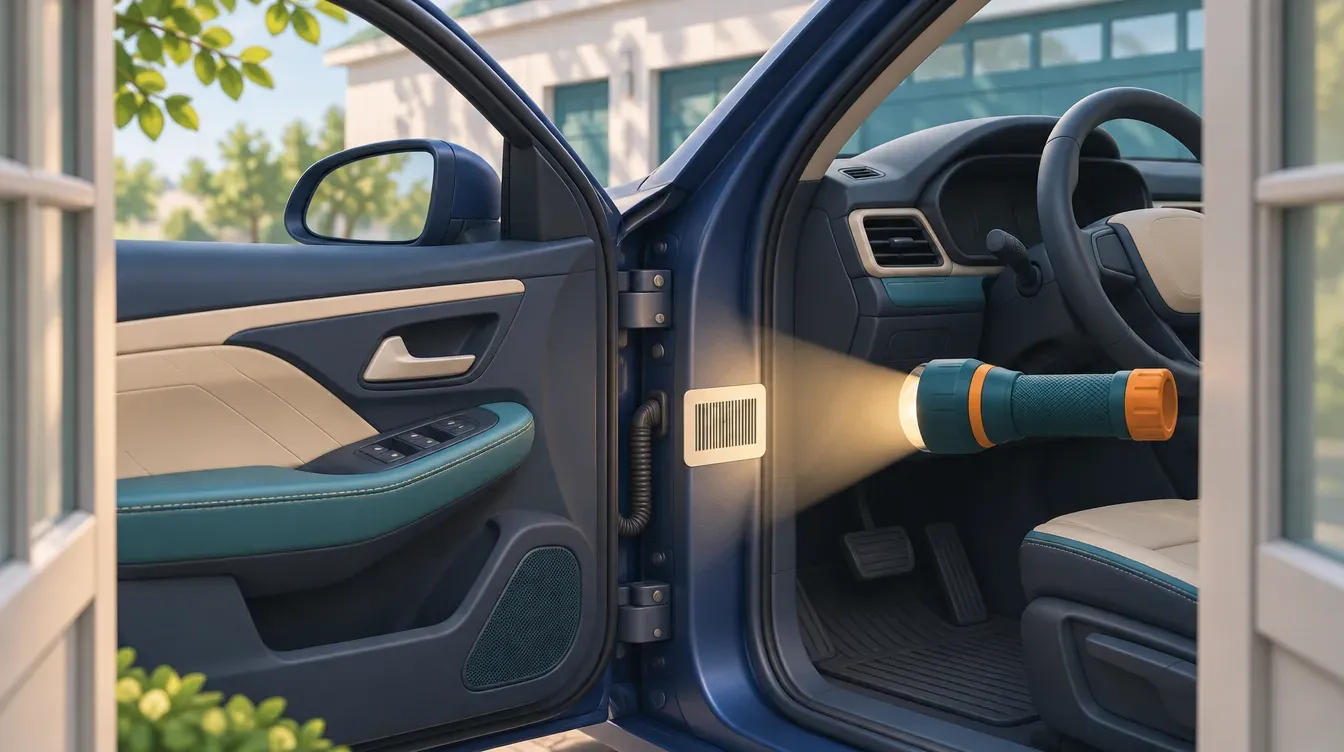
Your car’s paint code is almost always on a label in the driver’s door jamb. Open the driver’s door and look at the stickers on the body pillar and the edge of the door. If it isn’t there, the next places to check are the glove box, under the hood and inside the trunk. The code is a short mix of letters and numbers, often next to the word PAINT, COLOR or an abbreviation of it.
You need the code to order touch-up paint and for any paint quote. Here is where each maker puts it and how to use it.
Where the paint code is, by make
PPG, one of the largest refinish paint makers, publishes an OEM Color Code Locations Guide for painters. It notes that locations have been consistent among carmakers for some time, and that several makers use more than one spot. The table below comes from its 2017 edition, with newer notes from carmaker documents.
| Make | Where to look | Source |
|---|---|---|
| Ford | Driver’s door jamb label, after “EXT PNT” | Ford; PPG |
| Chrysler, Dodge, Jeep, Ram | Driver’s door jamb | PPG |
| Fiat | Driver’s door jamb, under the hood, or inside the trunk lid | PPG |
| GM cars (Chevrolet, Buick, Cadillac) | Service Parts Identification label: glove box, inside the trunk lid, or spare tire cover | PPG |
| GM trucks | Service Parts Identification label in the glove box; also listed: door jambs, sun visor, rear storage areas | PPG |
| Newer GM, e.g. 2022 Cadillac CT4 | Certification label on the center pillar, which may have a scannable barcode; if not, a label in the trunk | Cadillac owner’s manual |
| Honda, Acura | Driver or passenger door jamb | PPG |
| Hyundai, Kia | Driver’s door jamb | PPG |
| Mazda, Nissan, Infiniti, Volvo | Driver’s door jamb or firewall (under the hood) | PPG |
| Mercedes-Benz | Driver’s door jamb or radiator support | PPG |
| Subaru, Mitsubishi | Door jambs (Mitsubishi: also the firewall) | PPG |
| Toyota, Lexus, Scion | Driver’s door jamb | PPG |
| BMW | Engine compartment, right side | PPG |
| Volkswagen, Audi | Under the trunk floor mat or by the spare wheel well; rear deck lid | PPG |
| Tesla | The car’s Car Details screen; may also be on a label | Tesla service manual |
| Polestar | Decal on the front of the left-side B-pillar | Polestar owner’s manual |
“Firewall” means the panel at the back of the engine bay, under the hood. “Radiator support” is the frame across the front of the engine bay. The “B-pillar” or center pillar is the post between the front and rear doors.
Two more notes from PPG’s international code locator: for BMW, a code of 490 means an individual color, and the real code is under the hood on the passenger side. For Audi, the code may also be in the service book in the glove box.
How to read the label
The door jamb label usually also carries the VIN, tire pressures and build date, so look for the line marked for paint.
- Ford says the exterior paint code follows the letters “EXT PNT” and is two characters. Older vehicles may have more.
- Chrysler group: PPG’s sample label shows “PAINT:” followed by a three-character code, with a separate “TRIM” code on the same line.
- GM: the Service Parts Identification label is a block of short option codes. PPG’s sample shows the paint as a code beginning “WA” on a line marked “BSE/CLR COAT,” with separate upper and lower body colors on two-tone cars.
- Tesla: codes are four characters. Its service manual lists, for example, PPSB for Deep Blue Metallic, PBSB for Solid Black and PR01 for Ultra Red.
- Two-tone cars: Polestar’s label has a space for a secondary exterior color code, and GM labels list upper and lower body colors. Order the code for the part you are fixing.
Take a clear photo of the whole label, and have the code, year, make, model and VIN ready when you order paint or ask for a quote.
If you can’t find the code
- Check the owner’s manual. Look under “paint,” “color code,” “vehicle labels” or, for GM, “Service Parts Identification.” Labels move between model years.
- Look in the second spots in the table above: the glove box, the firewall and radiator support under the hood, and the trunk floor or spare tire well.
- Check the screen on a Tesla. Tesla says the paint code can be found in the car’s Car Details, and its owner’s manual explains how to display them.
- Use the VIN. Axalta says its VINdicator tool uses the VIN to choose the right formula when several variants of a color exist, and that it has done so for 98% of vehicles sold in the United States. A paint supplier using a VIN-based tool like this can find the formula without the label.
- Have it matched. If there is no code at all, as on a car that has been repainted a different color, a paint supplier can match it. Axalta’s procedure for this is to use color chips and fan decks, after cleaning and polishing the car, or a spectrophotometer, a handheld color-reading camera.
Why the code is only the starting point
The paint code tells the paint supplier which factory color the car was built in. It doesn’t account for how your paint looks today.
- One code, several variants. PPG’s color procedure has painters look up the formula for the code, then check variant colors with a chip deck or spray-out card. I-CAR lists the reasons: variation in the carmaker’s paint application, different plants and different paint suppliers.
- Weathering. Axalta notes that paint changes over time from sun and weather, so painters use a spectrophotometer and shading tools to adjust the formula. PPG’s procedure tells painters to polish the next panel before judging a match, and to judge it in natural sunlight or color-corrected light.
- Earlier repairs. PPG’s first steps are to get the code from the car and to find out whether the area has been refinished before. A repainted panel may not match the factory code at all.
That is why I-CAR, the industry’s training body, says color matching is done on every vehicle that comes into a collision repair shop, even black ones, and why shops blend new color into the panels next to a repair. Car paint color matching explains spray-out cards, tinting and blending in detail.
For touch-up paint, order by the code, then dab some on a card and hold it against the car in daylight before you put any on the paint. How to use touch-up paint walks through the whole job, and paint chip repair helps you decide whether touch-up is enough. Tri-coat pearl colors have an extra layer to match; types of car paint explains how they are built.
What to do next
Open the driver’s door and photograph the label. If the code isn’t there, work down the list above, then use the VIN. Write the code in your owner’s manual or phone notes so you have it for every quote. If you are pricing paint work, how much it costs to paint a car covers what to expect, and the car paint guide covers choosing a paint shop.
Frequently asked questions
Where is the paint code on my car?
On most cars, on a label in the driver's door jamb. PPG's color code guide lists that spot for Ford, Chrysler, Toyota, Hyundai, Kia, Nissan, Mazda, Mercedes-Benz and Volvo, and both door jambs for Honda, Acura and Subaru. GM cars often carry it on a Service Parts Identification label in the glove box or trunk, BMW in the engine bay, and Volkswagen and Audi in the trunk.
Is the paint code in the VIN?
Don't look for it there. The paint code is printed on a separate label. A VIN can still help: Axalta says its VINdicator tool uses the VIN to pick the right color formula when several variants of a color exist. A paint supplier with a VIN-based tool can look up the formula.
What does the paint code look like?
Usually a short mix of letters and numbers. Ford says its exterior code follows the letters EXT PNT and is two characters on current models. PPG's sample Chrysler label shows PAINT followed by a three-character code. Tesla's codes are four characters, such as PPSB for Deep Blue Metallic. Two-tone cars may list two codes.
Will the paint code give me a perfect match?
Not by itself. I-CAR says shops color match on every vehicle, because of factory variation, different plants and paint suppliers, and weathering. PPG's procedure has painters check variant colors for the code and compare spray-out cards in daylight. For touch-up paint, test it on a card before it touches the car.
Full guide: Car Paint Color Matching: Why It's Hard and How Shops Get It Right
Sources
- PPG Refinish, OEM Color Code Locations Guide (web page) — accessed November 24, 2026
- PPG Refinish, 2017 OEM Color Code Locations Guide (PDF) — accessed November 24, 2026
- PPG Automotive Refinish (EMEA), OEM Code Locator — accessed November 24, 2026
- PPG Refinish, PD-0631 Identify Color Formula — accessed November 24, 2026
- Axalta, VINdicator (Metalux color formula retrieval) — accessed November 24, 2026
- Axalta, ColorNet Cloud — accessed November 24, 2026
- Axalta, Getting the Color Right (Sustainability Report 2016–2017) — accessed November 24, 2026
- Axalta Transportation Coatings, SOP-03 Choosing a Color (May 2024) — accessed November 24, 2026
- Ford, "How to find your paint color" — accessed November 24, 2026
- Ford, "What is the touch-up paint number for my Ford?" — accessed November 24, 2026
- Cadillac CT4 Owner's Manual (2022), "Service Parts Identification", via ManualsLib — accessed November 24, 2026
- Tesla Model 3 Service Manual, "Vehicle and Wheel Paint Codes" — accessed November 24, 2026
- Polestar 2 (2023) owner's manual, "Color codes" — accessed November 24, 2026
- I-CAR, Color Match: Blending And Tinting (Apr 25, 2025) — accessed November 24, 2026