OEM vs Aftermarket vs Used Parts in Collision Repair
Your estimate can list three kinds of replacement parts. Here is what each one is, where the safety line really falls, what CAPA certification means, and what North Carolina law says about aftermarket parts on an insurance estimate.
Key takeaways
- OEM parts are new parts made by or for the carmaker. Aftermarket parts are new parts from other companies. Used (recycled) parts are original carmaker parts taken from another vehicle.
- IIHS says the part source matters little for cosmetic panels like fenders and bumper covers. Structural parts, airbags and driver-assistance sensors are where the choice matters most.
- For aftermarket panels, look for the CAPA seal. CAPA tests fit, materials and, for bumper parts, crash performance.
- In North Carolina, an insurer must disclose aftermarket parts in writing on the estimate, and cannot require them unless they equal the original in fit, quality, performance and warranty.
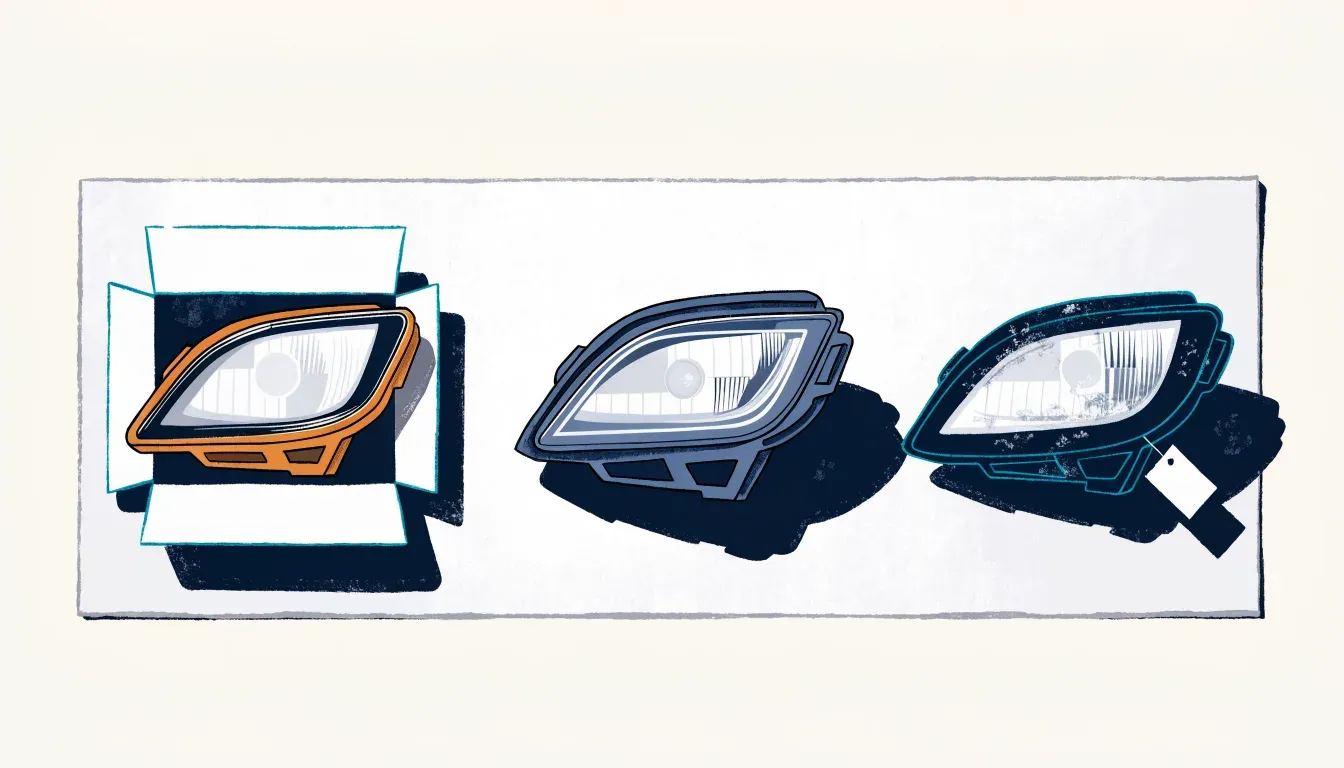
OEM vs aftermarket parts comes down to who made the part. OEM (original equipment manufacturer) parts are new parts made by or for your carmaker. Aftermarket parts are new parts made by other companies. Used parts, which estimates and industry reports often call recycled parts, are original carmaker parts taken from another vehicle. For cosmetic panels the choice matters less than most people think. For structure, airbags and sensors, it matters a lot.
Auto Body Wilson is an independent guide, not a repair shop. Every rule and figure below is linked to its source.
The three kinds of parts on an estimate
| OEM (new) | Aftermarket (new) | Used / recycled | |
|---|---|---|---|
| Who makes it | The carmaker or its supplier | Another manufacturer | The carmaker, originally; taken from another vehicle |
| Condition | New | New | Used; condition varies |
| Fit | Matches the original | Varies; CAPA-certified parts are test-fitted | Original fit, if undamaged |
| Typical use | Any repair; required by many carmakers for structure, airbags and sensors | Cosmetic panels, lights, some bumper parts | Older cars, hard-to-find parts, cosmetic panels |
Industry data shows how common each type is. CCC Intelligent Solutions’ Crash Course 2026 shows OEM parts took the largest share of part dollars every year from 2020 to 2025, followed by aftermarket, recycled, reconditioned and “optional OE” parts. The mix is moving. In 2025, OEM part dollars fell 1.8% and aftermarket part dollars rose 1.7%, which CCC described as aftermarket use passing historical highs.
CCC’s categories show you may also see “reconditioned” and “optional OE” parts on an estimate. Ask the shop to explain any part type you do not recognize, and whether a reconditioned part was repaired by the carmaker or by someone else.
Where the safety line falls
The useful split is not OEM vs aftermarket. It is cosmetic vs structural.
The Insurance Institute for Highway Safety (IIHS) puts it plainly: “Aftermarket parts fall into two categories: cosmetic and structural.” Its earlier research showed cosmetic parts “don’t alter crash test results.” It lists them: “Fenders, quarter panels, door skins, bumper covers and trim aren’t responsible for safeguarding occupants in a crash.”
Structural parts are different. They make up the crush zone and the safety cage, and IIHS says replacements “must exactly replicate the original parts” whoever makes them. It adds that “some aftermarket non-OEM parts can meet these requirements.” In 2018 IIHS reviewed a law firm’s crash tests of a Honda Fit fitted with aftermarket parts and found the car “performed on par” with its own test of the original.
Two other groups of parts deserve extra care:
- Airbags and restraint parts. IIHS says a deployed airbag must be replaced at a shop that uses OEM replacement parts “to ensure that the new airbag is not counterfeit.” See airbag replacement cost for why.
- Driver-assistance sensors. Radar units, cameras and the bumpers and brackets they sit in affect how those systems aim. See ADAS calibration after a collision.
What CAPA certification means
CAPA, the Certified Automotive Parts Association, certifies aftermarket replacement parts. It says it “establishes objective, measurable Quality Standards and Specifications for replacement parts,” and that “the CAPA Seal is proof a replacement part is CAPA Certified to fit, perform and last like the original” (CAPA).
Its standards include:
- a vehicle test fit for most parts, including metal (CAPA 101) and plastic (CAPA 201) parts;
- materials testing of composition and mechanical properties;
- crash testing for bumper parts under CAPA 501.
CAPA’s site offers a seal search and a parts database. If your estimate lists aftermarket panels, ask whether they are CAPA-certified and look for the seal on the part before it is painted. CAPA certification is a quality check on aftermarket parts. It does not make an aftermarket part acceptable where your carmaker forbids non-OEM parts.
What carmakers say
Carmakers publish position statements, and I-CAR, the industry training body, says carmaker repair procedures “are service specifications, not recommendations” (I-CAR). Some of those statements cover parts.
General Motors tightened its position in 2026. According to I-CAR, GM’s statement now says it “strictly prohibits the use of non-GM approved salvage, recycled/used, or non-Genuine aftermarket parts on Chevrolet, Buick, GMC, and Cadillac vehicles.” GM’s reason is that it does not “design, engineer, test, or validate” those parts. Repairer Driven News reports matching language in GM statements on ADAS sensors, on bumper fascias for ADAS-equipped vehicles, on restraint system repairs and on windshields.
Recyclers disagree. The Automotive Recyclers Association says recycled original parts “give vehicle owners access to affordable repair parts” and that recyclers are becoming “the only source for OEM parts as a vehicle ages.”
For you, the practical step is simple. Ask the shop whether your carmaker has a position statement on parts for the areas being repaired, and whether the estimate follows it.
Price, and why it is not the whole story
Aftermarket and used parts usually exist because they cost less than new OEM parts. We did not find a sourced, current figure for the typical price gap, so we do not give one. The gap varies by part and car.
Prices are rising across the board. Mitchell’s 2025 data, reported by Repairer Driven News, shows OEM part prices rose 4.21% and aftermarket prices 3.89%. CCC reported in 2025 that a weaker dollar was drawing U.S. salvage vehicles abroad, “shrinking the domestic pool of recycled parts and driving up their cost” (Repairer Driven News).
A cheaper part that needs extra trimming, refitting or repainting to look right can save less than it seems. That labor belongs on the estimate.
A non-OEM part does not cancel a new-car warranty on its own. The Federal Trade Commission says “your warranty stays in effect if you use aftermarket or recycled parts,” and that the carmaker or dealer “must prove the aftermarket or recycled part caused the damage” before it denies coverage for that damage. A lease contract can set its own return terms, so read yours.
North Carolina rules on aftermarket parts
North Carolina has two rules worth knowing when an insurer writes the estimate.
1. Written disclosure. Under G.S. 58-36-95, an insurer must disclose in writing, on the estimate or a page attached to it, in type no smaller than 10 point, that the estimate is “based on the use of automobile parts not made by the original manufacturer.” The required notice adds that those parts “are required to be at least equivalent in terms of fit, quality, performance, and warranty” to the parts they replace. The statute covers “nonoriginal crash repair parts,” which it defines as sheet metal or plastic parts, “generally components of the exterior,” not made by or for the carmaker.
2. No forced aftermarket parts. The NC Department of Insurance says: “No insurance company shall require the use of after-market parts unless the part is equal to the original part in terms of fit, quality, performance and warranty.” It adds that any changes needed because of aftermarket parts “shall be included in the estimates.”
The same statute makes it a violation for a shop or parts seller to fit a non-original part and invoice it as an original part, and it requires suspected fraud to be reported to the Insurance Commissioner. You also choose the shop in North Carolina; see your right to choose a repair shop.
Airbags have their own law. G.S. 20-136.2 makes it unlawful to knowingly sell or install a counterfeit restraint system part or a nonfunctional airbag.
Outside North Carolina, check your own state’s insurance department. This guide covers only the NC rules we have read.
How to check the parts on your estimate
- Find the part type on each line. If a code is unclear, ask the shop what it means. How to read a body shop estimate walks through a typical estimate.
- In North Carolina, look for the written non-OEM disclosure on or attached to an insurer’s estimate.
- Ask which parts are structural, restraint or sensor parts, and confirm those follow the carmaker’s procedures.
- For aftermarket panels, ask whether they are CAPA-certified.
- Ask what warranty covers each non-OEM part, and who honors it.
- If you want OEM parts the insurer will not pay for, ask the shop and insurer for the price difference in writing before work starts.
What to do next
Get the estimate itemized by part type, and ask the shop about any structural, airbag or sensor part that is not new OEM. If an insurer insists on parts you think are not equal to the original, raise it with the adjuster, then with the NC Department of Insurance. For the bigger picture on cost, read typical collision repair prices, and for how parts fit into the work, the collision repair process. Hidden damage found after teardown can change the parts list; see why estimates grow.
Repair or replace?
Repair usually makes sense when
- Aftermarket or used parts are reasonable for cosmetic panels such as fenders, door skins, bumper covers and trim, especially when the aftermarket part carries a CAPA seal.
- A used OEM part in good condition can be a sensible choice on an older car where new OEM parts are expensive or no longer made.
- The estimate shows any extra labor needed to make an aftermarket part fit, as NC regulators require.
Replace usually makes sense when
- Insist on new OEM parts for structural parts, airbags and other restraint parts, and driver-assistance sensors unless the carmaker's procedures allow otherwise.
- Your carmaker has a position statement against non-OEM or used parts for the area being repaired. GM, for example, prohibits them on ADAS sensors and bumper fascias of ADAS-equipped vehicles.
- The car is leased or under a new-car warranty and you are unsure how a non-OEM part affects that. Ask before you approve.
Part source matters most where the part protects you. For a fender or bumper cover, a certified aftermarket or good used part is usually fine. For structure, airbags and sensors, follow the carmaker's procedures, which usually means new OEM parts.
Frequently asked questions
Are aftermarket parts as good as OEM parts?
Some are and some are not. IIHS says cosmetic parts such as fenders, door skins and bumper covers do not change crash test results, wherever they come from. Structural parts must exactly copy the original, and IIHS says some aftermarket parts can meet that bar. For cosmetic aftermarket panels, a CAPA seal shows the part passed independent fit and materials tests.
Can my insurance company make me use aftermarket parts in North Carolina?
Not unless the part equals the original. The NC Department of Insurance says no insurer can require aftermarket parts unless they are equal in fit, quality, performance and warranty, and any extra work they need must be in the estimate. State law also requires the insurer to disclose non-OEM parts in writing on or with the estimate.
Full guide: North Carolina: Your Right to Choose a Repair Shop
What is a CAPA certified part?
It is an aftermarket replacement part that carries the seal of the Certified Automotive Parts Association. CAPA sets standards that include a test fit on the vehicle and materials testing, and its bumper standard includes crash testing. CAPA says its seal is proof a part is certified to fit, perform and last like the original. Each part should carry the seal itself.
Are used parts safe for collision repair?
A used part is usually an original carmaker part from another vehicle, so for a cosmetic panel in good condition it can be a fair choice. Some carmakers object to used parts in safety areas. GM's 2026 position statements prohibit salvage, recycled or used parts on its vehicles, including ADAS sensors and restraint parts. Check your carmaker's position before approving.
Full guide: ADAS Calibration After a Collision: Why Your Estimate Has It
Should airbags ever be aftermarket or used?
No. IIHS says a deployed airbag must be replaced at a shop that uses OEM replacement parts so the new airbag is not counterfeit, because counterfeit airbags may fail to deploy or throw metal fragments. In North Carolina, knowingly installing a counterfeit or nonfunctional airbag is a crime.
Full guide: Airbag Replacement Cost After an Accident
Sources
- North Carolina General Statutes § 58-36-95, Use of nonoriginal crash repair parts — accessed November 24, 2026
- North Carolina Department of Insurance, After an Accident — accessed November 24, 2026
- North Carolina General Statutes § 20-136.2, Counterfeit supplemental restraint system components and nonfunctional airbags — accessed November 24, 2026
- Certified Automotive Parts Association (CAPA), What We Certify — accessed November 24, 2026
- IIHS, IIHS responds to tests involving aftermarket repair parts (Advisory No. 42, 15 Feb 2018) — accessed November 24, 2026
- IIHS, Airbags — accessed November 24, 2026
- I-CAR Repairability Technical Support, General Motors Updates Position Statements (19 Nov 2026) — accessed November 24, 2026
- Repairer Driven News, GM revises position statements to add 'strictly prohibits' language (30 Jul 2026) — accessed November 24, 2026
- Automotive Recyclers Association, Statement on GM position regarding recycled OEM ADAS components — accessed November 24, 2026
- CCC Intelligent Solutions, Crash Course 2026: Complexity Compounds (Mar 2026) — accessed November 24, 2026
- Repairer Driven News, Calibrations grew 31.4% in 2025, Mitchell data shows (4 Jun 2026) — accessed November 24, 2026
- Repairer Driven News, New CCC report: Scans and calibrations now 'routine' at DRP shops (24 Sep 2025) — accessed November 24, 2026
- Federal Trade Commission, Auto Warranties and Auto Service Contracts (Apr 2024) — accessed November 24, 2026
- I-CAR Repairability Technical Support, Always follow vehicle maker procedures — accessed November 24, 2026