ADAS Calibration After a Collision: Why Your Estimate Has It
If your car has automatic emergency braking, lane keeping or adaptive cruise control, a collision repair will often include a calibration line. Here is what that is, why carmakers require it, what it costs and how to check it was done.
Key takeaways
- Calibration re-aims the cameras, radar and other sensors behind driver-assistance (ADAS) features so they see where the carmaker designed them to see.
- I-CAR says it may be needed whenever a sensor, its mounting point, or a part in front of or behind it is removed, replaced or damaged. Only the carmaker's information says for sure.
- It is now routine. CCC found calibrations on 28.3% of repairable estimates in 2025, and on 40.6% of insurer-network estimates in early 2026.
- AAA put the cost of replacing and calibrating single ADAS parts at $290 to $1,596, on top of the body work. Ask for the calibration report before you drive away.
ADAS calibration after a collision is the step that re-aims your car’s driver-assistance sensors (the cameras, radar and ultrasonic sensors behind automatic emergency braking, lane keeping and adaptive cruise control) so they point exactly where the carmaker designed them to. It shows up on estimates because body repairs move those sensors or the parts they mount to. I-CAR, the industry training body, calls calibration “a required step” after many of those parts are removed, installed or repaired, and carmakers require it in their repair procedures.
Auto Body Wilson is an independent guide, not a repair shop. Every cost and technical claim below links to its source.
What calibration does
Sensors work only if they are aimed precisely. I-CAR explains that “even one degree could cause a camera or sensor to miss a target or object by many feet” (I-CAR). A radar that is slightly off “may not detect when a vehicle ahead is braking,” and then “the collision braking system may not operate, or may be delayed.”
These systems are worth keeping in working order. IIHS found that forward collision warning with automatic braking “cut rear-end crashes in half” (IIHS).
I-CAR notes calibration goes by other names on estimates and repair orders: “aiming, health check, module setup, relearn, zero-point calibration, initiation, or calibration” (I-CAR).
When calibration is required
I-CAR’s industry definitions say post-repair calibration may be required after:
- removing, installing or repairing a sensor or camera;
- “damage/trauma to the mounting location(s)”;
- removing or replacing “parts in front of, or behind, cameras and/or sensors,” such as a bumper cover, grille or windshield;
- removing or replacing closure or trim panels.
The deciding word is the carmaker’s. I-CAR says “access to OEM information is mandatory to determine if post-repair calibration is required,” and that carmaker procedures “are service specifications, not recommendations” (I-CAR).
Carmakers say so directly in position statements. Honda’s says all vehicles in a collision must get minimum scans, inspections and calibrations, and it defines a collision as “damage that exceeds minor outer panel cosmetic distortion.” It adds a point many owners miss: these systems “often will not display DTCs [fault codes] during a vehicle scan unless there is damage to the applicable system, so aiming and/or calibration may be required” (I-CAR). A dashboard with no warning lights does not prove the sensors are aimed correctly.
AAA’s study priced sensors in these places on the three 2023 models it examined (AAA):
| Location | Sensor in AAA’s study | Repairs that disturb it |
|---|---|---|
| Front, behind the bumper or grille | Radar for automatic braking and adaptive cruise | Bumper cover, grille, front-end repair |
| Front | Camera for braking and lane keeping | Front-end repair |
| Windshield | Camera for lane keeping, sign and pedestrian detection | Windshield replacement |
| Side mirror | Camera for around-view systems | Mirror replacement |
| Front and rear bumpers | Ultrasonic parking sensors | Bumper repair or replacement |
Sensor locations vary by model, so check your car’s equipment.
How it is done
There are two main methods, and some systems need both.
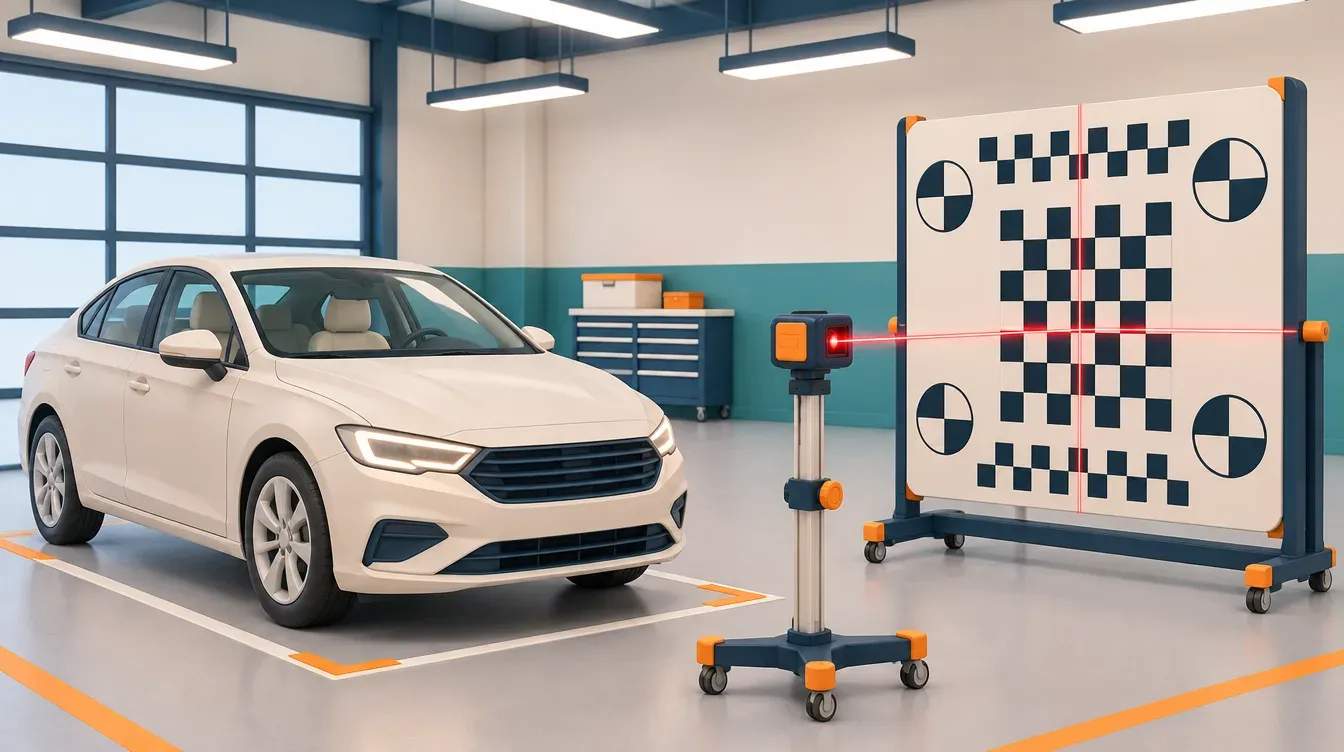
Static calibration happens in the shop. I-CAR says the car usually must sit on a surface that is level or has “limited slope,” at a “controlled ride height.” “Many calibrations require that the fuel tank be filled,” heavy cargo removed and the right tire size fitted. “If the wrong tire size is installed, it can also affect the calibration” (I-CAR).
Dynamic calibration happens on the road. I-CAR says it “requires the vehicle to be driven, often times with two technicians and a scan tool,” sometimes at set speeds and on roads with clear lane markings. A test drive is a separate, final step after all calibrations (I-CAR).
Before and after calibration, the shop should run diagnostic scans. See the collision repair process for where these steps fall.
How common it is
Calibration has gone from rare to routine. CCC Intelligent Solutions found calibrations on 28.3% of repairable estimates in 2025, up from 21.8% the year before (CCC). In the first quarter of 2026, 29.9% of all repairable appraisals and 40.6% of those at insurer direct-repair (DRP) shops included one (Repairer Driven News). Mitchell’s data shows the share of estimates with a calibration line grew 31.4% in 2025 (Repairer Driven News).
It is often added late. CCC found that in early 2026 only 47% of calibrations were on the initial estimate. The rest appeared on supplements after teardown, which is one reason estimates grow. See hidden damage and why estimates grow.
What it costs
AAA’s December 2023 study of a 2023 Ford F-150, Nissan Rogue and Toyota Camry priced each ADAS component, including part, labor and calibration, at $290 to $1,596. Those costs are “over and above the normal bodywork.” The table above lists AAA’s ranges by sensor. AAA also found:
- ADAS parts added $1,540 on average to a minor front-end repair, 13.2% of the total.
- In a minor rear collision, ADAS parts averaged $684, or 40.9% of a $1,698 estimate.
- ADAS components made up 25.4% ($360) of the average windshield replacement.
We did not find a sourced, current range for a calibration alone, without a replacement part, so we do not give one. The price depends on the vehicle, the sensor, the method and whether the shop does it in-house or sends it out. For the full cost picture, see what collision repairs cost.
How much time it adds
CCC’s data for the first quarter of 2025 shows insurer-network repairs averaged 13 days in the shop with no calibration, 15.5 days with one and more than 17 days with several (CCC Q3 2025). More in how long collision repair takes.
Parts and calibration
The sensor itself, its bracket and the bumper or glass in front of it all affect aim. Some carmakers restrict which parts can be used there. GM’s 2026 ADAS position statement “strictly prohibits the use of salvaged, recycled, reconditioned, remanufactured, aftermarket, or any secondary-market ADAS radars, cameras, sensors,” and another bars aftermarket, reconditioned or salvage bumper fascias on ADAS-equipped GM vehicles (Repairer Driven News). See OEM vs aftermarket vs used parts.
Structural damage matters too. I-CAR’s ADAS calibration course stresses “the importance of ensuring that these ADAS mounting locations are repaired back to factory specifications” (I-CAR). If the area a sensor mounts to has moved, that has to be fixed for the calibration to be right. See frame damage repair.
Questions to ask the shop
- Which ADAS features does my car have, and which sensors does this repair disturb?
- What does the carmaker’s procedure require for each one?
- Will you calibrate in-house or send the car out, and to whom?
- Can I have the pre- and post-repair scan reports and the calibration printout or record?
- Was a test drive done after calibration?
What to do next
Before you approve the estimate, check that each sensor near the damage has a calibration line or a written reason why it does not need one. When you pick up the car, ask for the calibration and scan records and keep them with your repair invoice. If a warning light appears or a system behaves oddly afterward, return to the shop promptly. For the rest of the job, read the collision repair process.
| Scenario | Typical range (estimate) | What drives it |
|---|---|---|
| Front radar sensor (automatic braking, adaptive cruise) | $500–$1,300 (AAA, Dec 2023) | Part plus labor and calibration, over and above the body work. |
| Front camera sensor (not including windshield) | $600–$800 (AAA, Dec 2023) | Lane keeping, automatic braking. |
| Windshield camera sensor | $900–$1,200 (AAA, Dec 2023) | Lane keeping, sign and pedestrian detection. |
| Side mirror with camera (around-view systems) | $740–$1,600 (AAA, Dec 2023) | The camera was most of the mirror cost. |
| Front or rear ultrasonic parking sensors | $300–$1,000 (AAA, Dec 2023) | Parking assist. |
| All ADAS parts in a minor front-end repair | $1,540 average (AAA, Dec 2023) | 13.2% of the average total repair. |
Ranges are estimates from the sources listed on this page, not quotes. Your price depends on the vehicle, the damage and local labor rates.
Frequently asked questions
Do I really need ADAS calibration after a collision?
Often, yes. I-CAR defines calibration as a required step after many sensor parts are removed, installed or repaired, and says it may also be needed when a sensor's mounting point is damaged or parts in front of or behind it are removed. Honda's position statement notes these systems often show no fault code, so a clean scan does not prove calibration is unnecessary.
How much does ADAS calibration cost?
AAA's 2023 study priced ADAS parts with their labor and calibration at $290 to $1,596 each, on top of the body work, and found ADAS parts added $1,540 on average to a minor front-end repair. We did not find a sourced range for a calibration on its own, without a new part. Costs vary by vehicle, sensor and who performs it.
Full guide: Collision Repair Cost: What Drives the Bill
Does a windshield replacement need calibration?
On many cars with a camera behind the windshield, yes. AAA's study found ADAS components made up 25.4% ($360) of the average windshield replacement cost in the vehicles it studied. Check the carmaker's procedure for your model, and ask the glass shop for the calibration record.
What is the difference between static and dynamic calibration?
Static calibration is done in the shop with the car parked on a level surface at a set ride height. Dynamic calibration means driving the car with a scan tool connected, often with two technicians, under conditions the carmaker sets. I-CAR says some systems need both, and a separate test drive should follow every calibration.
How long does calibration add to a repair?
CCC's data for early 2025 shows insurer-network repairs averaged 13 days in the shop with no calibration, 15.5 days with one and more than 17 days with several. Part of that is the calibration itself, and part is waiting for supplement approval, since CCC says most calibrations are added after teardown.
Full guide: How Long Does Collision Repair Take?
Sources
- I-CAR Repairability Technical Support, Collision Repair Diagnostics Definitions — accessed November 24, 2026
- I-CAR Repairability Technical Support, Honda/Acura Position Statement: Pre- and Post-Repair System Scanning (UPDATE) — accessed November 24, 2026
- I-CAR Repairability Technical Support, Even One Degree: ADAS Calibration — accessed November 24, 2026
- I-CAR Repairability Technical Support, Dynamic Calibrations Compared to a Test Drive — accessed November 24, 2026
- I-CAR Repairability Technical Support, Requirements And Considerations For Achieving An Accurate ADAS Calibration — accessed November 24, 2026
- I-CAR Repairability Technical Support, Preparing The Vehicle For Calibration — accessed November 24, 2026
- I-CAR Repairability Technical Support, Always follow vehicle maker procedures — accessed November 24, 2026
- AAA Newsroom, ADAS repair costs study (14 Dec 2023) — accessed November 24, 2026
- IIHS, Advanced driver assistance — accessed November 24, 2026
- CCC Intelligent Solutions, Crash Course 2026: Complexity Compounds (Mar 2026) — accessed November 24, 2026
- CCC Intelligent Solutions, Crash Course 2025 Q3 — accessed November 24, 2026
- Repairer Driven News, CCC mid-year collision repair trends update (19 Oct 2026) — accessed November 24, 2026
- Repairer Driven News, Calibrations grew 31.4% in 2025, Mitchell data shows (4 Jun 2026) — accessed November 24, 2026
- Repairer Driven News, GM revises position statements to add 'strictly prohibits' language (30 Jul 2026) — accessed November 24, 2026