Do You Need an Alignment After an Accident?
After most crashes that involve a wheel, the suspension or the structure, yes. On cars with driver-assistance cameras and radar, alignment also affects how those systems aim. Here is when you need one, why it has to come after the body repair, and what it costs.
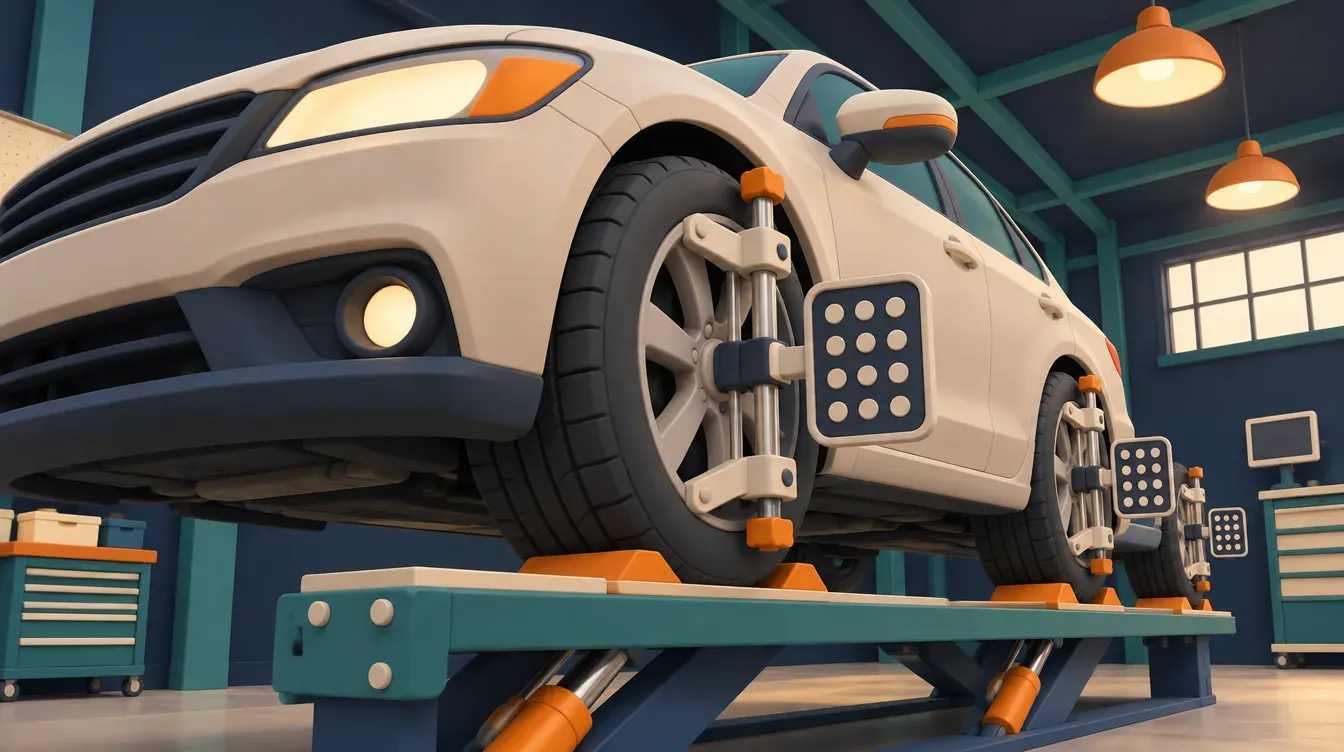
Key takeaways
- Usually yes. I-CAR says a great majority of collisions can cause some type of suspension damage, and that means a wheel alignment will be necessary.
- The alignment comes last. I-CAR says the structure must be three-dimensionally correct, and bent suspension parts replaced, before any alignment can be done properly.
- Ask for a four-wheel alignment with a printout. A two-wheel alignment cannot show whether the rear wheels were knocked out of line.
- On driver-assistance cars, many carmakers require calibration after an alignment, or an alignment check before calibration. A standalone four-wheel alignment costs $90 to $160 at chain shops (CarWhere, Nov 2026) or $100 to $175 (SlashGear, Jun 2026).
You usually do need an alignment after an accident if a wheel, tire, suspension part or the car’s structure took any of the hit. I-CAR, the industry’s training body, puts it simply: “A great majority of collisions can cause some type of suspension damage, which means a wheel alignment will be necessary” (I-CAR). A light scuff to a bumper cover, with no wheel involved and no change in how the car drives, may not need one. On cars with driver-assistance cameras and radar, even some bumper jobs call for an alignment check.
Auto Body Wilson is an independent guide, not a repair shop. Every technical claim and price below links to its source.
Signs your alignment is off after a crash
Gerber Collision’s guide lists these signs of misalignment:
- the steering wheel is unsteady;
- it “tends to favor one direction over the other”;
- the vehicle shakes;
- the steering makes noise.
Add a steering wheel that sits off-center when you drive straight, and tires wearing unevenly over the next few weeks. AAA’s Auto Club Group lists pulling, uneven tire wear and an off-center wheel as misalignment symptoms, and says to consider an alignment if you “experience a collision” (AAA).
No sign does not mean no damage. I-CAR says a car with bent suspension parts may “appear to align properly at first, but as the vehicle is driven over time the tires begin to show abnormal wear patterns” (I-CAR).
Why the alignment has to come last
An alignment sets angles: camber (how the wheel leans in or out), caster (the tilt of the steering axis) and toe (whether the wheels point in or out). It cannot fix a bent part or a moved structure.
I-CAR calls it a common mistake to align a car after a crash without first “checking for structural or suspension damage.” Its rule is direct: “The structure of the vehicle must be three-dimensionally correct before any wheel alignment can be properly performed” (I-CAR).
Small shifts matter. On a typical strut suspension, I-CAR says moving one pivot point about half an inch (13 mm) forward or back changes caster by one degree. That is how a shifted crossmember or cradle, the subframe that holds the suspension, can throw off steering centering and alignment (I-CAR).
So the order on a proper repair is: measure and repair the structure, replace bent suspension and steering parts, then align, then calibrate any sensors that need it. See unibody vs body-on-frame repair and frame damage repair for the structural steps.
Two-wheel or four-wheel?
After a crash, ask for a four-wheel alignment with a before-and-after printout.
I-CAR explains why. A two-wheel alignment sets the front wheels to each other. If the rear wheels were knocked out of line, the front wheels end up aimed against the rear wheels’ thrust angle (the direction the rear axle points the car), so the steering wheel sits off-center and the car may pull. “It is impossible to determine if the rear wheels are out of specification with a two-wheel alignment,” I-CAR says, which “makes performing a four-wheel alignment necessary.” Rear wheels out of specification “may be an indication of bent suspension parts or structural damage that has not been repaired” (I-CAR).
Some cars have a solid rear axle with little or no rear adjustment. I-CAR says the front wheels are then aligned to the rear thrust angle, and that all four wheels and the steering wheel should still be checked. Failing to correct or align to the thrust angle can cause tire wear, an off-center wheel, a pull, handling problems, and can “affect advanced driver assistance systems (ADAS) features.”
Alignment and driver-assistance systems
Lane-keeping and automatic braking need to know which way the car is really going. I-CAR says these systems “need to be properly aligned with how the vehicle is traveling down the road,” and they use inputs such as the steering angle sensor. If that sensor is adjusted during an alignment, “the forward-facing camera, which controls the lane departure warning, may think the steering wheel is turned,” and the car may try to correct its steering when it is already going straight (I-CAR).
I-CAR says “there are numerous OEMs that require the ADAS to be calibrated when a wheel alignment is performed,” and some make an alignment a step in the calibration. Audi, for example, told I-CAR that even a front bumper cover replacement calls for “a quick check to assure that the thrust angle is correct,” and that “either method requires that the thrust angle is true before doing the calibration” (I-CAR).
Precision matters here. I-CAR warns that “even one degree could cause a camera or sensor to miss a target or object by many feet” (I-CAR). For the full picture, see ADAS calibration after a collision.
What an alignment costs
A standalone alignment is one of the cheaper repairs. SlashGear’s June 2026 guide puts a two-wheel alignment at $50 to $100 and a four-wheel alignment at about $100 to $175. CarWhere’s survey of posted chain prices, checked in November 2026, puts a four-wheel alignment at $90 to $160, with dealer specials at about $120 to $200. If a driver-assistance calibration is needed afterward, CarWhere’s posted prices run $155 to $600 (a single-source estimate).
After a crash, the alignment is normally a line on the collision estimate, and the real cost is whatever has to be fixed first. Experian’s 2022 list puts suspension damage repair at $1,000 to $5,000 (a single-source estimate). The table on this page sums it up. For whole-repair costs, see collision repair cost.
Questions to ask the shop
- Did you check the suspension and steering parts for damage before the alignment?
- Was the structure measured, and was it within specification?
- Will you do a four-wheel alignment, and can I have the before-and-after printout?
- Does my carmaker require a driver-assistance calibration after the alignment, and will I get the report?
- Was the steering angle sensor reset or calibrated?
If the car pulls or wears tires unevenly after you pick it up, go back to the shop and show them. A rear-end hit can be the cause too; see rear-end collision damage.
What to do next
If the car pulls, shakes or sits off-center after a crash, tell the shop or insurer before the estimate is written, so suspension checks and a four-wheel alignment are on it. If the wheel or suspension took a hard hit, read is it safe to drive with frame damage? before driving it. Keep the alignment and calibration printouts with your invoice, and see the collision repair guide for the rest of the repair.
| Scenario | Typical range (estimate) | What drives it |
|---|---|---|
| Two-wheel (front) alignment | $50–$100 (SlashGear, Jun 2026); $100–$120 for a front-only or thrust-angle alignment at chain shops (CarWhere, prices checked Nov 2026) | |
| Four-wheel alignment | $100–$175 (SlashGear, Jun 2026); $90–$160 at chain shops (CarWhere, prices checked Nov 2026) | CarWhere puts dealer specials at about $120–$200 |
| Driver-assistance calibration after the alignment | $155–$600 in posted prices (CarWhere, prices checked Nov 2026; single-source estimate) | Only when the carmaker requires it |
| Suspension damage repair | $1,000–$5,000 (Experian, Aug 2022; single-source estimate) | When bent parts must be replaced before the alignment |
Standalone alignment prices are what a tire or service shop posts. After a crash, the alignment is usually one line on the collision estimate, and any suspension parts, structural work or calibration is priced separately.
Frequently asked questions
How do I know if my car needs an alignment after an accident?
Gerber Collision's guide lists an unsteady steering wheel, a car that favors one direction, shaking and steering noise. AAA adds uneven tire wear and an off-center steering wheel. Some damage shows no sign at first. I-CAR says a car with bent suspension parts can appear to align properly and then wear its tires abnormally over time.
Full guide: Hidden Damage After an Accident and Why Estimates Grow
Can I just get an alignment instead of fixing the damage?
No. I-CAR says a common mistake is aligning a car without checking for structural or suspension damage. If parts are bent or the structure has moved, the car may not align at all, or it may seem fine and then wear tires unevenly. The structure and suspension have to be repaired first, then the wheels aligned.
Full guide: Frame Damage Repair: Cost, Safety and When It's Not Worth Fixing
Do I need a two-wheel or four-wheel alignment after a crash?
Ask for four. I-CAR says it is impossible to tell whether the rear wheels are out of specification with a two-wheel alignment, so a four-wheel alignment is necessary. Rear wheels out of specification can point to bent suspension parts or unrepaired structural damage. The front wheels are then set to the rear wheels' thrust angle.
Why would my car need calibration after an alignment?
Cameras and radar use the direction the car travels and the steering angle sensor. I-CAR says that if the steering angle sensor is adjusted during an alignment, the forward camera may think the wheel is turned. Many carmakers require driver-assistance calibration after an alignment, and some require an alignment as a step in calibration.
Full guide: ADAS Calibration After a Collision: Why Your Estimate Has It
Sources
- I-CAR Repairability Technical Support, The Effects Of Wheel Alignment On ADAS (30 Aug 2018) — accessed November 24, 2026
- I-CAR Repairability Technical Support, Common Mistakes: Performing Wheel Alignments When Damage Still Exists (16 Oct 2019) — accessed November 24, 2026
- I-CAR Repairability Technical Support, Two-Wheel vs. Four-Wheel Alignments (19 May 2021) — accessed November 24, 2026
- I-CAR Repairability Technical Support, Even One Degree: Steering And Suspension (12 Aug 2020) — accessed November 24, 2026
- I-CAR Repairability Technical Support, OEM Linking Pin: Wheel Alignment - Audi ADAS Clarification (21 Oct 2021) — accessed November 24, 2026
- I-CAR Repairability Technical Support, I-CAR Just In Time: Wheel And Suspension Alignment (12 Aug 2026) — accessed November 24, 2026
- I-CAR Repairability Technical Support, Even One Degree: ADAS Calibration (8 Jul 2020) — accessed November 24, 2026
- Gerber Collision & Glass, Five Signs of Hidden Damage After a Collision — accessed November 24, 2026
- AAA The Auto Club Group, Vehicle wheel alignment and suspension — accessed November 24, 2026
- SlashGear, How Much Does A Car Alignment Cost? (29 Jun 2026) — accessed November 24, 2026
- CarWhere, Wheel Alignment Cost (2026), prices checked 9 Nov 2026 — accessed November 24, 2026
- Experian, What's the Average Cost of an Auto Repair After an Accident? (17 Aug 2022) — accessed November 24, 2026