Rear-End Collision Damage: What to Check Beyond the Bumper
A rear bumper cover can pop back into shape after a hit while the parts behind it are crushed. Here is what a rear-end collision can damage beyond the bumper, the warning signs to look for, what the sensor work costs, and how to make sure the estimate covers it.
Key takeaways
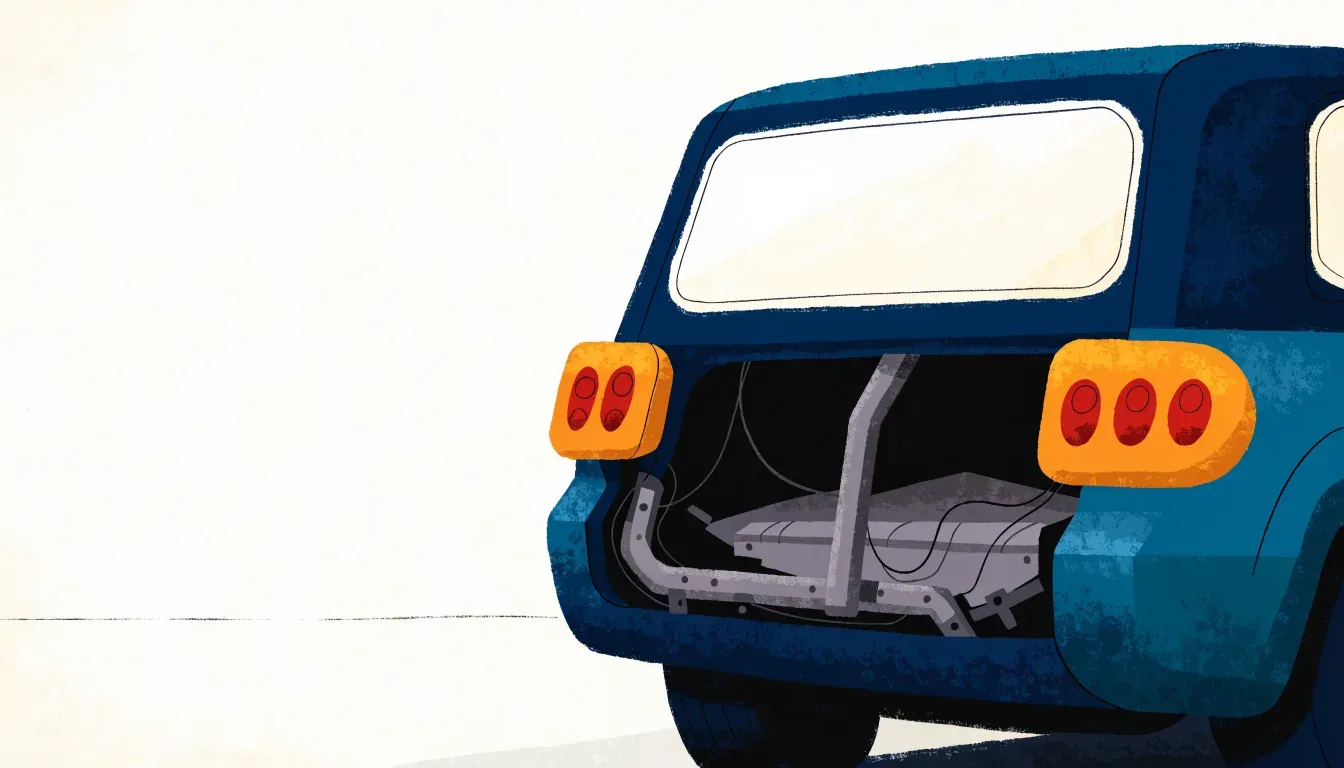
- The bumper cover is only the outer skin. Behind it sit a crushable absorber, a steel or aluminum reinforcement bar and its mounts, and those take the energy of a rear hit.
- Check past the bumper for trunk or liftgate gaps, lights, the rear body panel and trunk floor, the exhaust, and on rear-drive cars any fluid leaks.
- Sensors add up. In AAA's study of three 2023 models, driver-assistance parts made up $684, or 40.9%, of an average $1,698 minor rear collision repair.
- Neck sprains and strains are the most frequently reported injuries in U.S. auto insurance claims, IIHS says, and rear impacts typically cause them. Get checked if you feel sore.
Rear-end collision damage usually goes deeper than the bumper you can see. The plastic cover can flex back after a hit while the absorber, reinforcement bar, mounts and sensors behind it are crushed or knocked out of place. A harder hit can also reach the trunk floor, rear body panel, exhaust and suspension. Have a shop remove the bumper cover and inspect behind it before you accept a “cover only” estimate.
Auto Body Wilson is an independent guide, not a repair shop. Every figure and technical claim below links to its source.
What sits behind a rear bumper
A FenderBender article on bumper systems says they “are made up of four elements: the cover, absorber, reinforcement bar and mounting system.”
- Cover: usually plastic and “largely as a style element.” In low-speed hits it “can bend and flex back,” which is why a bumper can look fine afterward.
- Absorber: plastic, “intended to collapse in minor impacts to absorb the energy.” A crushed absorber does not spring back.
- Reinforcement bar: the rigid bar behind the absorber. It directs crash forces into both frame rails, and the article says this is “why vehicle manufacturers do not approve of repairs to reinforcement bars.”
- Mounts: these may be hydraulic, may be “designed to bend and be replaced after minor impacts,” or may be the end of the frame rail itself.
The article says the absorber “should be inspected in all but the most minor cover repair jobs,” even if that means removing the cover just to look.
What else to check beyond the bumper
Walk around the car in daylight and look for these, then ask the shop to check each one.
- Trunk lid or liftgate. It should open, latch and sit evenly. Gerber Collision’s guide warns that damage can upset the latches, and “driving with broken latches may cause them to open suddenly” (Gerber).
- Lights and gaps. Broken or loose tail lamps, and gaps between the bumper, quarter panels and trunk that are wider on one side.
- Rear body panel and trunk floor. Ask the shop to check these, not just the bumper. They are structure, not trim: BMW, for example, lists the rear body panel among the structural parts it sells only to trained, equipped shops (Repairer Driven News).
- Exhaust and tow hitch. In IIHS’s rear crash test of two F-150 pickups at 10 mph, both trucks had damage to “their beds, tailgates and exhaust pipes” (IIHS). Gerber notes a rear hit can “push the exhaust components forward.”
- Fluid leaks and warning lights. On rear-wheel-drive and all-wheel-drive cars, Gerber says some drivetrain parts sit near the rear, so “even in the smallest rear-end collision, some transmission components may get knocked out of place.” A check engine light or a new leak after the crash is worth reporting.
- How it drives. Pulling, an off-center steering wheel or vibration can mean bent suspension parts or shifted structure. See do you need an alignment after an accident?
- Sensors and cameras. If the backup camera, parking sensors, blind-spot warning or rear cross-traffic alert shows an error, or does not work, the parts may be damaged or out of aim.
Some damage shows none of these signs. I-CAR says “minor damage to one side of a vehicle may not be noticeable when visually comparing it to the other side,” which is why shops measure the structure rather than eyeball it (I-CAR).
Why the sensors matter, and what they cost
Rear bumpers now carry safety equipment. AAA’s fact sheet lists rear systems including blind spot monitoring, rear cross-traffic alert and parking assist (AAA). IIHS says systems with rear automatic braking are “associated with the largest reductions in insurance claims and backing crashes reported to the police” of any rear crash prevention type (IIHS).
Those sensors have to point exactly where the carmaker intends. I-CAR warns that “even one degree could cause a camera or sensor to miss a target or object by many feet” (I-CAR). A sensor that has been knocked loose, or a cover refitted without calibration, may not work as designed.
The cost is real. In AAA’s study of three 2023 models, the average minor rear collision repair came to $1,698, and $684 of that, or 40.9%, was for driver-assistance parts and labor (AAA, Dec 2023). The cost table on this page lists AAA’s component ranges. For full bumper prices, see bumper repair prices, and for how calibration works, ADAS calibration after a collision.
Injuries from rear-end crashes
Rear impacts are the classic cause of neck injuries. IIHS President David Harkey said in January 2026 that “neck sprains and strains are the most frequently reported injuries in U.S. auto insurance claims,” and that rear impacts “typically cause these injuries” (IIHS). IIHS launched a new seat and head restraint test that month, and only four of the first 18 small SUVs earned a good rating.
Soreness can show up later. If your neck or back hurts after a rear-end crash, get checked, and tell your insurer about any injury when you report the claim.
Making sure the estimate covers it
A first estimate written in a parking lot often lists only the cover and paint. Ask for these:
- A teardown inspection. The cover comes off so the absorber, reinforcement bar, mounts and rear body panel can be checked. Hidden damage then goes on a supplement. See hidden damage after an accident.
- A pre-repair and post-repair scan, to find stored fault codes in the rear sensors and confirm they clear.
- Calibration of any sensor that was removed, replaced or near the damage, with the report.
- Structural measuring if the trunk floor, rear body panel or rails are involved. See unibody vs body-on-frame repair for what that involves.
- An alignment check if the car drives differently.
If a quarter panel is damaged too, see quarter panel repair and replacement cost.
Reporting the crash in North Carolina
Under G.S. 20-166.1, the driver in a reportable crash must “immediately, by the quickest means of communication, notify the appropriate law enforcement agency.” G.S. 20-4.01 defines a reportable crash as one with death or injury, or “total property damage of one thousand dollars ($1,000) or more.” AAA’s average minor rear collision repair was $1,698, above that line, so call the police even when the bumper damage looks small. What to do after a car accident covers the rest of the first 48 hours.
What to do next
- Photograph the rear of the car, the trunk floor and the other car before anything is moved, if it is safe.
- Get a claim number. If the other driver was at fault, read whose insurance pays the body shop.
- Ask the shop for a teardown estimate, not a walk-around quote, and ask which rear sensors your car has.
- Keep the scan and calibration reports with your final invoice. For how the whole repair runs, see the collision repair process and the collision repair guide.
| Scenario | Typical range (estimate) | What drives it |
|---|---|---|
| Whole minor rear collision repair, average | $1,698 average total, of which $684 was driver-assistance parts and labor (AAA, Dec 2023; single-source estimate) | 2023 Ford F-150, Nissan Rogue and Toyota Camry |
| Rear parking (ultrasonic) sensors | $300–$1,000 (AAA, Dec 2023; single-source estimate) | On top of the bodywork |
| Camera used with around-view systems (front, mirror or rear) | $740–$1,600 (AAA, Dec 2023; single-source estimate) | On top of the bodywork |
AAA priced original-equipment parts at list price with $75 body and $110 mechanical labor rates for three 2023 models. Figures cover the driver-assistance parts and labor only, unless the row says otherwise.
Frequently asked questions
How do I know if a rear-end collision did more than bumper damage?
Look for a trunk lid or liftgate that will not close or sits unevenly, gaps that changed, broken or loose lights, a tailpipe pushed out of place, warning lights and, on rear-drive or all-wheel-drive cars, fluid leaks. Many signs do not show at all. The absorber and reinforcement bar sit behind the cover, so a shop has to remove the cover to inspect them.
Full guide: Hidden Damage After an Accident and Why Estimates Grow
Can a rear bumper reinforcement bar be repaired?
Usually not. A FenderBender article on bumper systems says the reinforcement bar spreads crash energy into both frame rails, which is why vehicle manufacturers do not approve repairs to reinforcement bars. If it is bent, expect it to be replaced. The plastic absorber in front of it is also usually replaced after it has crushed.
Does a rear-end collision affect wheel alignment?
It can. A hard hit can bend rear suspension parts or shift the structure, which changes how the rear wheels track. Signs include the car pulling, an off-center steering wheel or uneven tire wear. I-CAR says the structure must be correct before an alignment can be done properly, so the alignment comes after any structural repair.
Full guide: Do You Need an Alignment After an Accident?
Who pays for rear-end collision damage?
It depends on who was at fault and what coverage each driver carries. The claim route you choose can change whether you pay a deductible and how quickly the repair is approved, so decide before you authorize work. Our guide to not-at-fault accidents explains whose insurance pays the body shop, and our deductible guide explains what you may owe up front.
Full guide: Not-at-Fault Accident: Whose Insurance Pays the Body Shop?
Sources
- FenderBender, Revisiting Bumper Basics, by Charles Wilhite (1 Jan 2020) — accessed November 24, 2026
- AAA Newsroom, Fixing advanced vehicle systems makes up over one-third of repair costs following a crash (14 Dec 2023) — accessed November 24, 2026
- AAA, ADAS Repair Costs Fact Sheet (Dec 2023) — accessed November 24, 2026
- IIHS, Pricier repairs for aluminum F-150 than steel model in fender-benders (30 Jul 2015) — accessed November 24, 2026
- IIHS, IIHS launches new whiplash prevention test (27 Jan 2026) — accessed November 24, 2026
- IIHS, Advanced driver assistance topic page — accessed November 24, 2026
- Repairer Driven News, BMW expands restricted parts to include 3 Series and other models (25 Jun 2026) — accessed November 24, 2026
- Gerber Collision & Glass, Five Signs of Hidden Damage After a Collision — accessed November 24, 2026
- I-CAR Repairability Technical Support, Back-To-Basics: Comparative Measuring — accessed November 24, 2026
- I-CAR Repairability Technical Support, Even One Degree: ADAS Calibration (8 Jul 2020) — accessed November 24, 2026
- North Carolina General Statutes § 20-166.1, Reports and investigations required in event of accident — accessed November 24, 2026
- North Carolina General Statutes § 20-4.01 (33b), Reportable crash — accessed November 24, 2026