Not-at-Fault Accident: Whose Insurance Pays the Body Shop?
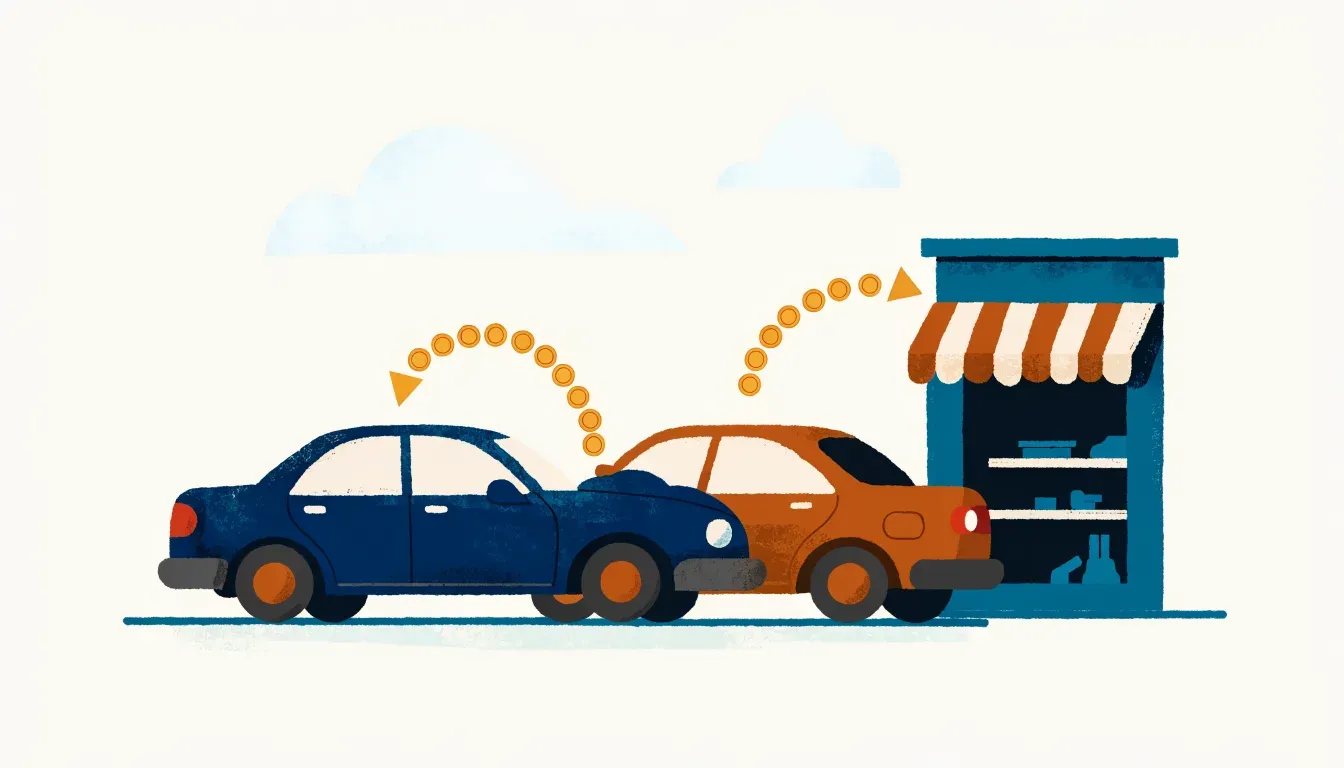
When another driver causes the crash, their property damage liability insurance should pay your body shop. You can also use your own collision coverage and let your insurer chase the money. In North Carolina, being even a little at fault can change everything.
Key takeaways
- The at-fault driver's insurer pays for your repairs through a third-party claim. You pay no deductible on that claim.
- You can also claim on your own collision coverage, a first-party claim. You pay your deductible first, and your insurer tries to recover it from the other side.
- North Carolina uses contributory negligence. NC Department of Insurance says it bars a driver from collecting damages if found partially at fault, so your own collision coverage may be the only way to get paid.
- Insurers cannot charge North Carolina insurance points for an accident that was not your fault. You choose the repair shop on either kind of claim.
If another driver caused the crash, their insurance pays for your repairs. You file a third-party claim against the at-fault driver’s property damage liability coverage, you pay no deductible, and you still choose the body shop. You can also use your own collision coverage, which is often faster, and let your insurer recover the money later. In North Carolina there is a catch: if you were even partly at fault, you may not be able to collect from the other driver at all.
This is general information, not legal advice. Fault rules vary by state, and the facts of a crash matter. Auto Body Wilson is an independent guide, not a shop, an insurer or a law firm.
Two ways to pay for the repair
NC Department of Insurance (NCDOI) describes both routes. You can be a “first party claimant” on your own policy or a “third party claimant” on “someone else’s liability policy.” NCDOI adds: “In either circumstance, the insurance company is responsible for the costs to repair your vehicle.”
| Third-party claim (their insurer) | First-party claim (your collision coverage) | |
|---|---|---|
| Who pays | The at-fault driver’s property damage liability coverage | Your insurer, under your collision coverage |
| Deductible | None. The Texas Department of Insurance: “You don’t have to pay a deductible for claims against another driver’s insurance company.” | You pay it, then your insurer tries to recover it |
| Fault | Their insurer must accept that its driver was at fault | Fault doesn’t decide whether your collision coverage pays |
| If you disagree on the amount | No appraisal clause. You negotiate, use your own coverage, or go to court | Your policy’s appraisal provision applies |
| Speed | Can stall while fault is investigated | The fallback NCDOI and the Texas regulator point to when the other insurer stalls |
| You need | Their insurer’s name and policy number | Collision coverage on your own policy |
Liability-only drivers have one route. NCDOI’s FAQ says liability insurance “only pays for other people’s injuries and property damage,” so without collision coverage your repair depends on the other driver’s insurer.
North Carolina’s contributory negligence rule
North Carolina’s fault rule is strict. NCDOI’s after-accident page says: “North Carolina Contributory Negligence Law bars a driver from collecting damages if determined to be partially at fault. In essence, if you contribute to an accident, you may not be able to collect on a liability claim.”
A few points follow from that:
- The other insurer has a reason to look for your share of fault. A claim that you were slightly fast or slow to brake can be enough to deny a third-party claim.
- The burden is on them. G.S. 1-139 says “A party asserting the defense of contributory negligence has the burden of proof of such defense.” That matters most if the dispute ends up in court.
- Courts settle the hard cases. NCDOI: “Any disagreement over negligence may ultimately have to be resolved in a court of law.”
- Your own collision coverage doesn’t depend on fault. If the other insurer denies the claim on contributory negligence, collision coverage is often the practical way to get the car fixed.
The rule has exceptions and fine points that only a lawyer can apply to your facts. If the damage is large, or someone was hurt, get legal advice before you accept a denial.
How a third-party claim works
- Collect the other driver’s details at the scene. NCDOI’s checklist says to record “the name of the insurance company and policy number exactly as it appears on the other driver’s proof of insurance card,” plus witness names and numbers. Call the police, especially if anyone is hurt or a driver leaves.
- Report it to both insurers. NCDOI: “If another individual is responsible for your damages, you need to contact their insurance agent or company as well.”
- Wait for the fault decision. NCDOI says the adjuster “will attempt to determine who is negligent or at-fault.”
- Get the inspection. Once liability is established on a third-party claim, NC rule 11 NCAC 04 .0419 says the insurer “shall perform a physical or digital inspection of the damaged vehicle within 10 business days of receipt of the claim,” or explain the delay. You can ask for a physical inspection, and you can ask for copies of the estimate and every supplement.
- Pick your shop. NCDOI says the insurer “may recommend a repair shop; however, you have the right to select the repair shop of your choosing.” Under G.S. 58-3-180, the amount the insurer decides it owes “shall be paid regardless of the repair service or source selected by the claimant.”
- Get paid. NCDOI’s FAQ says an insurer has 30 days to acknowledge a claim, and that payments “should be mailed or delivered within 10 business days after the claim is settled.”
On a third-party claim you may also be owed a rental car and, in North Carolina, the car’s lost value after repair. NCDOI says no statute or rule requires insurers to provide a rental. See rental cars during repairs and diminished value claims.
When the other insurer stalls or says no
You don’t have to wait for the other company to make up its mind. NCDOI says a third-party claimant who disagrees with the amount can “file a claim on your own comprehensive or collision coverage, if your policy includes that, and let your company ‘subrogate’ or recover the payment from the liable company.” The Texas Department of Insurance gives the same advice when the other insurer won’t pay: “file a claim with your own insurance company. You must have collision coverage to do this.”
What that costs you:
- Your deductible, at first. Progressive says it will try to recover “any money you may have paid toward your deductible or repairs,” but “We can’t promise that we’ll always be able to recover your deductible.” If fault is shared, “the amount you receive back may be prorated.” Collision deductibles explained covers this.
- Possibly a renewal question, not insurance points. NCDOI says “An insurance company cannot charge insurance points for an accident that was not your fault.” It also says insurers may count fault-free claims when deciding whether to renew collision and comprehensive coverage. Will a claim raise my rates? explains both.
If the other insurer is slow without a reason, North Carolina’s unfair claims law, G.S. 58-63-15(11), lists practices such as “Not attempting in good faith to effectuate prompt, fair and equitable settlements of claims in which liability has become reasonably clear.” That law is enforced by the Insurance Commissioner when a practice is frequent enough to be a pattern. It does not by itself give you a right to sue, but it is the basis for a complaint to NCDOI. Claim delays and disputes in NC explains how to complain.
When the other driver has no insurance
North Carolina policies include uninsured motorist (UM) coverage, and NCDOI says it “also provides property damage coverage.” Under G.S. 20-279.21, uninsured motorist property damage coverage protects you when you are “legally entitled to recover damages from owners or operators of uninsured motor vehicles,” and it is “subject, for each insured, to an exclusion of the first one hundred dollars ($100.00) of such damages.”
Hit-and-run crashes are harder. Ask your insurer how it handles property damage when the other driver can’t be found. Collision coverage pays either way, minus your deductible.
Deadlines
Don’t let a third-party claim drift. G.S. 1-52 sets a three-year limit for many lawsuits, including those “for taking, detaining, converting or injuring any goods or chattels.” Subdivision (16) of the same statute says a claim for physical damage to your property does not accrue until the damage “becomes apparent or ought reasonably to have become apparent” to you. How that applies to your facts is a question for a lawyer. Treat three years as the outside limit, not a target.
What to do next
- Report the crash to your insurer and the other driver’s insurer the same day, and ask each for a claim number.
- Get your own estimate from a shop you choose. How to file a collision claim walks through the inspection, supplements and payment, and collision repair cost shows typical price ranges.
- If the other insurer hasn’t accepted fault within a couple of weeks, or blames you for any part of the crash, consider moving the claim to your own collision coverage.
- Keep photos, the police report number and every letter or email from both adjusters.
- If the other insurer stalls without a reason, call NCDOI’s consumer line at 855-408-1212. For the rest of the claims process, see the insurance claims guide.
Frequently asked questions
Do I call my insurance or theirs after a not-at-fault accident?
Both. NC Department of Insurance says to contact your own agent or insurer, and if another person is responsible for your damages, to contact their insurer as well. Your policy also requires you to report the accident. Reporting it to your insurer is not the same as claiming on your collision coverage. You decide which claim pays for the repair.
Full guide: How to File a Collision Claim, Start to Finish
Do I pay a deductible if the accident wasn't my fault?
Not on a claim against the other driver's insurer. The Texas Department of Insurance puts it plainly: you don't pay a deductible on claims against another driver's company. If you use your own collision coverage instead, you pay your deductible first. Progressive says it tries to recover it from the other side but can't promise to, and the amount may be prorated if fault is shared.
Full guide: Collision Deductibles: How They Work and Why a Shop Can't 'Waive' One
What if the other driver's insurer says I was partly at fault?
In North Carolina that can stop the claim. NCDOI says contributory negligence bars a driver from collecting damages if determined to be partially at fault, and that disputes over negligence may have to be resolved in court. Ask for the reason in writing, claim on your own collision coverage if you have it, and talk to a lawyer if the amount is large.
Will a not-at-fault claim raise my rates in North Carolina?
It should not add insurance points. NCDOI says an insurer cannot charge insurance points for an accident that was not your fault. NCDOI also says insurers can count fault-free claims when deciding whether to renew your collision and comprehensive coverage. Ask your agent how your insurer treats them.
Full guide: Will a Claim Raise My Rates?
Sources
- NC Department of Insurance, After an Accident — accessed November 24, 2026
- NC Department of Insurance, FAQs About Auto Insurance — accessed November 24, 2026
- NC Department of Insurance, Basic and Miscellaneous Auto Coverages — accessed November 24, 2026
- NC Department of Insurance, Consumer Services memo with readopted rules 11 NCAC 04 .0418, .0419, .0421, .0425 (May 6, 2020) — accessed November 24, 2026
- NC Office of Administrative Hearings, G.S. 150B-21.3A report for 11 NCAC 04 (rule status, submitted Mar. 27, 2026) — accessed November 24, 2026
- N.C. Gen. Stat. § 1-139, Burden of proof of contributory negligence — accessed November 24, 2026
- N.C. Gen. Stat. § 1-52, Three years — accessed November 24, 2026
- N.C. Gen. Stat. § 20-279.21, Motor vehicle liability policy (uninsured motorist property damage) — accessed November 24, 2026
- N.C. Gen. Stat. § 58-3-180, Motor vehicle repairs; selection by claimant — accessed November 24, 2026
- N.C. Gen. Stat. § 58-63-15, Unfair methods of competition (unfair claim settlement practices) — accessed November 24, 2026
- Texas Department of Insurance, Auto insurance guide — accessed November 24, 2026
- Progressive, Claims FAQ — accessed November 24, 2026