Unibody vs Body-on-Frame: How Each Gets Repaired
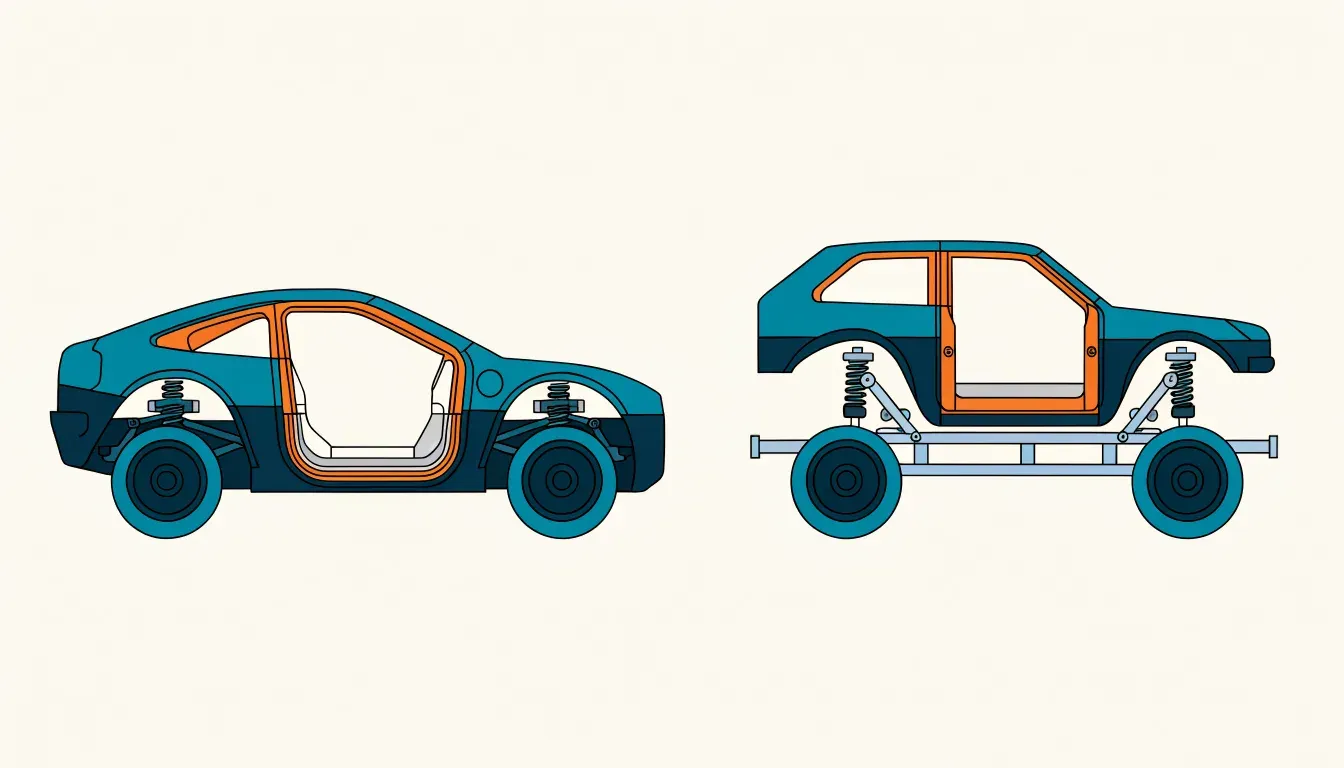
Most modern vehicles are unibody. Many pickups and SUVs still sit on a separate frame. The two are built differently, so they are measured, straightened and replaced differently after a crash. Here is what each repair involves and what to ask before you approve it.
Key takeaways
- A unibody car's body and frame are one welded structure. Repairs mean measuring it, straightening within limits, and cutting out and replacing damaged sections only where the carmaker allows.
- A body-on-frame truck or SUV has a separate, much stiffer frame under the body. It can take several pulls to straighten, and a frame damaged beyond repair can be swapped as a complete assembly.
- On either type, the carmaker's repair procedure decides what can be straightened, sectioned or must be replaced. I-CAR calls those procedures specifications, not recommendations.
- Published estimates put frame damage repair at $600 to $10,000. Ask for before-and-after measurements and the procedure the shop followed.
Unibody vs body-on-frame repair comes down to how the vehicle is built. A unibody car’s frame and body are one welded shell, so the repair is about measuring that shell and straightening, sectioning or replacing parts of it exactly where the carmaker allows. A body-on-frame truck or SUV has a separate, much stiffer steel frame with the body mounted on top, so the repair may mean heavy straightening pulls, replacing frame sections, or swapping the whole frame. Either way, the carmaker’s procedure sets the rules.
Auto Body Wilson is an independent guide, not a repair shop. Every technical claim below links to its source.
Which one do you have?
Most of what is on the road is unibody. MOTOR, the repair-data publisher, says that because of crash-energy and fuel-economy rules, “most modern vehicles are now built on a unibody frame instead of the traditional full-frame setup.” It adds that “many modern SUVs and trucks still feature a full-frame as well as some cars, along with the abundance of older models still on the road” (MOTOR).
Caliber Collision’s guide describes unibody construction this way: “The skeleton of the car’s body and frame are made as one component” (Caliber). An I-CAR article adds that most full-frame passenger vehicles “also use a unitized body structure mounted to a full frame” (FenderBender). So a pickup’s cab can be its own welded shell sitting on a separate frame.
| Unibody | Body-on-frame | |
|---|---|---|
| Typical vehicles | Most modern vehicles | Many pickups and SUVs, some cars |
| Structure | Body and frame welded into one shell | Separate frame; body bolted on top |
| Crash energy | Crumple zones built into the shell | Frame built to absorb energy, plus the body structure |
| Straightening | Within the carmaker’s limits; some steels must not be straightened | Frame is “far more rigid”; may need several pulls |
| Sectioning | Only at carmaker-marked locations | Only where the carmaker publishes a procedure |
| Last resort | Replace whole structural parts at factory seams | Replace the complete frame assembly |
How a unibody car is repaired
Measure first
Because the frame is the body, a shop cannot see unibody damage by looking under the car. I-CAR says “minor damage to one side of a vehicle may not be noticeable when visually comparing it to the other side.” Technicians use tram gauges and three-dimensional measuring systems to check set points, such as holes in the frame rails, against the carmaker’s specifications or the undamaged side (I-CAR).
Straighten only what may be straightened
Repairing unibody damage “may require straightening and aligning the unibody structure, cutting out damaged sections, and replacing them with new OEM parts,” and MOTOR says those procedures “must be performed exactly as manufacturers recommend.” Unibody crumple zones are built to collapse, which is why MOTOR calls these single-unit designs “more challenging to repair.”
Modern steels add a limit. I-CAR says that for ultra-high-strength steel rated over 600 MPa (megapascals, a measure of strength), its industry-vetted best practice is that damaged parts “should NOT be straightened,” so replacement is the only option (I-CAR).
Section or replace at the right spot
Sectioning means cutting out the damaged length of a rail or panel and welding in a new piece. MOTOR lists when sectioning is not an option and the whole part must be replaced:
- the carmaker prohibits it;
- the damage is near suspension or structural mounting points, or a compound structure;
- the damage is in a crush zone;
- the damage is near the drivetrain or engine mounts.
After structural work, MOTOR notes the shop should restore corrosion protection inside the rails.
How a body-on-frame truck or SUV is repaired
Straightening a stiff frame
The I-CAR article in FenderBender says “a frame is far more rigid than a unibody,” and with a unitized cab or body on top, the whole vehicle is stronger still. “When the frame and body are both damaged, multiple pulls may be necessary to remove the damage.” Modern frames are lighter than older ones and must still absorb crash energy, so many use hydroformed (pressure-formed tube) rails and higher-strength steel.
To decide between repair and replacement, shops use the kink vs bend rule as a guide: “if a part is kinked, it should be replaced and if it is bent, it may be repairable.” The same article warns the rule “does not always provide a definite repair vs. replace answer,” and that cutting an access window into a boxed frame rail to push out damage has “no documentation available to support” it.
Sectioning only where the carmaker allows
Carmakers sell some frame sections and brackets with their own procedures, often joined at factory seams. Where they do not, the answer is replacement. Asked about a RAM rear rail, I-CAR replied that “RAM does not have a sectioning procedure for the rear rail,” and that “if the damage extends beyond the sectioning location, entire part replacement is the only acceptable repair” (I-CAR).
Replacing the whole frame
A body-on-frame vehicle has an option a unibody car does not. “When a frame is damaged beyond repair, the frame can be replaced as a complete assembly.” The article notes a frame swap still has many mechanical steps, may need retrofitting for model-year changes, and that a recycled frame must first be inspected for damage, corrosion and earlier repairs. It also says “some states, including Texas, Louisiana, Arizona and Oregon have laws requiring branding of the vehicle title when the frame assembly is replaced.” North Carolina’s branding law, G.S. 20-71.3, has no brand that names frame replacement. Its “reconstructed vehicle” brand (G.S. 20-4.01(33)c) covers a vehicle “materially altered from original construction due to removal, addition or substitution of new or used essential parts,” so in North Carolina ask NCDMV how a frame swap will be titled. Elsewhere, ask the shop how it affects your title in your state.
A skills gap to ask about
Both MOTOR and I-CAR point out that training programs emphasized unibody repair once it became common. MOTOR says some courses give “only a passing introduction to something like fixing a rail on full-frame vehicles.” If your truck has frame damage, ask the shop how often it repairs or replaces full frames, and which carmaker procedures it will use.
Wheel alignment comes after the structure
On both types, the structure has to be right before the wheels can be. I-CAR says “the structure of the vehicle must be three-dimensionally correct before any wheel alignment can be properly performed,” and that bent suspension parts can make a car seem to align and then wear its tires unevenly later (I-CAR). See do you need an alignment after an accident?
What structural repair costs
Published estimates put frame damage repair at $600 to $10,000 (Experian, Aug 2022), and Caliber Collision’s guide gives the same $600 to $10,000 range for frame straightening. Caliber says the biggest cost factor is “the extent of the damage,” followed by the make and model. We did not find a sourced figure comparing unibody and body-on-frame repair costs, so we do not give one. For what moves the price, see frame damage repair and collision repair cost.
What to ask the shop
- Is my vehicle unibody or body-on-frame, and which structural parts are damaged?
- Will you straighten, section or replace each part, and which carmaker procedure says so?
- Will you give me printed measurements from before and after the repair?
- For a truck: is a frame section available, or does the frame need replacing? Is the replacement new or recycled?
- Will the car get a wheel alignment, scan and any calibrations after the structural work?
Hidden damage after an accident explains why the answers can change once parts come off.
What to do next
If you suspect structural damage, read is it safe to drive with frame damage? and tow the car if anything feels wrong. Get a written estimate that lists each structural operation, and ask for the measuring printouts with the final invoice. For the full sequence of steps, see the collision repair process, or start from the collision repair guide.
Frequently asked questions
Is my car unibody or body-on-frame?
Most modern vehicles are unibody. MOTOR notes that many SUVs and trucks still use a full frame, along with some cars. If you are not sure, ask the shop or check the carmaker's body repair information, which shows the structure and how it is joined.
Is unibody damage harder to repair than frame damage on a truck?
They are hard in different ways. Unibody structures have crumple zones and high-strength steels, so many parts must be sectioned or replaced rather than straightened, and only at locations the carmaker allows. A truck frame is far stiffer, according to an I-CAR article, so it can take several pulls to straighten, and some trucks have no sectioning procedure for certain rails.
Full guide: Frame Damage Repair: Cost, Safety and When It's Not Worth Fixing
Can a truck frame be replaced?
Yes. An I-CAR article in FenderBender says that when a frame is damaged beyond repair, it can be replaced as a complete assembly. The body still usually needs some straightening first. Some states, including Texas, Louisiana, Arizona and Oregon, require the title to be branded when the frame assembly is replaced, so ask how the swap will be documented.
Is it safe to drive a car with unibody damage?
Not until a shop has measured it. In a unibody car the structure is the frame, so damage to it can affect crash protection, wheel alignment and sensor aim. I-CAR notes that minor damage may not be visible by eye, which is why shops compare measurements side to side.
Full guide: Is It Safe to Drive With Frame Damage?
Sources
- North Carolina General Statutes § 20-71.3, Salvage and other vehicles: titles to be branded — accessed November 24, 2026
- North Carolina General Statutes § 20-4.01, Definitions (reconstructed and salvage vehicles) — accessed November 24, 2026
- MOTOR Information Systems, Are Your Frame Rail Repair Skills Up to Snuff? (17 May 2023) — accessed November 24, 2026
- FenderBender, Full Frames: On the Rack Again (article from I-CAR) — accessed November 24, 2026
- I-CAR Repairability Technical Support, Always follow vehicle maker procedures (7 Jul 2016) — accessed November 24, 2026
- I-CAR Repairability Technical Support, Back-To-Basics: Comparative Measuring — accessed November 24, 2026
- I-CAR Repairability Technical Support, Ask I-CAR: RAM rear rail sectioning — accessed November 24, 2026
- I-CAR Repairability Technical Support, Common Mistakes: Performing Wheel Alignments When Damage Still Exists (16 Oct 2019) — accessed November 24, 2026
- Caliber Collision, Car Frame Straightening: A Complete Guide — accessed November 24, 2026
- Experian, What's the Average Cost of an Auto Repair After an Accident? (17 Aug 2022) — accessed November 24, 2026