Frame-Off vs Frame-On Restoration: What Each Means and Which Your Car Needs
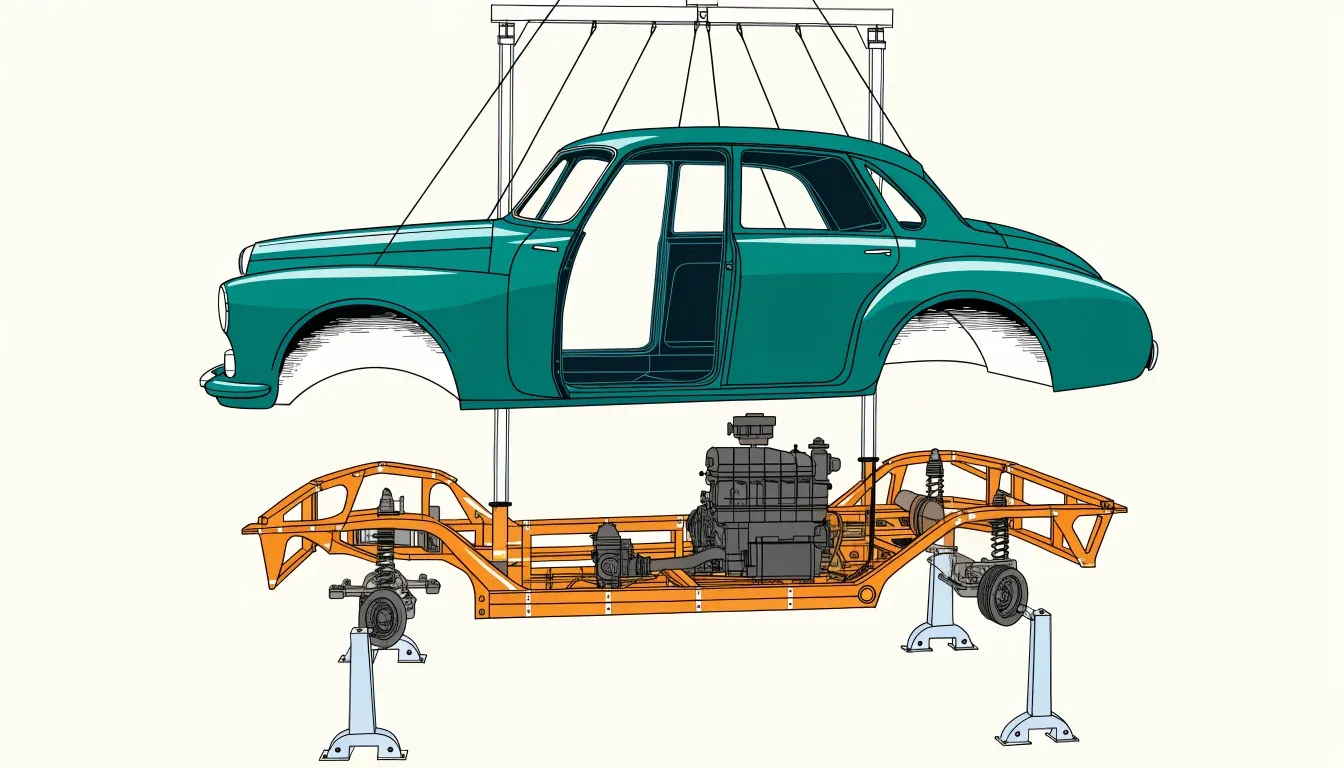
A frame-off restoration lifts the body off the chassis so every part can be stripped and refinished. Frame-on work leaves the body in place. The right choice depends on how your car is built, how much rust it hides and how good the finished car needs to be.
Key takeaways
- Frame-off, better called body-off, means lifting the body from a separate frame so both can be stripped, repaired and painted. Only body-on-frame cars and trucks can have one.
- Many classics, including the first Mustangs, are unibody cars with no separate frame. Their equivalent is a bare body shell on a rotisserie, and an ad calling one frame-off is a warning sign.
- Body-off work makes sense for a show car, or when rust or damage sits where the body meets the frame. A sound driver-quality car rarely needs it.
- The words prove nothing about quality. Ask for teardown photos of the actual car, and get the scope in writing before work starts.
A frame-off restoration means lifting the body off a car’s separate frame so the frame and the whole underside can be stripped, repaired and refinished. Frame-on work leaves the body bolted down and restores what can be reached around it. Pick frame-off for a show car or for rust where the body meets the frame. A sound car that you plan to drive rarely needs it.
There is a catch: only cars and trucks built with a separate frame can have one. Many classics are unibody cars, and the closest thing for them is a bare shell on a rotisserie. Auto Body Wilson is an independent guide. We do not restore cars. This page explains the terms so you can read ads and shop quotes with a clear head.
The terms, and why they confuse people
People use these words loosely, so define them before you compare prices.
| Term | What it usually means | What to check |
|---|---|---|
| Frame-off or body-off | Body unbolted and lifted off a separate frame. Both restored apart, then rejoined. | Photos of the bare frame and of the body on a stand or cart |
| Frame-on | Body stays on the frame. Work is done on panels, paint, interior and parts that can be reached. | What was done underneath, if anything |
| Rotisserie | A stripped body or frame turned on a rack so every side can be reached | Whether the car was stripped bare first |
| Unibody shell restoration | A car with no separate frame, stripped to its shell and usually put on a rotisserie | Rust repair photos of floors, rails and rockers |
Hagerty’s Rick Carey says “rotisserie restoration” is so broad it means nothing about quality. It can describe a car stripped to the bare frame and carefully restored. It can also describe a complete car clamped in a rack, steam-cleaned and sprayed with chassis black wherever the gun could reach. He says “body off restoration” is the clearer term, and he asks sellers to never say “frame off.”
Even “frame-up” has two meanings. Progressive uses “frame-up” as the opposite of frame-off. Corvette expert Kevin Mackay, quoted by Hagerty in 2016, uses it for a full restoration that can take 2,000 to 3,000 hours. When a shop or seller uses any of these words, ask what was actually removed and ask to see photos.
First question: does your car have a separate frame?
How the car was built decides what is possible.
- Body-on-frame. The body bolts to a separate steel frame. eBay Motors Blog notes that on most classic American cars the front sheet metal is its own assembly attached to the frame. These vehicles can have a true body-off restoration. Hagerty’s Andrew Ganz notes that a two-post lift gives mechanics enough room to separate a body-on-frame car.
- Unibody. The body and frame are one welded structure. Hagerty’s 1965–66 Mustang buyer’s guide puts it plainly: the body and frame are welded into a single component, so rust in a structural spot is the big worry. Hagerty also lists Chrysler’s compact A-body cars, such as the Plymouth Scamp, as unibody designs.
A unibody car cannot have its frame taken off. Hagerty readers made exactly this point under a Hagerty Marketplace feature on a unibody 1973 Scamp that was reported to have had a body-off restoration costing more than $120,000. “How is that possible with a unibody car?” one wrote. For a unibody car, the thorough version is to strip it to a bare shell, blast it, and mount it on a rotisserie for metal work. Hagerty describes one owner doing exactly that with a 1971 Ford Maverick.
If you are not sure which kind your car is, the owners club for your model will know.
What body-off work gets you
The main gain is access. With the body off, the frame can be cleaned, stripped, repaired, aligned, primed and painted on its own. Carey describes this as the route to a complete, show-quality restoration, after which the body is reunited with the frame.
It also finds problems. Hagerty’s cost guide warns that once the body comes off, you might find a frame that needs straightening or repair. Carey’s advice to buyers is to use a flashlight and look where frame and body meet. The hard-to-reach places should be treated as well as the easy ones.
The trade-off is time and money. Removing the body means more labor, more parts to catalog and more to put back together. No named, dated source we could check gives a clean figure for how many extra hours body-off adds over frame-on work. Ask each shop to price both ways in writing, line by line.
What it costs and how long it takes
Restoration is billed mostly by the hour. Hagerty puts the average labor charge at upwards of $70 an hour, higher for specialized work. Two top shops profiled by Hagerty charge $135 an hour (2022) and $225 an hour (2025).
Hours climb fast at the top. Colin Comer, writing in Hagerty in 2022, said the old rule for a high-end ’60s muscle car restoration was 1,000 hours plus rust repair, and that today’s standards easily double it. One concours shop he quoted spends 4,000 to 5,000 hours on a restoration. Back when the old rule applied, he notes, most customers didn’t care much about a frame-off job at all.
For a full number, a Florida restorer quoted by Farmers Insurance estimates a typical body-off restoration takes one year and costs about $100,000. The table above sets these markers side by side. Classic car restoration cost breaks down the full budget by level.
If you plan to do some of the work yourself, eBay Motors Blog puts a new auto rotisserie at $1,000 to $2,000. It also says to strip the engine, transmission, glass and loose parts first, and that convertibles may need bracing so the body doesn’t flex.
Which approach fits your car
Body-off (or a bare-shell rotisserie job for a unibody) usually makes sense when:
- You want a show or concours car, where the underside has to be as good as the top.
- Rust or damage sits on the frame, the body mounts, the floors or the rails, where you can’t fix it properly with the body on. Classic car rust and metal work covers how that repair is done.
- The frame may be bent. Hagerty lists a frame that needs straightening among the surprises of teardown. For frame damage on a newer car, see frame damage repair.
- The car is valuable enough that the best examples are pulling away from the rest. Hagerty Price Guide publisher Dave Kinney reported in 2024 that over five years, average values rose 32.4% for #1 condition cars and 33.8% for #2, but only 29.4% for #3 and 23.4% for #4.
Frame-on work usually makes sense when:
- You want a good driver, the #3 level where Hagerty says most collector cars sit.
- The frame and floors are solid, and the work is mostly paint, panels, interior and mechanical parts.
- The budget can’t carry a full teardown. Hagerty says you are highly unlikely to recover a major restoration’s cost unless the car is extremely rare.
Be honest about the level you want. In 2016, Revs Institute founder Miles Collier told Hagerty that getting a car from 90 to 95 percent is the gap between wonderful and garbage, and that the last 5 percent takes 20 to 25 percent of the effort. A restomod build often goes body-off for different reasons, since it may get a new chassis. See restomod vs restoration.
Buying a car sold as “frame-off restored”
Treat the phrase as a claim to check, not a fact.
- Ask for teardown photos of this car: the bare frame, the body off the frame, and the floors and rails before paint.
- Check whether the car is unibody. If it is, “frame-off” is the wrong word, and you need to know what was really done.
- Look underneath with a flashlight where the body meets the frame, as Carey advises.
- Ask who did the work and when. Photos and receipts also add value to the car, Kinney notes.
Insurance while the body is off
A car in pieces can still be insured. Progressive says the type of restoration, frame-off or frame-up, typically doesn’t affect insurability. What matters is showing real progress over time. Standard auto policies usually don’t offer restoration coverage, but classic car insurers do.
North Carolina readers
North Carolina’s Motor Vehicle Repair Act counts the rebuilding or restoring of rebuilt vehicles, body work and painting as repair, and it covers paint and body shops and self-employed people (G.S. 20-354.2). A shop must give you a written estimate before work over $350 unless you waive it in writing (G.S. 20-354.3). If charges will run more than 10% over the estimate, the shop must tell you, and you then authorize, change or cancel the work (G.S. 20-354.5). That matters on a body-off job, where teardown often turns up more work. The North Carolina guide covers the rest.
What to do next
- Find out whether your car is body-on-frame or unibody.
- Decide the level you want: driver, show or concours. The restoration and custom hub explains each.
- Put the car on a lift, or pay for an inspection, and look at the frame, floors and body mounts.
- Ask two or three shops that restore your model to quote both frame-on and body-off, in writing, task by task. How to choose a restoration shop has the checklist.
- Agree before work starts how the shop will handle what teardown finds.
| Scenario | Typical range (estimate) | What drives it |
|---|---|---|
| Typical body-off restoration at one Florida shop | About $100,000 and one year (restorer Mike Case, quoted by Farmers Insurance, undated, checked Nov 2026) | Single-source estimate. Rust and missing parts push it up. |
| Full-blown professional restoration | $40,000–$60,000 (Junkyard Mob, cited by GOBankingRates, Oct 2022) | Single-source estimate. Does not say whether the body comes off. |
| Restoration shop labor, per hour | Upwards of $70 (Hagerty, Apr 2022); $75–$100 (Junkyard Mob, via GOBankingRates, Oct 2022) | Top concours shops profiled by Hagerty bill $135 (2022) and $225 (2025) an hour. |
| Hours for a high-end restoration | 1,000 hours plus rust repair was the old rule for a '60s muscle car, easily doubled today; 4,000–5,000 hours at one concours shop (Hagerty, Aug 2022) | Hours, not dollars. Multiply by the shop's rate. |
| Buying an auto rotisserie for home use | $1,000–$2,000 new (eBay Motors Blog, Jun 2026) | Single-source estimate. Most are sold as kits. |
Ranges are estimates from the sources listed on this page, not quotes. Your price depends on the vehicle, the damage and local labor rates.
Frequently asked questions
What is a frame-off restoration?
It is a restoration where the body is unbolted and lifted off the car's separate frame. The frame is then stripped, repaired and refinished on its own, and the body's underside gets the same treatment before the two are put back together. Hagerty's Rick Carey says "body off restoration" is the clearer name, and asks sellers never to say "frame off." Either way, ask for photos of the work.
Can a unibody car have a frame-off restoration?
No. A unibody car has no separate frame to remove. Hagerty describes the 1965–66 Mustang's unibody as a body and frame welded into a single component. The closest equivalent is stripping the car to a bare shell and mounting it on a rotisserie for metal work and paint. If an ad claims a frame-off or body-off restoration on a unibody car, ask exactly what was done.
Is frame-off restoration worth it?
It is worth it for a show-level car, or when rust or damage sits where you cannot reach it with the body on. It is rarely worth it for a solid driver. Hagerty says you are highly unlikely to recover a major restoration's cost unless the car is very rare. Spend the extra hours only if the car or your goal calls for them.
Full guide: Classic Car Restoration Cost: Driver, Show and Concours Levels
What is a rotisserie restoration?
A rotisserie is a rack that holds a stripped body or frame and lets it turn on its long axis, so every surface can be reached. The term is loose. Hagerty's Rick Carey says a rotisserie job can be a careful bare-frame restoration or a quick clean-up, so the term says nothing about quality. Judge the car by teardown photos.
Does frame-off restoration affect insurance?
Usually not. Progressive says the type of restoration, frame-off or frame-up, typically doesn't affect whether the project can be insured. What matters is showing real progress over time, with photos, receipts and a plan. Classic car insurers offer coverage for cars under restoration that standard policies usually don't.
Sources
- Hagerty: Rotisserie Restoration, Rick Carey (28 Apr 2016) — accessed November 24, 2026
- Hagerty: Words from the wise, Paul Duchene (26 Apr 2016) — accessed November 24, 2026
- Hagerty: Your handy 1965–66 Ford Mustang buyer's guide, Sajeev Mehta (20 Jan 2021) — accessed November 24, 2026
- Hagerty: Auction Pick of the Week: 1973 Plymouth Scamp (listing and reader comments) — accessed November 24, 2026
- Hagerty: Original Owner: This 1971 Ford Maverick Is on Its Fourth Life — accessed November 24, 2026
- Hagerty: 5 Ways to Lift Your Classic Car off the Ground, Andrew Ganz (12 Mar 2025) — accessed November 24, 2026
- Hagerty: What Does It Cost to Restore My Classic Car? (22 Apr 2022) — accessed November 24, 2026
- Hagerty: Before you dive into a restoration, read this, Colin Comer (2 Aug 2022) — accessed November 24, 2026
- Hagerty: This New York Restoration Shop Lives and Breathes Mid-Century Cadillacs, Eric Weiner (23 May 2025) — accessed November 24, 2026
- Hagerty: Prices Are Widening Between the Best-Condition Cars and the Rest. Why?, Dave Kinney (28 Feb 2024) — accessed November 24, 2026
- Hagerty: How to (try to) protect against a car restoration rip-off, Dave Kinney (29 Sep 2023) — accessed November 24, 2026
- eBay Motors Blog: What Is a Rotisserie Restoration?, Mark Bach (22 Jun 2026) — accessed November 24, 2026
- eBay Motors Blog: Jump-Start Your Restoration With a Brand-New Body Shell, Mark Bach (27 Jan 2026) — accessed November 24, 2026
- Farmers Insurance: What you need to know when restoring a muscle car, John Diether (undated) — accessed November 24, 2026
- GOBankingRates via AOL: How Much Does it Cost To Restore a Classic Car? (15 Oct 2022) — accessed November 24, 2026
- Progressive: Does insurance cover classic car restoration? (updated 29 May 2025) — accessed November 24, 2026
- N.C. Gen. Stat. 20-354.2: Motor Vehicle Repair Act definitions — accessed November 24, 2026
- N.C. Gen. Stat. 20-354.3: Written motor vehicle repair estimate and disclosure statement required — accessed November 24, 2026
- N.C. Gen. Stat. 20-354.5: Notification of charges in excess of repair estimate — accessed November 24, 2026