Restomod vs Restoration: Cost, Value and Insurance Compared
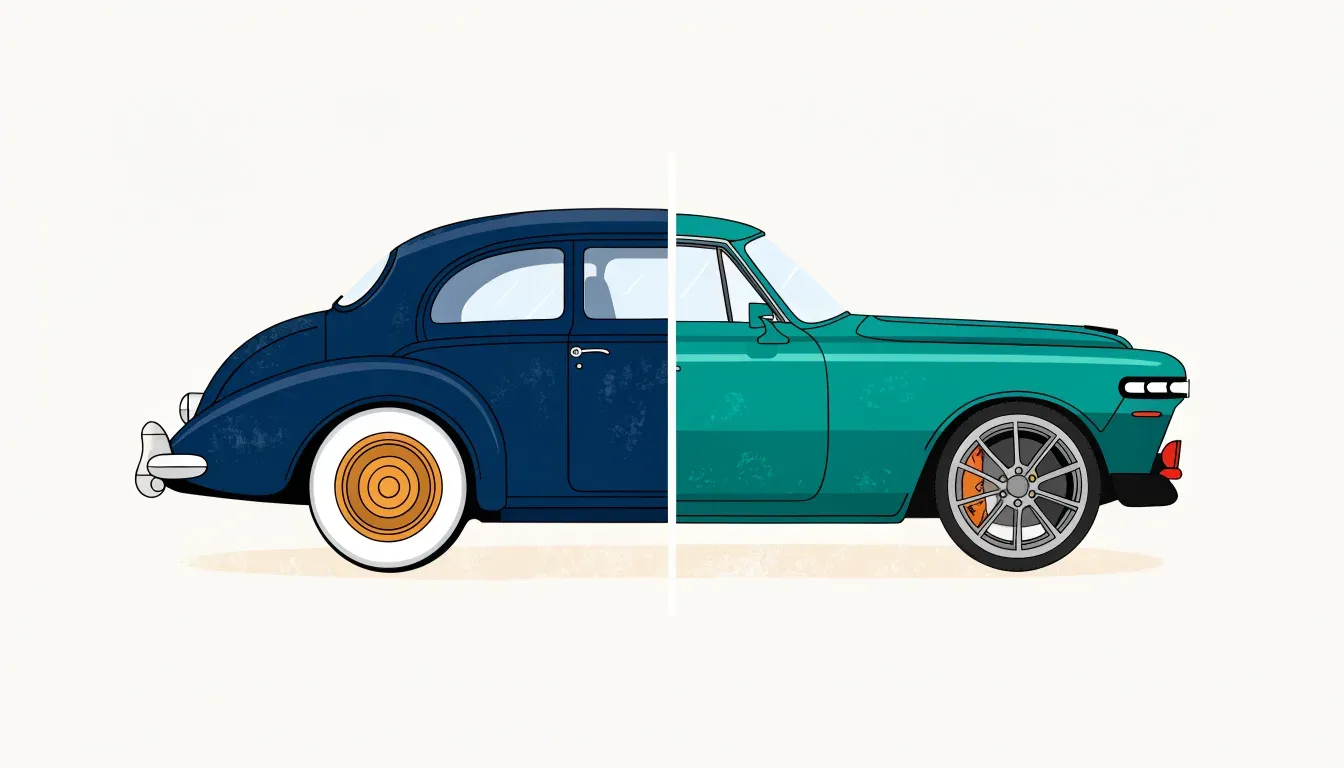
A restoration returns a classic to how it left the factory. A restomod keeps the classic look but swaps in a modern engine, brakes, suspension and comforts. Both cost more than most cars are worth, so the better choice is the car you will actually use.
Key takeaways
- Restore if originality matters to you or the car is rare, valuable or historically important. Restomod if you want to drive the car often and the car is a common model.
- At Barrett-Jackson in January 2024, Hagerty reported two custom Corvettes selling for $440,000 and $412,500, against $220,000 and $330,000 for factory-correct cars. Those were top professional builds, not typical ones.
- Neither path is an investment. Hagerty says you are highly unlikely to recoup a major restoration's cost, and the Petersen Museum's director told Hagerty that a top custom build is probably not worth what it cost.
- Insure a restomod as a modified vehicle on an agreed value, and keep build receipts and photos. Progressive says custom parts you don't tell your insurer about may not be covered.
A restoration returns a classic car to how it left the factory. A restomod keeps the classic look but adds a modern engine, brakes, suspension and comforts. Restore a car that is rare, valuable or historically important. Build a restomod from a common car you want to drive. Neither one is likely to pay back what it costs. Hagerty says you are highly unlikely to recoup a major restoration’s cost unless the car is extremely rare or famous, and top custom builds rarely sell for what they cost either.
Auto Body Wilson is an independent guide. We do not build, restore or sell cars. This page compares the two paths using Hagerty’s valuation and insurance material and other named, dated sources.
What each one is
Restoration. Progressive describes it as rebuilding a car to its original factory specifications after taking it apart, repairing or replacing parts and recreating its original look and feel. The finished car is judged on how correct it is. The restoration and custom hub explains the driver, show and concours levels.
Restomod. Hagerty’s Rick Carey, writing in February 2024, says the term was coined by the Barrett-Jackson auction team in the mid-2000s. It means a car that looks mostly stock on top, apart from a lower stance and larger modern wheels, but has completely new underpinnings: a modern drivetrain, upgraded suspension and brakes, and comforts like modern air conditioning. The goal is the performance, safety and reliability of a new car with the style of a classic. Progressive’s list of typical upgrades includes a fuel-injected engine, four-wheel disc brakes, updated suspension and better lighting.
Custom. Carey notes that older “custom cars” were wild reimaginings with little of the original car left, and that those customs have merged with the restomod category over the last two decades. For body kits and widebody work on newer cars, see custom body work.
Side by side
| Restoration | Restomod | |
|---|---|---|
| Goal | Factory-correct, original look and feel | Classic look, modern driving |
| Parts | Original, rebuilt or reproduction parts to factory spec | New engine, brakes, suspension, wiring, often a new chassis |
| Judged on | Correctness, condition, documentation | Build quality, design, builder’s name |
| Best car to start with | Rare, numbers-matching or historically important cars | Common models where originality adds little |
| How it ages | Carey says correct cars lose their edge more slowly and can be re-restored | Carey says patina is not the friend of the restomod; modern tech can date |
| Insurance | Classic or collector policy | Rated as a modified vehicle, Hagerty says |
What each one costs
Both are mostly labor. Every restoration needs the body, rust and paint work described in classic car rust and metal work. A restomod adds engineering, new parts and fitting on top.
Restoration. A Florida restorer quoted by Farmers Insurance says his typical customers spend $25,000 to $45,000 on a light restoration, and that a typical body-off job takes a year and costs about $100,000. At the very top, Colin Comer wrote in Hagerty in 2022 that labor for a true concours restoration is well into six figures and can easily exceed $500,000. Classic car restoration cost breaks this down by level.
Restomod. Fewer named, dated figures exist. A 2022 Motorious article, quoting Sean of Autotopia LA, gives these pieces for a professional build:
- Donor car: from about $10,000 for a rough classic to over $100,000 for a high-end one. The article suggests a cheaper car may make sense, since most original parts get replaced.
- Professional design: about $10,000 to $30,000.
- Engine: from $2,000 to $3,000 for a used junkyard V8 to over $30,000.
- Finished show-level builds, after thousands of hours of work: $500,000 to $1,000,000.
That top figure is for headline cars from famous shops. We could not find a named, dated source for the cost of a typical mid-level restomod, so we don’t give one. Get a written build sheet with parts and hours from any shop you consider.
What each one is worth
At the top of the market, restomods are winning. Carey reported from Barrett-Jackson Scottsdale in January 2024 that customs consistently brought more than stock cars of the same year, make and model, even ones restored to factory specs. His two Corvette examples:
- A factory-correct 1958 Corvette, an older restoration, sold for $220,000. A 1958 on a modern Art Morrison chassis with a 2023 Corvette LT1 engine sold for $440,000, double.
- A restored 1963 Z06 split-window, Bloomington Gold certified and NCRS Top Flight, sold for $330,000. A custom 1963 split-window with a supercharged LS-based engine and six-speed sold for $412,500.
Carey’s conclusion: the collector market, which long put factory-correct first, is now embracing custom creations.
But those are fresh, top-tier builds. Carey also warns that restomods age worse. Patina is not the friend of the restomod, he writes, and a 2024 touchscreen in a 1964 Corvette may look out of place in 2044. Restored cars that get worn can be re-restored and gain value again.
Building one rarely pays back. In a 2024 Hagerty piece on valuing hot rods, Petersen Automotive Museum director Terry Karges said of top-notch custom work, “Is that car worth what it cost to build after it’s done? Probably not.” He added that people who commission them usually don’t plan to sell, and that you can’t restore a car and get back what you put in, whatever the type.
Originality still drives value for important cars. Collector Miles Collier told Hagerty in 2016 not to change a car’s color, engine or transmission unless you never plan to sell it, because “original” is what creates demand. Progressive makes the other side of the case: a well-done restomod can command a higher price than a stock classic from a buyer who wants modern comforts.
Condition matters on both sides. Hagerty Price Guide publisher Dave Kinney reported in 2024 that over five years, the best cars (#1 and #2 condition) gained about 32% to 34% in value, while #4 cars gained 23.4%. He also noted paint and paint supplies can cost over 100% more than in 2015.
Insurance: where restomods differ most
Hagerty’s data shows how big the modified market is. A July 2023 Hagerty agent brief, citing Hagerty Data & Analytics from July 2021, counts about 8.6 million insurable vehicles in segments including hot rods, street rods, restomods and lowriders. It says modified-vehicle owners have a higher average total insurable value than stock-vehicle owners, $48,000 versus $35,000, and spend about twice as many hours working on their cars.
What that means for you:
- Tell your insurer before you modify. Progressive says any enhancement not made at the factory counts as a modification, and custom parts you don’t report may not be covered.
- Expect to be rated as modified. Hagerty lists “resto mod classics” with a modernized drivetrain and safety features as modified vehicles. Its agent guide says engine, suspension, drivetrain, wheel and custom body changes can all affect how a car is classified. Builds of 650 horsepower or more may face extra underwriting.
- Insure the build, not the book value. Hagerty says one of the biggest risks with modified vehicles is underinsuring the investment, since a standard policy may not account for customization and labor. It recommends an agreed (Guaranteed Value) policy.
- Keep records. Hagerty advises updated photos, build receipts, appraisals and a list of modifications.
- Cover the build while it happens. Hagerty’s Vehicle Under Construction coverage raises the car’s agreed value by 10% per quarter, up to a $25,000 increase.
How to decide
Restore if:
- The car is rare, numbers-matching, historically important or has known history.
- You care about originality, judged shows or long-term collector appeal.
- You drive it on nice days, not every week.
Build a restomod if:
- The car is a common model with plenty of parts and little premium for originality.
- You want to drive it often, in traffic, with modern brakes and air conditioning.
- You accept that you are building for yourself, not for resale.
North Carolina readers
North Carolina’s Motor Vehicle Repair Act covers modification as well as repair, including body work and painting (G.S. 20-354.2). So a restomod builder, like a restorer, must give you a written estimate before work over $350 unless you waive it in writing (G.S. 20-354.3). The North Carolina guide covers the rest.
What to do next
- Decide how you will use the car: shows and Sunday drives, or regular driving.
- Check what your car is worth stock, and whether it is rare or numbers-matching, before changing anything original.
- Ask builders for a written build sheet with parts, hours and a timeline. Use the checklist in how to choose a restoration shop.
- Call a classic car insurer before work starts and set up coverage for a car under construction.
- If the car may need its body lifted for chassis work, read frame-off vs frame-on restoration.
| Scenario | Typical range (estimate) | What drives it |
|---|---|---|
| Light (driver-quality) restoration | $25,000–$45,000 typical customer spend (restorer Mike Case, quoted by Farmers Insurance, undated, checked Nov 2026) | Single-source estimate. |
| Body-off restoration | About $100,000 and one year (Mike Case, via Farmers Insurance, undated) | Single-source estimate. |
| Concours restoration labor | Well into six figures and can exceed $500,000 (Hagerty, Aug 2022) | Single-source estimate. |
| Top-tier professional restomod, finished | $500,000–$1,000,000 (Autotopia LA, quoted by Motorious, May 2022) | Single-source estimate for headline show builds from famous shops. |
| Restomod donor car | $10,000 for a rough classic to over $100,000 for a high-end example (Motorious, May 2022) | Single-source estimate. |
| Restomod engine | $2,000–$3,000 for a used junkyard V8 to over $30,000 (Motorious, May 2022) | Single-source estimate. Installation, wiring and cooling are extra. |
| Auction result: 1958 Corvette, stock vs custom | $220,000 stock; $440,000 restomod (Barrett-Jackson Scottsdale, reported by Hagerty, Feb 2024) | One sale each. Not a price guide. |
| Auction result: 1963 Corvette split-window, stock vs custom | $330,000 stock Z06; $412,500 restomod (Barrett-Jackson Scottsdale, reported by Hagerty, Feb 2024) | One sale each. The stock car was a rare, award-winning Z06. |
Ranges are estimates from the sources listed on this page, not quotes. Your price depends on the vehicle, the damage and local labor rates.
Frequently asked questions
What is the difference between a restomod and a restoration?
A restoration rebuilds a car to its original factory specification, with the original look and feel. A restomod keeps the classic body and style but adds modern parts: Progressive lists a fuel-injected engine, four-wheel disc brakes, new wheels and tires, updated suspension and better lighting. Hagerty's Rick Carey describes completely new underpinnings plus comforts like modern air conditioning.
Are restomods worth more than original cars?
Sometimes, at the very top. Hagerty reported custom Corvettes outselling factory-correct ones at Barrett-Jackson in 2024, one by double. But those were fresh builds from noted builders. Hagerty's Rick Carey warns that modern parts date, and that a 2024 touchscreen may look out of place in 2044. For rare or historic cars, originality still drives value.
Does a restomod hurt resale value?
It can. Collector Miles Collier told Hagerty in 2016 not to change a car's color, engine or transmission unless you will never sell it, because originality creates demand. Progressive notes that matching numbers, a sign the car has its original parts, raise a classic's value, so modifying a rare, numbers-matching car gives that up. On a common model that is not worth much stock, a well-built restomod can sell for more to a buyer who wants a usable classic.
How do I insure a restomod?
Tell your insurer about every modification. Progressive says custom parts you don't report may not be covered. Classic insurers such as Hagerty rate restomods as modified vehicles and offer agreed-value coverage. Hagerty advises keeping photos, build receipts, appraisals and a list of modifications, and warns that underinsuring the build is one of the biggest risks.
Is it cheaper to build a restomod or restore a car?
Neither is cheap, and the answer depends on the car and the level. A driver-quality restoration can start around $25,000 at one Florida shop quoted by Farmers Insurance. A Motorious article put top professional restomod builds at $500,000 to $1,000,000. A restomod adds new parts and engineering on top of the body and paint work every restoration needs.
Full guide: Classic Car Restoration Cost: Driver, Show and Concours Levels
Sources
- Hagerty: For These Corvettes, the Stock vs. Modified Debate Has a Clear Winner, Rick Carey (9 Feb 2024) — accessed November 24, 2026
- Hagerty: Why Hot Rods Are So Difficult to Value, Brandan Gillogly (9 May 2024) — accessed November 24, 2026
- Hagerty: Prices Are Widening Between the Best-Condition Cars and the Rest. Why?, Dave Kinney (28 Feb 2024) — accessed November 24, 2026
- Hagerty: Words from the wise, Paul Duchene (26 Apr 2016) — accessed November 24, 2026
- Hagerty: What Does It Cost to Restore My Classic Car? (22 Apr 2022) — accessed November 24, 2026
- Hagerty: Before you dive into a restoration, read this, Colin Comer (2 Aug 2022) — accessed November 24, 2026
- Hagerty Agents: The Modified Vehicle Market: What Agents Should Know (17 Jul 2023) — accessed November 24, 2026
- Hagerty Agents: How to Quote Modified Vehicles with Confidence (12 May 2026) — accessed November 24, 2026
- Hagerty: Modified vehicle insurance (insurance product page) — accessed November 24, 2026
- Progressive: How to modernize your classic car (updated 29 Jan 2026) — accessed November 24, 2026
- Progressive: How to find your classic car's value (updated 21 Aug 2025) — accessed November 24, 2026
- Progressive: Does insurance cover modified cars? (updated 15 Aug 2023) — accessed November 24, 2026
- Motorious: How Much Does It Really Cost To Build A Restomod?, Elizabeth Puckett (21 May 2022) — accessed November 24, 2026
- Farmers Insurance: What you need to know when restoring a muscle car, John Diether (undated) — accessed November 24, 2026
- N.C. Gen. Stat. 20-354.2: Motor Vehicle Repair Act definitions — accessed November 24, 2026
- N.C. Gen. Stat. 20-354.3: Written motor vehicle repair estimate and disclosure statement required — accessed November 24, 2026