Classic Car Rust Repair and Metal Fabrication: Patch, Panel or Replace
Rust is the main reason restoration budgets grow. The fix depends on how far it has spread: a welded patch for a small hole, a full panel when the rot is wide, hand-made metal when no panel exists, and sometimes a new body shell. This guide explains each and how to judge the work.
Key takeaways
- Patch when the rust is confined to a small area and the metal around it is sound. Replace the whole panel when you would need more than a few patches on it, and always consider it for floors.
- Rust has to be cut out and replaced with new steel. Filler over rust comes back. A good patch is butt-welded, ground flush and needs only a skim of filler.
- Where no reproduction panel exists, a metal fabricator can make one. For badly rotted popular models, complete new body shells are sold, but they still need dozens of hours of fitting.
- Rust in a unibody car's rails, floors or rockers is structural. Hagerty's condition guide says a car rusted through in all of those places is rarely worth restoring unless it is very rare.
Classic car rust repair comes down to how far the rust has spread. A small hole in otherwise sound metal gets a welded patch. A panel with rust in several places, or a rotted floor, gets a full replacement panel. When no new panel exists, a fabricator makes one. For a popular model rotted almost everywhere, a complete new body shell can make more sense than fixing the old one. In every case, the rust is cut out and replaced with steel, not covered with filler.
Auto Body Wilson is an independent guide. We do not repair or restore cars. This page explains the options so you can judge a quote or a car for sale. For rust on an everyday car, see car rust repair cost.
How bad is it? Grade the rust first
Hagerty’s vehicle condition guide calls rust the most important factor in an old car’s final value, and it grades rust in five steps:
| Grade | What Hagerty describes | What it usually means for repair |
|---|---|---|
| Light | Body intact and sound, surface rust where paint has faded, maybe light pitting around the glass | Strip, treat, prime and paint |
| Moderate | Frame and subframes good. Small rust-through holes, usually in the front floor and wheel wells | Minimal metal replacement |
| Serious | Surface rust on the frame but not weakened. Rust-through in wheel wells and floors | Restorable, but the metal work will be costly |
| Severe | Frame and body heavily encrusted. Holes in floors, fender wells, door sills and rockers | Not economically restorable unless the car is extremely rare |
| None | No rust anywhere | If a car sold as rust-free has any, Hagerty says walk away |
Rust hides. Classic Industries notes that paint, trim, vinyl, trunk liners and carpet can all cover it, so the only clear look comes from taking those parts off. Hagerty’s inspection guide suggests a magnet: if it sticks at different strengths across a steel panel, there may be filler over rust or old damage. Look under the car too, even without a lift.
Know where your model rots. Hagerty’s 1965–66 Mustang guide, for example, lists the floors, frame rails, lower doors, trunk lid, cowl, rear window area, under the battery and the lower shock towers. On a flood car, Hagerty says fresh flash rust or deposits of dirt and silt are signs of serious damage. Surface, scale and penetrating rust explains the stages in plain terms.
Option 1: Patch panels
A patch replaces only the rotted section of a panel. Classic Industries says patches suit rust that is confined to small areas where water and road salt collect, with most of the original metal around it still intact. Lower quarter-panel patches are its example: on a big car, a full quarter can be very long and costly, while the rust often sits only around the wheel arch.
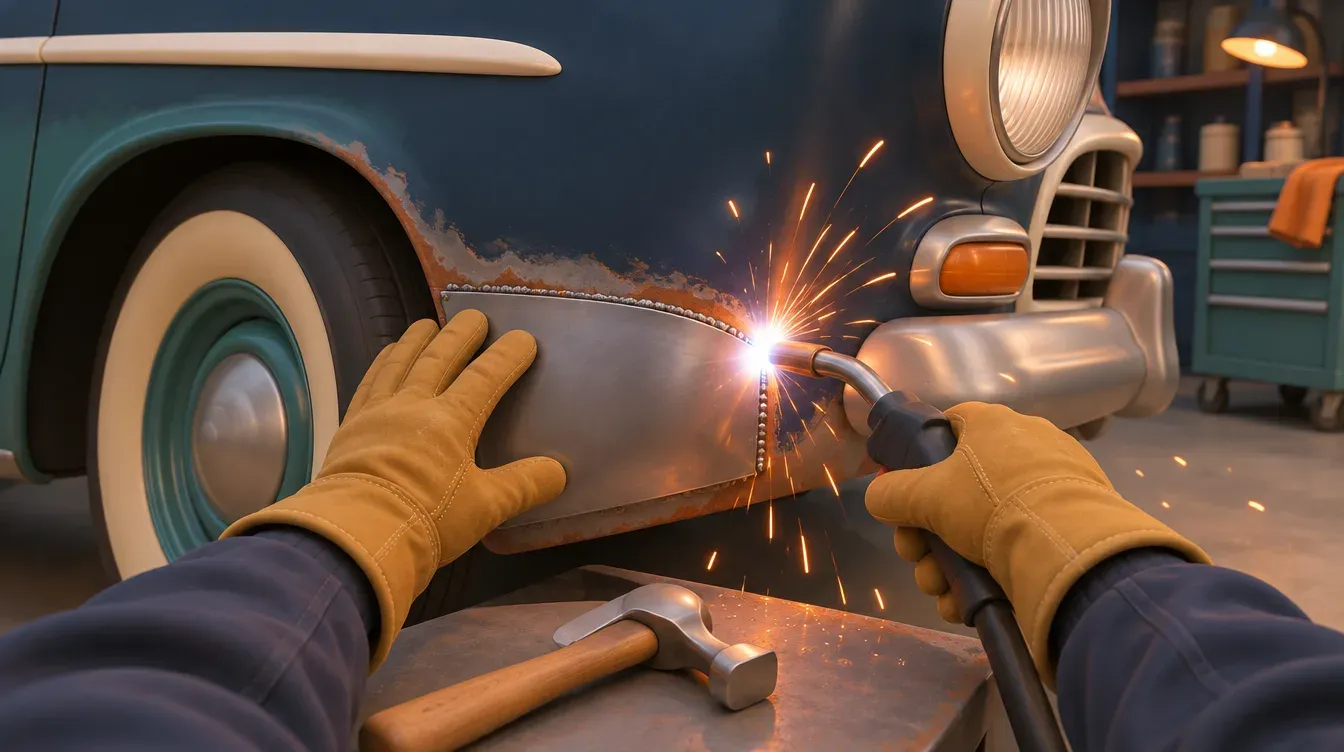
Patches come two ways. Reproduction patch panels are sold for many popular classics. Where none exists, a metal worker makes one. Ron Covell, owner of Covell Creative Metalworking, writing for welding maker Miller Electric in 2025, notes that vintage cars usually rust on the lower edges of panels, where water collects, and that patches can be made with standard metalworking methods when no aftermarket panel is available.
What a well-done patch looks like, from Covell’s step-by-step:
- The rotted metal is cut away and the new patch is clamped over the opening.
- The old panel is marked along the patch edge and trimmed on that line, so the two pieces meet edge to edge.
- The pieces are joined with a butt weld. Covell says this is preferred because an overlapped seam can trap moisture and cause more rust later, and because metal of one thickness is easier to straighten.
- The seam is tacked no more than an inch apart, then stitched closed in short bursts with cooling in between, to limit warping.
- The weld is ground down, low spots are raised with a hammer and dolly, and the area is sanded smooth.
- A little filler may cover small imperfections before primer. Covell says a repair done this way should last decades.
Ask a shop how it joins patches. If the answer is overlapping the new metal and filling the step, ask why.
Option 2: Replace the whole panel
Patches stop making sense once there are too many. Classic Industries says that if you would need more than a few patches on one panel, it may be easier to replace the whole piece. It singles out floors: they take more water, road debris and salt than almost any other part of the body, and a patched floor soon looks like a jigsaw puzzle. A full new pan is stronger and lasts longer.
Reproduction panels need fitting. Classic Industries notes that classic cars were largely hand-assembled to looser tolerances than modern cars, so every panel should be test-fitted before paint. That may mean stretching mounting holes or adding shims. Small scratches or dents in new sheet metal are normal and get fixed in the filler and primer stage. Kevin Mackay gives the same advice in Hagerty: fit hoods, moldings, door handles and bumpers two or three times before the car is painted, because the paint job depends on the body work.
Option 3: Fabricate new metal
When a panel isn’t made, or a shape is too complex for a patch, the metal has to be formed by hand. Hand-forming metal takes skill and time. Hagerty notes that a popular body style with lots of aftermarket parts can cost less to restore than a rare import. Ask to see a fabricator’s earlier work on cars like yours, and ask how the hours will be estimated.
Option 4: A new body shell
For some popular American cars, and a few imports, you can buy a complete new steel body. eBay Motors Blog reported in January 2026 that these shells are built from licensed original designs, usually run from the firewall to the taillight panel, and are sold unpainted with a protective primer. Most vendors have a waitlist, and delivery can take up to nine months.
A new shell is not bolt-on. The co-owner of one shell maker told eBay Motors Blog that buyers should plan on 60 to 80 hours of fitting and body work for a high-quality result, before any trim and glass go back in. If your car’s identity and originality matter to its value, talk to an appraiser before replacing the body. Restomod vs restoration covers how originality affects value.
Structural rust is a safety question first
On a unibody car, the body is the frame. Hagerty’s Mustang guide says the biggest concern is rust in a structural spot. Rot in frame rails, floors, rockers or shock towers is not cosmetic. It decides whether the car is safe and whether it is worth saving.
On a body-on-frame car, check the frame and the body mounts. Hagerty’s cost guide warns that frames sometimes need straightening once the body comes off. Reaching rust where the body sits on the frame may mean lifting the body off. Frame-off vs frame-on restoration explains when that is worth it.
Protect the repair
New metal rusts too if it isn’t sealed. I-CAR says repairs disturb a car’s corrosion protection and create hot spots that will rust if left untreated. Carmaker repair specifications generally call for seam sealer, adhesives, foam fillers and cavity waxes.
For long-term care, Hagerty’s Benjamin Preston wrote in 2015 that rubberized undercoating can cause trouble if it has gaps, since cracks can hide rust until it becomes a hole. He found many people recommend a wax or oil-based spray instead, sprayed into tight corners every year so it drips down inside doors and panels.
What drives the cost
Rust repair is labor-heavy, so hours and the shop’s rate set the bill. Hagerty puts restoration labor at upwards of $70 an hour. GOBankingRates, citing Junkyard Mob, gave $75 to $100 in 2022. eBay Motors Blog said in 2026 that quality shops charge over $200 an hour for major body work. The table above sets these side by side.
Scale matters too. Colin Comer, writing in Sports Car Market in 2008, budgeted at least 600 hours of body and paint for a concours car that needed no significant metal work. Rust repair comes on top of that. Hagerty columnist Comer later wrote that the old rule for a high-end muscle car was 1,000 hours of labor plus any rust repair.
What moves your price:
- How many panels have holes, and whether rust reaches the structure.
- Whether reproduction panels exist for your car or metal has to be made.
- Whether the body has to come off to reach the rot.
- The finish level. A show car needs invisible seams; a driver may not.
We could not find a named, dated source that prices individual classic car jobs such as floor pans or quarter panels. Get an itemized estimate that lists each area, the panel or patch used and the hours.
North Carolina readers
North Carolina’s Motor Vehicle Repair Act counts body work, painting and the restoring of rebuilt vehicles as repair, and it covers paint and body shops and self-employed people (G.S. 20-354.2). A shop must give you a written estimate before work over $350 unless you waive it in writing (G.S. 20-354.3). Rust jobs often grow once the metal is opened. If the charges will run more than 10% over the estimate, the shop must tell you, and you then authorize, change or cancel the work (G.S. 20-354.5). The North Carolina guide has more.
What to do next
- Strip trim and carpet from the worst areas, or pay for an inspection on a lift, and grade the rust using the table above.
- Find out which panels are reproduced for your model. Your owners club will know.
- Ask two or three restoration shops for an itemized estimate: each area, patch or full panel, butt-welded or not, and the corrosion protection afterward. How to choose a restoration shop has the vetting checklist.
- Ask to see photos of the bare metal before any filler or primer goes on.
- Check the full budget in classic car restoration cost, and see the restoration and custom hub for the rest of the project.
| Scenario | Typical range (estimate) | What drives it |
|---|---|---|
| Restoration or body shop labor, per hour | Upwards of $70 (Hagerty, Apr 2022); $75–$100 (Junkyard Mob, via GOBankingRates, Oct 2022); over $200 at quality shops for major body work (eBay Motors Blog, Jan 2026) | The sources disagree widely. Ask every shop for its rate and how it estimates hours. |
| Perforated wheel arch or lower panel, cut out and patched | $800–$2,500 (ThePricer, Jul 2026; single-source estimate) | Daily-driver figure. |
| Rocker or cab-corner replacement | $1,500–$5,000+ per side (ThePricer, Jul 2026; single-source estimate) | Daily-driver figure. Inner reinforcements are often rusted too. |
| Complete body panel replacement | $1,500–$4,000+ (ThePricer, Jul 2026; single-source estimate) | Daily-driver figure. Part, fitting, joining, paint and blending. |
| Frame or unibody rust repair | $2,500–$10,000+ (ThePricer, Jul 2026; single-source estimate) | Daily-driver figure. Some vehicles are not worth or safe to repair. |
| Fitting and body work on a new reproduction body shell | 60–80 hours (Real Deal Steel co-owner, quoted by eBay Motors Blog, Jan 2026) | Single-source estimate. Hours only; multiply by the shop's rate. The shell itself is extra. |
The rows marked 'daily-driver figure' come from a cost guide written for everyday cars, not show restorations. Classic and show work usually takes more hours.
Frequently asked questions
Should I patch rust or replace the whole panel on a classic car?
Patch when the rust is limited to one or two small areas and the metal around them is solid, such as the lower edge of a fender or quarter. Classic Industries says that if you would need more than a few patches on one panel, replacing the whole piece may be easier. Floors are the usual case where a full new pan beats a patchwork.
Can you just use body filler over rust?
No. Corvette restorer Kevin Mackay told Hagerty that with metal you must cut out the rust, and that putting filler over rust is a big mistake because the rust comes back. The rusted metal has to be removed and replaced with new steel. A thin skim of filler over a properly welded repair is normal.
How much does classic car rust repair cost?
It is mostly labor, so it depends on the hours and the rate. Hagerty puts restoration labor at upwards of $70 an hour, and one 2026 article says quality shops charge over $200 an hour for major body work. ThePricer's July 2026 guide for everyday cars puts a perforated lower panel at $800 to $2,500 and a rocker at $1,500 to $5,000 or more per side.
Full guide: Car Rust Repair Cost: Surface Rust to Rot
Is a car with frame rust worth restoring?
Only sometimes. Hagerty's condition guide says a car with rust-through in its floors, fender wells, door sills and rockers, and a heavily encrusted frame, is not economically restorable unless it is extremely rare. Surface rust on a frame that is not structurally weakened is a different story. Get an inspection on a lift before you buy or commit.
Full guide: Classic Car Restoration Cost: Driver, Show and Concours Levels
What is a reproduction body shell?
It is a complete new steel body, usually from the firewall to the taillight panel, built from licensed original designs for popular classics. eBay Motors Blog says most are made overseas, sold unpainted in a protective primer, and can have a waitlist of up to nine months. One maker says to plan on 60 to 80 hours of fitting and body work.
Sources
- Hagerty: Vehicle Condition And Relative Value Guide, The Second Chance Garage (17 Oct 2004) — accessed November 24, 2026
- Hagerty: Collector Vehicle Inspection Basics (pocket appraisal guide, undated PDF) — accessed November 24, 2026
- Hagerty: Your handy 1965–66 Ford Mustang buyer's guide, Sajeev Mehta (20 Jan 2021) — accessed November 24, 2026
- Hagerty: Things to consider when buying a storm-damaged classic car, Carl Heideman (15 Nov 2012) — accessed November 24, 2026
- Hagerty: Words from the wise, Paul Duchene (26 Apr 2016) — accessed November 24, 2026
- Hagerty: The Endless Quest for Effective Rust Prevention, Benjamin Preston (3 Mar 2015) — accessed November 24, 2026
- Hagerty: What Does It Cost to Restore My Classic Car? (22 Apr 2022) — accessed November 24, 2026
- Hagerty: Before you dive into a restoration, read this, Colin Comer (2 Aug 2022) — accessed November 24, 2026
- Sports Car Market: Restoration 101, Colin Comer (1 Dec 2008) — accessed November 24, 2026
- Miller Electric: How to MIG and TIG Weld Auto Body Sheet Metal, Ron Covell (30 Apr 2025) — accessed November 24, 2026
- Classic Industries: An Introduction to Car Rust Repair & Auto Body Panels (updated 13 Jun 2023) — accessed November 24, 2026
- eBay Motors Blog: Jump-Start Your Restoration With a Brand-New Body Shell, Mark Bach (27 Jan 2026) — accessed November 24, 2026
- eBay Motors Blog: What Is a Rotisserie Restoration?, Mark Bach (22 Jun 2026) — accessed November 24, 2026
- I-CAR: Corrosion Protection Guidelines (1 Aug 2018) — accessed November 24, 2026
- ThePricer: How Much Does Car Rust Repair Cost? (updated 22 Jul 2026) — accessed November 24, 2026
- GOBankingRates via AOL: How Much Does it Cost To Restore a Classic Car? (15 Oct 2022) — accessed November 24, 2026
- N.C. Gen. Stat. 20-354.2: Motor Vehicle Repair Act definitions — accessed November 24, 2026
- N.C. Gen. Stat. 20-354.3: Written motor vehicle repair estimate and disclosure statement required — accessed November 24, 2026
- N.C. Gen. Stat. 20-354.5: Notification of charges in excess of repair estimate — accessed November 24, 2026