Surface, Scale and Penetrating Rust: How Bad Is the Rust on Your Car?
Car rust comes in three stages: surface, scale and penetrating. How to tell which one you have, where it is dangerous, and what each takes to fix.
Key takeaways
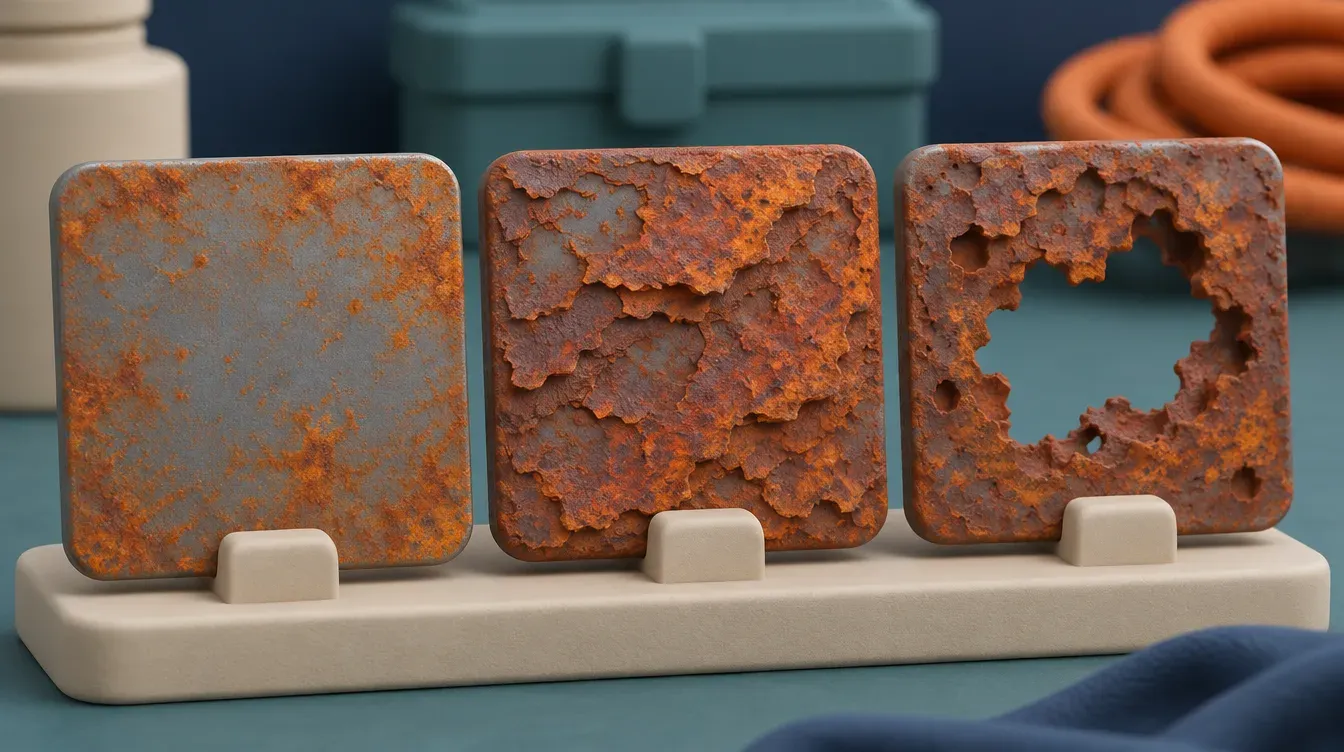
- Surface rust sits on top of solid metal and can be sanded and painted. Scale rust has eaten through the paint and coating. Penetrating rust has made holes in the metal.
- Each stage is more expensive than the last. ThePricer's 2026 guide puts small surface spots at $100–$400 and structural rust at $2,500–$10,000+.
- Bubbling paint is a warning sign: the rust may be bigger underneath than it looks.
- Rust on frame rails, subframes, floors, rockers or suspension mounts is a safety issue. Rust is not usually covered by car insurance.
There are three types of car rust: surface rust, scale rust and penetrating rust. Progressive describes them as stages that “get more severe over time.” Surface rust sits on top of solid metal and can be sanded and painted. Scale rust has eaten through the paint and coating to bare metal. Penetrating rust has eaten through the metal itself, leaving holes or a weakened structure.
Knowing which one you have tells you two things: whether the car is safe to drive, and roughly what the repair will involve. Auto Body Wilson is an independent guide, not a repair shop.
The three stages at a glance
| Stage | What it looks like | Metal | Typical fix |
|---|---|---|---|
| Surface rust | Reddish-brown film in a chip, scratch or edge | Still solid | Sand to clean metal, prime, paint |
| Scale rust | Bubbling or flaking paint | Bare and corroding | Strip, treat, often patch, refinish |
| Penetrating rust | Holes, or pinholes once sanded | Gone in places | Cut out and weld in new metal |
Descriptions follow Progressive’s definitions and The Drive’s 2022 and 2023 guides.
Surface rust
Progressive says surface rust “is often found in scratches on your car, and you can easily fix it.” It usually starts where a stone chip, scratch or damaged edge leaves steel exposed, ThePricer’s 2026 guide notes.
The Drive’s 2022 guide is reassuring here: “Even if a part has surface rust, the metal underneath still has the vast majority of its integrity. Some sandpaper and paint would be adequate” to stop it.
How to tell: the rust is a thin film in a chip, a scratch or along a trim edge. The paint around it is flat, not raised. Once sanded, solid metal remains, as Stacker’s 2026 guide puts it.
What it takes: sand to bare metal, feather the paint edges, prime, color and clear. The Drive’s step-by-step guide uses 40-grit to strip, finer grits to feather, then epoxy primer before the color coats. A small professional repair runs $100–$400 (ThePricer, 2026) or $150–$500 per area (AAA). See car scratch repair cost if the rust started in a scratch.
Scale rust
Progressive calls scale rust “the evolution of surface rust.” Left alone, surface rust “can eat through a vehicle’s paint and surface coating and leave the bare metal underneath exposed.” The Drive groups it with surface rust as “non-penetrating” rust you can still fix without cutting tools.
How to tell: the paint bubbles or blisters, or flakes away from bare, rusting metal. ThePricer calls bubbling paint “a stronger warning,” because the rust may be growing from the back of a seam or inside a cavity, pushing outward under paint that looks mostly fine. It says a quarter-size bubble “may hide corrosion along a door seam, behind a wheel-arch liner, or inside a rocker panel.”
What it takes: strip the bubbled area to see how far the rust goes, remove it to clean metal, treat and prime, and refinish. If sanding exposes pinholes, it has become penetrating rust. ThePricer puts bubbling or perforated rust at $400–$1,500 per panel area.
This is the stage to act on. Progressive notes that surface and scale rust “are relatively easy fixes.” Waiting turns them into the next stage.
Penetrating rust
Progressive says penetrating rust “eats through the metal of the car and can leave holes or even compromise the structural integrity of the vehicle. It’s the most expensive type of rust damage to repair and the most dangerous.”
How to tell: you can see holes, or sanding a bubble turns up pinholes or “a much larger weak area,” as ThePricer puts it. The Drive says “metal pieces that have rust holes, or intense loss of metal, have seriously lost their structural integrity.”
What it takes: the rusted metal is cut out and new metal welded in, or the whole panel replaced. ThePricer puts cutting, welding, refinishing and corrosion protection at $1,500–$5,000 or more per repair. It also warns: “Body filler does not replace missing structural metal.” A filler patch over a hole hides the problem for a while. It does not fix it.
A proper repair also restores the corrosion protection the factory put there. I-CAR notes carmaker specs “generally include seam sealer, adhesives, foam fillers, and cavity waxes,” and that “failure to follow corrosion protection guidelines can lead to the premature failure of a repair.”
Where the rust is matters more than how big it is
A large rusty patch on a fender is cosmetic. A small hole in a frame rail is not. The Drive says “a rusty frame, subframe, or unibody with severely compromised metal isn’t safe to drive,” and lists the key places to check:
- Rocker panels and sills
- Strut towers
- Lower control arms
- Springs
- Floorboards
- Windshield frames
- Subframes and frames
AAA’s 2017 de-icer study adds that rust can cause “serious and dangerous damage to a vehicle’s brakes, fuel tank, and exhaust systems.” AAA urges drivers to pull off the road and have the car towed if they see brake or other critical warning lights, feel a “spongey” brake pedal, or smell fuel.
ThePricer puts structural rust repair on a frame rail, subframe, suspension mount or floor at $2,500–$10,000 or more. On an older car, that can pass what the car is worth. The Drive notes that for a “not-so-special car, the cost of labor and materials often isn’t worth the trouble.” Rocker panels, one of the most common structural rust spots, get their own guide: rocker panel rust repair.
What speeds rust up
Rust is steel reacting with oxygen and water. Progressive says it is worst with water, snow and salt, especially where roads are salted or near the ocean. AAA’s 2017 study estimated salt-related rust cost U.S. drivers more than $3 billion a year, with an average repair of $490.
AAA’s prevention list is practical:
- Touch up paint chips and scratches where bare metal shows.
- Wash the whole car often, including the underside, with a car detergent, not dish soap.
- Wax the paint.
- Give the underside one last cleaning in spring.
Insurance and warranty
Progressive says rust “is not typically covered by car insurance because rust is usually due to negligence over time,” and that insurance does not typically cover frame damage caused by rust. If a scratch from a covered crash later rusts, the rust is not covered either, so repair covered damage promptly.
Carmaker warranties can help with rust-through. Toyota, for example, covers “corrosion perforation of sheet metal” for 60 months with unlimited miles. Surface rust and stone-chip rust are usually outside that kind of coverage, ThePricer notes, so report bubbling early and ask the dealer which warranty clause applies.
What to do next
Wash the car, then look closely at the lower doors, wheel arches, rocker panels and anywhere paint is chipped. Under the car, look at the frame rails, floor and suspension mounts with a flashlight. If you find surface rust on a body panel, fix it now while it is cheap. If you find bubbling, get it stripped and assessed before it spreads. If you find holes in anything structural, or any of AAA’s warning signs, have the car inspected before you keep driving it. Prices for each stage are in car rust repair cost, and other body damage starts at the body damage guide.
| Scenario | Typical range (estimate) | What drives it |
|---|---|---|
| Surface rust, small spot, metal solid | $100–$400 (ThePricer, Jul 2026); $150–$500 per affected area (AAA, undated) | Sand, prime, paint, clear |
| Surface rust, DIY materials | $50–$200 (Stacker, Apr 2026); $50–$250 (ThePricer, Jul 2026) | Only on solid, non-structural metal |
| Scale or bubbling rust, one panel area | $400–$1,500 per area (ThePricer, Jul 2026; single-source estimate) | Often bigger once stripped |
| Penetrating rust needing cutting and welding | $1,500–$5,000+ (ThePricer, Jul 2026; single-source estimate) | New metal, seam sealer, cavity wax, paint |
| Structural rust: frame, subframe, unibody | $2,500–$10,000+ (ThePricer, Jul 2026; single-source estimate) | Get an inspection before driving far |
Ranges are estimates from the sources listed on this page, not quotes. Your price depends on the vehicle, the damage and local labor rates.
Frequently asked questions
What are the three types of car rust?
Surface rust, scale rust and penetrating rust. Progressive describes them as stages that "get more severe over time." Surface rust is a thin layer, often in a scratch or chip, over metal that is still solid. Scale rust has eaten through the paint and coating to bare metal. Penetrating rust eats through the metal itself and can leave holes or weaken the structure.
Can surface rust be fixed at home?
Often, if it is small and on a body panel rather than the structure. The Drive's guide sands the area to bare metal, feathers the paint edges, then applies epoxy primer, primer, color and clear. Stacker puts DIY materials at $50 to $200. Leave anything with holes, bubbling seams or rust on the frame, floor or suspension to a professional.
Full guide: Car Rust Repair Cost: Surface Rust to Rot
How do I know if rust has made my car unsafe?
Look at where it is, not how it looks. The Drive says a frame, subframe or unibody with severely compromised metal is not safe to drive, and lists rockers, strut towers, control arms, springs, floors and frames as the places to check. AAA says to tow the car if a brake warning light comes on, the brake pedal feels spongy, or you smell fuel.
Does insurance cover rust repair?
Usually not. Progressive says rust is not typically covered because it is treated as wear and tear or negligence, and that includes frame damage caused by rust. Some carmakers' warranties cover rust that eats through sheet metal for a set time. Toyota's, for example, covers corrosion perforation for 60 months with unlimited miles.
Full guide: File a Claim or Pay Out of Pocket? How to Decide
Sources
- Progressive Answers, "Does car insurance cover rust damage?" (updated Dec 14, 2023) — accessed November 24, 2026
- The Drive, "When Is a Car Too Rusty?" (Sep 1, 2022) — accessed November 24, 2026
- The Drive, "How to Remove Light Surface Rust From Your Car" (updated Feb 23, 2023) — accessed November 24, 2026
- ThePricer, "How Much Does Car Rust Repair Cost?" (updated Jul 22, 2026) — accessed November 24, 2026
- AAA Automotive, "How Much Does It Cost To Paint a Car?" (undated) — accessed November 24, 2026
- AAA, "Road De-icers and Rust Damage" fact sheet (Feb 2017) — accessed November 24, 2026
- Stacker / RealTruck, "How to fix rust on a car" (Apr 28, 2026) — accessed November 24, 2026
- I-CAR RTS, "Corrosion Protection Guidelines: Mercedes-Benz" — accessed November 24, 2026
- Toyota, Owners warranty page (rust-through coverage) — accessed November 24, 2026