Car Scratch Repair Cost by Scratch Depth
How deep the scratch goes decides the repair and the price. Here are sourced, dated costs for clear coat, color coat, primer and bare-metal scratches, and when polishing, touch-up or a refinish is the right call.
Key takeaways
- A clear-coat-only scratch costs $150–$300 at a shop, a scratch into the color coat $400–$1,000, and one down to primer or bare metal $800–$1,500, per panel (ValuePenguin, Jun 2026).
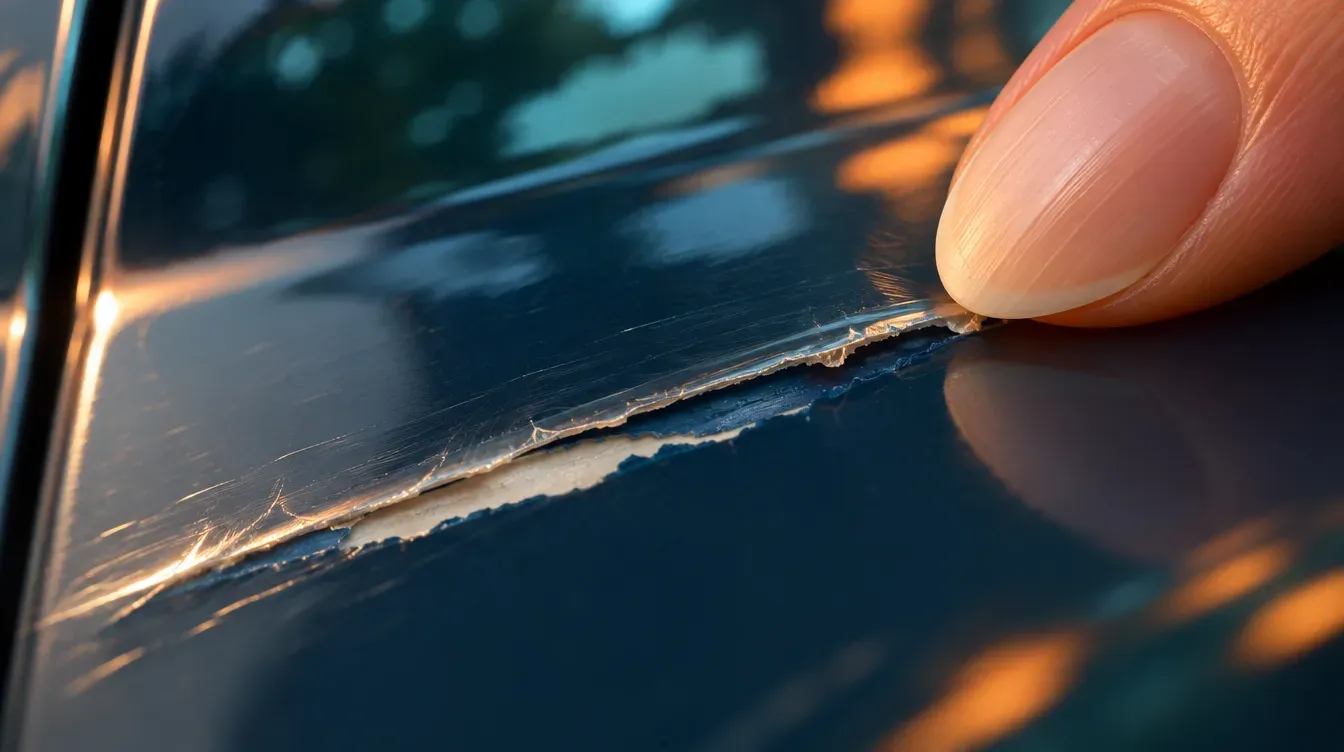
- Use the fingernail test. If you can barely feel the scratch and see no color change, it is probably in the clear coat and may polish out.
- Scratches that cross two or more panels cost much more, because each panel is refinished and the color is blended.
- Fix anything down to bare metal soon. Exposed steel rusts, and rust repair costs more than scratch repair.
Cost by scenario
| Scenario | Typical range (estimate) | What drives it |
|---|---|---|
| Clear coat only, polished out at a shop | $150–$300 (ValuePenguin, Jun 2026; single-source estimate) | Single panel; often fixable at home with a scratch remover (about $20, Synchrony, Feb 2026) |
| Through the clear coat into the color coat | $400–$1,000 (ValuePenguin, Jun 2026; single-source estimate) | Single panel; a DIY repair kit costs about $30 (Synchrony, Feb 2026) |
| Down to primer, bare metal or plastic | $800–$1,500 (ValuePenguin, Jun 2026); $150–$300 for deep scratches that need filling and sanding before a repaint (AAA, undated) | AAA's figure is for prep work ahead of a paint job, not a stand-alone refinish |
| Scratches on a bumper cover | $50–$600 (Lemonade, Aug 2025; single-source estimate) | Low end is a touch-up; high end is a refinished cover |
| Keyed car, long scratch | $1,000 or more per scratch (ValuePenguin, Jun 2026; single-source estimate) | Rises when the scratch crosses several panels |
Ranges are estimates from the sources listed on this page, not quotes. Rows marked single-source estimate rest on one publication. Your price depends on the vehicle, the damage and local labor rates.
Car scratch repair cost depends on how deep the scratch goes. ValuePenguin’s June 2026 guide puts a clear-coat-only scratch at $150–$300 at a shop, a scratch into the color coat at $400–$1,000, and one down to primer or bare metal at $800–$1,500, for a single panel. A scratch you can polish out at home can cost about $20 in materials (Synchrony, Feb 2026).
These are published estimates, checked November 2026. Get a written estimate before you decide.
The layers in your car’s paint
A factory paint job is a stack of thin layers. A 2016 presentation by a Ford paint researcher, hosted by the National Institute of Standards and Technology (NIST), gives typical thicknesses:
| Layer (top to bottom) | Typical thickness | What it does |
|---|---|---|
| Clearcoat | About 45 microns (about 1.8 thousandths of an inch) | Gloss, protects the basecoat |
| Basecoat | 10–20 microns | The color |
| Primer | About 25 microns | Smooths the e-coat and protects it from light |
| E-coat (electrocoat) | About 20 microns | Corrosion protection |
| Phosphate | About 5 microns | Pretreatment on the bare steel or aluminum |
The whole stack is very thin. That is why a scratch you can barely feel can still reach the color, and why every layer a scratch cuts through adds a step to the repair.
Scratch depth and cost
Clear coat only. The most common and easiest to fix, says Synchrony, because the color and primer are untouched. Synchrony explains that professionals remove a thin top layer of the clear coat where the scratch is, leveling the area. ValuePenguin: $150–$300. At home, Synchrony puts a liquid scratch remover at about $20.
Into the color coat. The scratch has cut through the clear and into the base color. Synchrony’s guide moves from buffing to repair kits or professional detailing at this depth. Options are touch-up paint, a DIY kit (Synchrony: about $30), or a refinish of the area. ValuePenguin: $400–$1,000 at a shop.
Down to primer. You will see a white or gray line. Synchrony notes that primer is meant to protect the metal, so “any breach increases the risk of rust.” ValuePenguin’s range for primer or bare-metal scratches is $800–$1,500.
Down to bare metal. Silver shows in the scratch. AAA’s de-icer report tells drivers to touch up paint scratches and chips where bare metal is exposed, and Progressive advises repairing scratches as soon as possible “so rust doesn’t set in and spread.” Once it does, the job becomes a rust repair.
Bumpers. Plastic covers can show bare plastic instead of metal. Lemonade’s 2025 guide puts bumper scratch repairs at $50–$600. See bumper repair cost.
Polishing vs touch-up vs refinish
These are the three real choices, and they suit different scratches.
| Method | Best for | Trade-off |
|---|---|---|
| Polishing or buffing | Clear coat scratches and light surface marks | Works by removing a thin top layer of clear coat, so it only suits shallow scratches |
| Touch-up paint or a DIY kit | Small chips and short, narrow scratches | Seals the area, but ValuePenguin notes DIY work won’t look as perfect as a professional job |
| Panel refinish | Long, wide or deep scratches; anything on a car where looks matter | Costs most, and usually needs blending into the next panel |
Synchrony’s own summary matches this: buffing for clear coat scratches, kits or professional detailing for shallow color scratches, touch-up with primer for primer scratches, and a body shop for deep scratches through to metal.
Why a scratch across two doors costs so much more
ValuePenguin’s ranges are per panel, and it notes that a scratch that “extends across more than one panel, such as on front and rear doors,” will cost substantially more. Each damaged panel has to be refinished.
Then there is blending. New paint rarely matches old paint exactly, so painters fade the new color into the panel next door. A 2022 study by the Society of Collision Repair Specialists (SCRS), run with the five primary North American refinish paint makers, found blending a panel took 31.59% more time than fully refinishing it. The three main estimating systems allow 50% less. So a long scratch down one side of a car can mean refinishing two or three panels and blending one or two more. Color matching explains why this is hard.
That is how a keyed car reaches ValuePenguin’s “$1,000 or more per scratch.”
Scratches near bumper sensors
On a newer car, a scratch on the bumper can bring sensor rules into play. Toyota warns that “repainting the damaged area multiple times will add thickness, which can compromise the performance” of blind-spot sensors. Honda’s 2024 position statement, reported by Repairer Driven News, allows sanding and refinishing for paint scratches in a radar zone but caps the base coat at 40 microns, and says not to blend inside that zone. Ask the shop whether your scratch is near a sensor before it quotes a spot repair.
What moves the price
- Depth. Clear, color, primer or metal.
- Length and panels crossed. Single panel vs several.
- Blending. Whether neighboring panels must be blended to match.
- Color. Tri-coat colors split the color into a ground coat and an effect layer, according to the NIST-hosted presentation, so there is one more layer to match.
- Location. Bumper covers with sensors carry extra rules.
- Whether rust has started. Rust in a scratch turns it into a rust repair.
- Who does it. A detailer can polish clear coat scratches. Refinishing a panel is body shop work.
Insurance or out of pocket?
Most scratches are cheaper to pay for yourself. A clear coat or single-panel color scratch often costs less than a typical deductible.
Keying and vandalism fall under comprehensive coverage, which the Insurance Information Institute says covers riots and vandalism. Either way you pay the deductible. ValuePenguin says a scratch claim usually affects rates less than an accident, but if the repair “isn’t much more than your deductible, it probably isn’t worth it to file a claim.” It also suggests weighing the repair against the car’s value: paying a $1,000 deductible for cosmetic damage on a $4,000 car may not be prudent. File a claim or pay out of pocket? has the full decision.
Progressive adds a timing point: a scratch from a covered incident may be covered, but letting it turn into rust would be considered negligence or wear and tear.
How to check a scratch quote
- Ask what depth the shop sees and whether it plans to polish, touch up or refinish.
- Ask which panels it will refinish and which it will blend. Check that matches what you see.
- Ask about color matching. PPG’s refinish guidance for a poor match is to choose the correct color formula and tint it if needed. Ask whether the shop tints and checks the color against your car.
- On bumpers, ask about sensors and the carmaker’s paint thickness rules.
- Compare with a detailer’s quote for clear coat scratches. Polishing may be all you need.
- Get the warranty in writing for any refinish.
What to do next
Wash the area and do the fingernail test in good light. If you can barely feel it, try a scratch remover or a detailer first. If your nail catches, or you see primer or metal, get two written estimates and compare which panels each shop plans to refinish and blend. If bare metal is showing, seal it with touch-up paint now, even if the full repair waits. For the full range of body damage, see the body damage guide, and if you are weighing a full repaint instead, read how much it costs to paint a car.
Repair or replace?
Repair usually makes sense when
- The scratch is only in the clear coat. Polishing removes a thin layer of clear and levels it out.
- The scratch is short and narrow, and a careful touch-up will be hard to see from a few feet away.
- It is a small chip or scratch to bare metal on an older car, and you want to seal it against rust for little money.
Replace usually makes sense when
- The scratch is long, wide or crosses a panel's whole face. Refinish the panel instead of touching up.
- The scratch reaches primer or metal on a car you care about. A proper refinish, with blending, gives the best-looking result.
- The scratch runs across several panels, such as a keyed side. Each panel needs refinishing.
Polish clear coat scratches, touch up small chips and narrow scratches, and refinish the panel when the scratch is long, deep or on a car where the finish matters. Never leave bare metal exposed.
Frequently asked questions
How much does it cost to fix a scratch on a car?
It depends on depth. ValuePenguin's 2026 guide puts a clear-coat-only scratch at $150 to $300 at a repair shop, a scratch into the color coat at $400 to $1,000, and one that shows primer, bare metal or plastic at $800 to $1,500. Those prices are for one panel. A scratch that crosses two or more panels costs substantially more.
How can I tell how deep a scratch is?
Run a fingernail across it. Synchrony says that if you can barely feel the scratch and see no color change underneath, it is likely just in the clear coat. If your nail catches, it has gone deeper. ValuePenguin's rule: if you can see white primer, silver bare metal or plastic in the scratch, expect the most expensive kind of repair.
Can a body shop buff out scratches?
Yes, if the scratch is only in the clear coat. Professionals use polishes, pads and machines to remove a thin top layer of clear coat where the scratch is, which levels the area. Once a scratch cuts into the color coat, expect touch-up paint, a repair kit or a refinish instead, depending on its size and how much the finish matters to you.
Does insurance cover a keyed car?
ValuePenguin says vandalism damage to a car's body is covered by comprehensive insurance, so a keyed car is usually a comprehensive claim. You still pay your deductible. ValuePenguin suggests skipping the claim if the repair cost is not much more than your deductible, since a claim can raise your rates. File a police report if you plan to claim.
Full guide: File a Claim or Pay Out of Pocket? How to Decide
Sources
- ValuePenguin, "Someone Keyed My Car. Will Insurance Cover the Cost to Fix It?" (updated Jun 30, 2026) — accessed November 24, 2026
- AAA Automotive, "How Much Does It Cost To Paint a Car?" (undated) — accessed November 24, 2026
- Lemonade, "Bumper Repair, Explained" (updated Aug 6, 2025) — accessed November 24, 2026
- Synchrony, "Different Types of Scratches on Cars and How to Fix Them" (Feb 5, 2026) — accessed November 24, 2026
- M. Nichols (Ford), "Paint Materials and Processes from an Automotive OEM Perspective," NIST-hosted presentation (2016) — accessed November 24, 2026
- Repairer Driven News, "SCRS research concludes blend time is greater than full refinish" (Nov 2, 2022) — accessed November 24, 2026
- Toyota Collision Pros, "Toyota Bumper Repair with ADAS" — accessed November 24, 2026
- Repairer Driven News, "Honda releases position statement on bumper cover repairs for AcuraWatch 360" (May 13, 2024) — accessed November 24, 2026
- PPG Refinish, "Poor Color Match" — accessed November 24, 2026
- Progressive Answers, "Does car insurance cover rust damage?" (updated Dec 14, 2023) — accessed November 24, 2026
- Triple-I, "What is covered by collision and comprehensive auto insurance?" — accessed November 24, 2026
- AAA, "Road De-icers and Rust Damage" fact sheet (Feb 2017) — accessed November 24, 2026