Faded or Oxidized Paint: Can It Be Restored Without a Respray?
Dull, chalky or faded paint can often be brought back by compounding and polishing, as long as the top layer is still intact. Once clear coat is peeling or the color is worn through, only a repaint fixes it. Here is how to tell which you have.
Key takeaways
- Fading and chalking on the surface can usually be polished out. PPG's correction for chalking is to sand lightly, compound and polish to restore the gloss, and repaint only in severe cases.
- Peeling, flaking or cracked clear coat cannot be polished back. That needs the panel refinished.
- Polishing removes paint. Clear coat is only about 2 mils thick, and I-CAR warns that removing too much causes hazing, discoloration and peeling.
- Professional paint correction is often a few hundred dollars; a respray of the affected panels costs more. Wax, shade and prompt washing slow fading down.
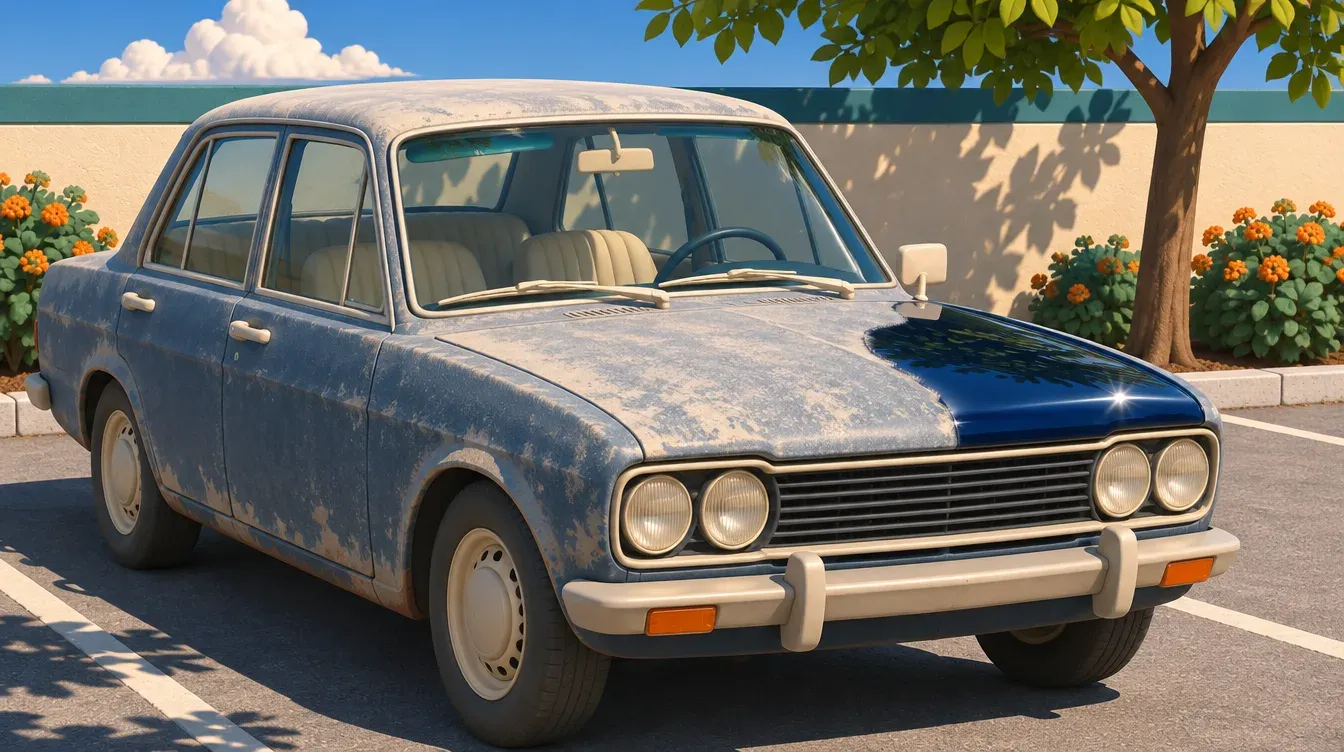
Faded or oxidized paint can often be restored without a respray, as long as the top layer of paint is still sound. Machine compounding and polishing removes the dead, chalky surface and brings back the gloss. PPG’s defect guide gives exactly that as the fix for chalking, and calls for a repaint only in severe cases. If the clear coat is already peeling, flaking or cracked, no polish will save it. The panel has to be refinished.
The test below tells you which you have in about ten minutes.
What fading and oxidation are
Paint is a binder (the resin that holds it together) carrying pigment (the color). Sun, heat and chemicals break both down over the years.
- Chalking. PPG describes this as a chalky dusting or powdering at the paint surface, often seen on old, weathered paint. It lists the causes as breakdown of the binder or the pigment, and as prevention says to avoid strong sunlight and harsh shampoos. This is what most people call oxidation.
- Fading and discoloration. I-CAR, the industry’s training body, says clear coat provides the UV protection for the finish, and that when too much of it is lost, the result can be hazing, discoloration, peeling and finish failure.
- Chemical etching. PPG lists acid rain and fallout as causes of discoloration, and says the clear coat may lose transparency or gloss. It also lists bird droppings among the substances that can attack a paint film.
Single-stage paint and modern base coat and clear coat weather differently. Synchrony’s paint guide explains that single-stage paint combines the color and clear in one layer, while two-stage paint applies them separately. On single-stage paint, the chalky surface is the color layer itself. On base and clear paint, the clear layer on top takes the sun first, which is why I-CAR stresses its UV protection. Types of car paint explains how to tell which your car has.
Polish it or repaint it? A ten-minute test
- Wash and dry the panel in the shade.
- Look closely in daylight. Is it evenly dull, or are there patches where the clear is milky, lifting or flaking at the edge?
- Check the edges. PPG describes flaking as paint lifting from the surface beneath it in smooth flakes, with edges that tend to peel away. Any lifting edge means the layer has lost its bond.
- Try a small test spot with a fine polish on a clean cloth. If the gloss comes back on that spot, the panel is a polishing job. If it stays dull or milky, polishing alone will not fix it.
| What you find | What it likely is | Fix |
|---|---|---|
| Evenly dull or powdery, shine returns on test spot | Surface oxidation or chalking | Compound and polish, then protect |
| Still chalky after a careful polish | Severe chalking | PPG: repaint the topcoat |
| Light etch marks or water spots | Chemical or water spotting | PPG: compound and polish; refinish if severe |
| Milky patches in the clear, edges lifting | Clear coat failure | Refinish the panel (see clear coat peeling) |
| Bare primer or metal showing | Paint worn through | Repaint the panel |
How a restoration works
A professional restoration is usually called paint correction. Capital One’s guide describes it as buffing out imperfections with a machine polisher and a series of pads and compounds. It starts with a thorough wash and decontamination, often including a clay bar, and is then often followed by a wax or a ceramic coating. A single pass can take half a day; a car that needs several passes can take up to 25 hours of labor.
PPG’s corrections for the defects behind fading follow the same pattern:
- Chalking: flat (sand very lightly), compound and polish to restore the gloss. Repaint the topcoat in severe cases.
- Acid rain and fallout: wash with warm soapy water, then sand and buff with rubbing compound and polish. Severe cases need the finish removed and refinished.
- Light acid attack, such as old bird-dropping marks: flatting, compounding and polishing. Severe damage needs the paint taken down to a sound surface and repainted.
The limit is film thickness. I-CAR puts the clear coat at about 2.0 mils of a 4.0 to 6.0 mil finish, and says how much can be removed depends on how much was applied. Each compounding pass takes some of it. Remove too much and you get the hazing and peeling you were trying to fix. I-CAR says film thickness should be monitored during the work, which is done with a paint thickness gauge. Ask whether the shop measures before it polishes.
When polishing won’t work
- The clear coat is peeling or flaking. PPG’s correction for clear coat delamination is to sand the affected areas and refinish. There is nothing for polish to grip.
- The color is worn through to primer. Polish cannot add paint.
- The panel has already been polished thin. I-CAR’s warning applies: more removal leads to finish failure.
- The paint is matte. Axalta’s matte-care bulletin says never to use polish or wax made for gloss paint on a matte finish, because it leaves blotchy patches, and that rubbing hard makes shiny patches that cannot be reversed.
In those cases the answer is a repaint of the affected panels. Often that is not every panel, so ask the shop to mark which ones have failed. Synchrony’s 2025 paint guide calls a full repaint the go-to option for widespread problems such as large patches of peeling or heavy sun fading. Full repaint vs spot repair helps you decide between panels and the whole car.
What it costs
| Option | Published estimate | Source |
|---|---|---|
| Professional paint correction | $350–$1,200+ | ThePricer, Oct 2026 (single-source estimate) |
| Hood repaint | $300–$1,000; $1,000–$1,500+ with failed clear | ThePricer, Aug 2026 |
| Roof repaint | $1,135–$1,735 | StormWise, updated Oct 2026 (single-source estimate) |
| Full respray, budget | $300–$1,000 (AAA); $500–$1,000 (Synchrony, Jan 2025) | Two sources |
| Full respray, mid-grade | $1,000–$4,500 (AAA); $1,000–$5,000 (Synchrony, Jan 2025) | Two sources |
These are estimates checked in November 2026, not quotes. Capital One notes that correction prices reflect time: the more passes the paint needs, the more it costs. The full price guide is how much it costs to paint a car. Budget resprays come with their own catches; see cheap car paint jobs.
Insurance won’t help here. GEICO says normal wear and tear, such as fading paint and oxidation, isn’t covered under any standard auto policy. On a newer car, AAA says most manufacturer paint warranties cover defective paint, often for three years or 36,000 miles, so check before you pay anyone.
Doing it yourself
A light hand polish is a reasonable first step on a car you own outright. Machine compounding is where people damage paint. Capital One’s guide warns that the clear coat is likely only about two mils thick, and that a polisher held in one place too long, or a compound that is too aggressive, can wear through the clear and burn into the paint. PPG lists coarse abrasives and poor compounds as causes of swirl-shaped polishing marks. Start with the least aggressive product on a small test area, keep the machine moving, and stop if the pad picks up color on a base-and-clear car, because the color layer sits under the clear.
How to keep paint from fading again
- Protect it. Polestar’s owner’s manual says polymer waxes protect the bodywork against oxidation, road dirt and fading, and that it is fine to polish and wax when the paint has lost its shine. Synchrony suggests waxing at least twice a year.
- Shade. Synchrony says UV rays fade paint and recommends shaded parking or a car cover.
- Wash it off fast. Kia’s manual says bird droppings can damage paint “in just a few hours.” Polestar says to wash in the shade, because detergent or wax that dries in the sun can turn abrasive.
- Use gentle products. PPG lists harsh shampoos among the things to avoid to prevent chalking.
Restored paint is bare again, so protect it right away. Caring for fresh paint covers wax, sealants and coatings.
What to do next
Wash the car and run the test on the worst panel. If the shine comes back, get a quote for paint correction from a detailer or body shop that measures film thickness, then wax or seal it. If the clear is lifting, get two or three written quotes for refinishing the affected panels and compare them with a full respray. The car paint guide covers choosing a paint shop.
| Scenario | Typical range (estimate) | What drives it |
|---|---|---|
| Professional paint correction (machine compounding and polishing) | $350–$1,200+ (ThePricer, Oct 2026; single-source estimate) | Capital One says packages start at a few hundred dollars and can run into the thousands |
| Repaint a faded hood | $300–$1,000 straightforward, $1,000–$1,500+ with failed clear coat (ThePricer, Aug 2026); $840–$1,440 (StormWise, updated Oct 2026) | When the clear coat has failed on that panel |
| Repaint a faded roof | $1,135–$1,735 (StormWise, updated Oct 2026; single-source estimate) | Often paired with the hood |
| Full respray, budget to mid-grade | $300–$1,000 budget, $1,000–$4,500 mid-grade (AAA, undated); $500–$1,000 budget, $1,000–$5,000 mid-grade (Synchrony, Jan 2025) | When most panels are failing |
Ranges are published estimates checked in November 2026, not quotes. Rows marked single-source estimate rest on one publication.
Frequently asked questions
Can faded car paint be restored?
Often, yes, if the fading is on the surface and the top layer is intact. PPG's defect guide says chalking, the powdery dullness of old, weathered paint, is corrected by flatting, compounding and polishing to restore the gloss, with a repaint only in severe cases. If the clear coat is flaking, peeling or cracked, polishing cannot fix it and the panel needs refinishing.
Full guide: Clear Coat Peeling: Causes and Real Fixes
What is the difference between oxidized paint and clear coat failure?
Oxidation and chalking are a breakdown at the surface of the paint, which looks dull, faded or powdery but stays smooth and attached. Clear coat failure is when the clear top layer loses its bond and starts to haze, lift or flake. The first can usually be polished. The second cannot, because there is no sound layer left to polish.
How much does it cost to fix faded paint?
It depends on whether polishing works. ThePricer's October 2026 guide puts professional paint correction at about $350 to $1,200 or more, a single-source estimate. If the clear has failed, a hood repaint runs about $300 to $1,500 or more (ThePricer, Aug 2026), and a budget to mid-grade full respray $300 to $4,500 (AAA). Get the paint inspected before paying for either.
Full guide: How Much Does It Cost to Paint a Car?
Does insurance cover faded or oxidized paint?
No. GEICO says normal wear and tear, such as fading paint and oxidation, isn't covered under any standard auto insurance policy. If the car is newer, AAA says most manufacturer paint warranties cover defective paint, often for three years or 36,000 miles, so check before you pay for a repair.
Can I polish faded paint myself?
You can try on a small test area, by hand or with a dual-action machine, but go gently. Capital One's guide warns that the clear coat is likely only about two mils thick and that an aggressive compound or a slow-moving polisher can wear through it. Never polish matte paint: Axalta says gloss polishes and waxes leave blotchy patches on a matte finish.
Sources
- PPG Automotive Refinish (EMEA), Chalking (Common Paint Defects Guide) — accessed November 24, 2026
- PPG Automotive Refinish (EMEA), Acid Attack (Common Paint Defects Guide) — accessed November 24, 2026
- PPG Refinish, Acid Rain (Common Paint Defects Guide) — accessed November 24, 2026
- PPG Refinish, Water Spotting (Common Paint Defects Guide) — accessed November 24, 2026
- PPG Refinish, Polishing Marks (Common Paint Defects Guide) — accessed November 24, 2026
- PPG Automotive Refinish (EMEA), Flaking (Common Paint Defects Guide) — accessed November 24, 2026
- PPG Refinish, Delamination of Clearcoat (Common Paint Defects Guide) — accessed November 24, 2026
- I-CAR, Back-To-Basics: Clearcoat Film Thickness (Aug 8, 2019, validated 2025) — accessed November 24, 2026
- Polestar 2 (2023) owner's manual, "Polishing and waxing" — accessed November 24, 2026
- Polestar 2 (2023) owner's manual, "Hand washing" — accessed November 24, 2026
- Kia owner's manual, "Keep paint and trim in good condition" — accessed November 24, 2026
- Axalta Coating Systems, Technical Bulletin TD 6066: Cleaning, Care and Maintenance of Matt Finishes (Apr 2023) — accessed November 24, 2026
- Capital One Auto Navigator, What Is Paint Correction? (Beth Nichols, Apr 7, 2022) — accessed November 24, 2026
- Synchrony, How Much Should It Cost To Paint Your Vehicle? (Jan 6, 2025) — accessed November 24, 2026
- ThePricer, How Much Does Ceramic Coating Cost? (updated Oct 4, 2026) — accessed November 24, 2026
- ThePricer, How Much Does a Car Hood Paint Job Cost? (updated Aug 13, 2026) — accessed November 24, 2026
- StormWise, Car Paint Repair Cost guide (Jun 22, 2023, updated Oct 9, 2026) — accessed November 24, 2026
- AAA, How Much Does It Cost to Paint a Car? (undated) — accessed November 24, 2026
- GEICO, Does Car Insurance Cover Scratches and Dents? (Sep 18, 2026) — accessed November 24, 2026