Body Shop vs Mechanic: Who Fixes What
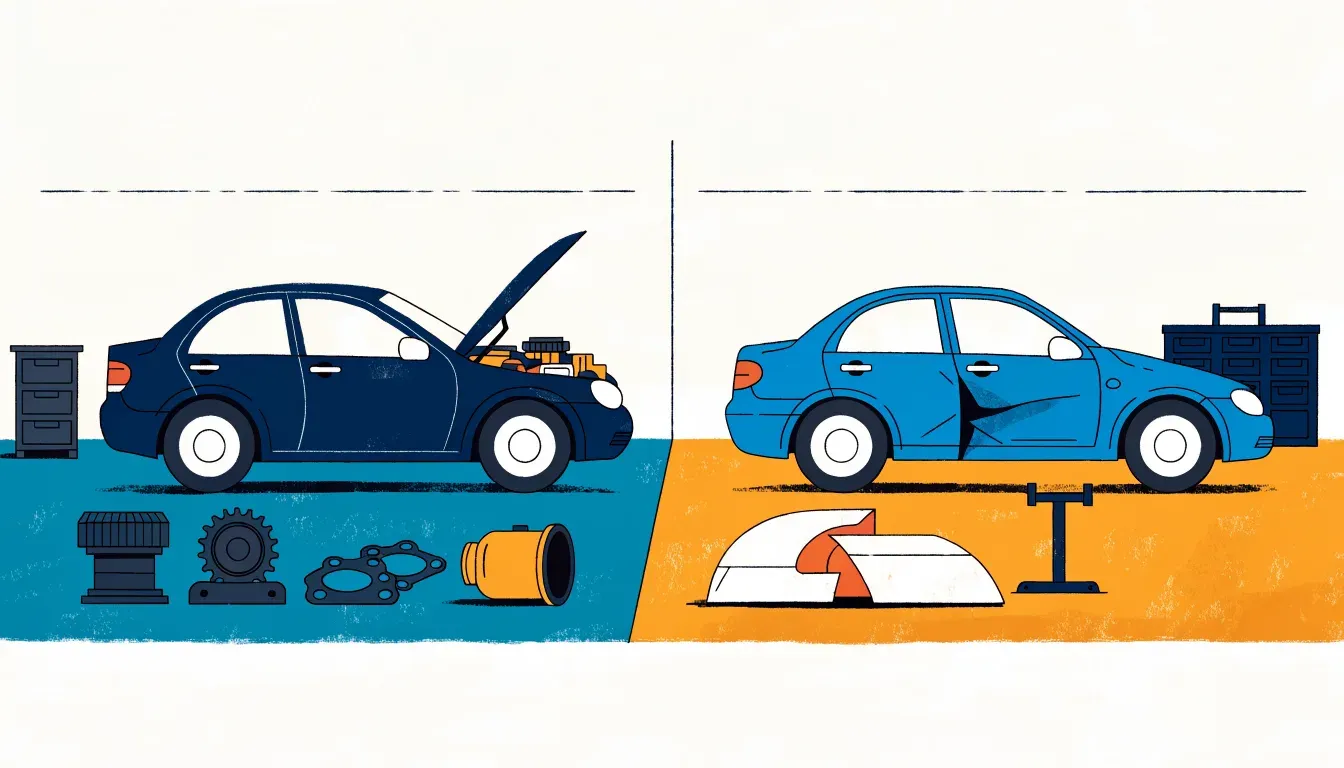
Dents, paint and bent frames go to a body shop. Engines, brakes and warning lights go to a mechanic. After a crash you often need both, and the line between them is blurrier than it looks.
Key takeaways
- Body shops repair the car's structure and skin: frame, panels, bumpers, paint and glass. Mechanics repair the systems that make it run, stop and steer.
- After a collision, damaged suspension, cooling, A/C or electrical parts are often fixed by the body shop as part of the claim, either in-house or sent to a specialist.
- Training is separate. ASE tests mechanics on the A-series and collision technicians on the B-series, which includes one test on mechanical and electrical parts.
- Rates differ by labor type. A 2026 survey found body shops' median mechanical rate was nearly twice their body rate.
A body shop repairs the car’s structure and skin: the frame, panels, bumpers, paint and glass. A mechanic repairs the systems that make the car run, stop and steer: engine, transmission, brakes, suspension and electrical faults. After a crash you often need both, and the body shop usually coordinates it, because collision damage reaches mechanical parts too. This guide is part of the body shops guide.
Who fixes what
| Problem | Usually goes to | Notes |
|---|---|---|
| Dent, crease or scratch | Body shop | Small dents may suit paintless dent repair |
| Cracked bumper or broken light | Body shop | Sensors behind the bumper may need calibration |
| Bent frame or unibody | Body shop | Structural work, often a separate frame labor rate |
| Repaint, faded or peeling paint | Body shop | Refinish work, covered by ASE test B2 |
| Windshield | Glass specialist or body shop | Forward camera may need recalibration |
| Radiator, A/C condenser damaged in a crash | Body shop (in-house or sublet) | Billed as mechanical labor on the estimate |
| Bent suspension arm or wheel after a crash | Body shop (often with alignment sublet) | Part of the collision repair |
| Check-engine light, no crash | Mechanic | Diagnostic work |
| Brakes, oil leaks, transmission | Mechanic | Wear and maintenance items |
The split isn’t strict. A body shop estimate can include engine-bay and suspension parts if a crash damaged them. What decides it is usually the cause: crash damage starts at a body shop, wear and breakdowns start at a mechanic.
Training is different
ASE runs separate test series for each trade (ASE):
- Mechanics: the A-series, A1 to A9, covers engine repair, transmissions, drivetrain, suspension and steering, brakes, electrical, heating and A/C, engine performance and light diesel. Passing A1 to A8 makes a Master Automobile Technician.
- Collision technicians: the B-series, B2 to B5, covers painting, non-structural repair, structural repair, and “mechanical and electrical components.” B6 is for estimators.
So collision technicians are tested on the mechanical parts most often damaged in a crash, but not on the full range a general mechanic covers. I-CAR also recognizes a mechanical technician role for collision shops, and its Gold Class standards include location-level training in mechanical repair, electrical diagnostics and ADAS “even when repairs are outsourced.”
How mechanical work shows up on a body shop estimate
Collision estimates keep mechanical labor separate. In a CCC ONE estimate, mechanical components carry a small (m), and mechanical labor is marked M next to the hours (CCC). Each type has its own hourly rate.
Some mechanical jobs come with detailed rules in the estimating guides. Mitchell’s guide, for example, says its A/C times assume equipment that evacuates the system and holds a vacuum for a leak check, and that “diagnosing a failed leak check is not included” (Repairer Driven News).
Work the body shop can’t do in-house shows up as a sublet line: wheel alignment, some calibrations, sometimes mechanical repairs. CCC says that because of the many different driver-assistance systems, subletting calibrations to vendors or dealerships “has become a common practice.” How to read a body shop estimate explains every line type.
What it costs per hour
| Labor type | Median or typical rate | Source |
|---|---|---|
| Body labor at body shops | $66–$70 an hour, median non-DRP by insurer | Who Pays for What? 2026 |
| Frame labor at body shops | $90–$95 an hour | Who Pays for What? 2026 |
| Mechanical labor at body shops | $125–$135 an hour | Who Pays for What? 2026 |
| General repair shops | $120–$159 an hour for almost half of shops | 2025 PartsTech report, cited by AAA (2026) |
Sources: Autobody News, Oct 2026; AAA. These are estimates from surveys, checked November 2026. Your local rates will differ.
Body shops’ mechanical rates sit close to what general repair shops charge. Body labor is cheaper per hour, but body jobs add paint, paint materials and parts. AAA also notes that dealer mechanics “generally cost more than independent mechanics, often by 25 percent or more.”
Body-and-mechanic shops
Some businesses advertise both. That can save a trip when a crash damages, say, a bumper and a radiator. Before you rely on one shop for both, ask:
- Which work do you do in-house, and which do you send out?
- Who does the mechanical work: an ASE A-series technician or a collision technician?
- Do you do pre- and post-repair scans and calibrations, or sublet them? I-CAR says even minor collision repairs can require calibration.
- Is the mechanical work covered by the same written warranty as the body work?
The FTC suggests asking whether the shop has experience with your make and model. That applies to both trades. Questions to ask a body shop has the full list.
North Carolina: the same rights at both
The Motor Vehicle Repair Act covers both kinds of shop. Its definition of a repair shop includes garages, service stations, dealers, mobile repair shops, “paint and body shops” and brake, muffler and transmission shops (G.S. 20-354.2). Repairs over $350 come with the same rights to a written estimate, notice before going more than 10% over, and an itemized invoice. The NC Department of Justice handles complaints about either. See the North Carolina guide for details.
“Collision repair” and “auto body repair” are often used for the same work; how the two terms differ explains where the line sits.
What to do next
- If the damage came from a crash, start at a body shop and ask it to estimate everything, including anything mechanical.
- If a warning light or noise started without a crash, start at a mechanic.
- Check each estimate for separate mechanical lines and sublets, and ask who does that work.
- Compare shops with how to choose an auto body shop, and check typical totals in collision repair cost.
Frequently asked questions
Do I take my car to a body shop or a mechanic after an accident?
Start with a body shop if there is visible damage to the body, bumpers, lights or glass, or if you are making an insurance claim. The body shop estimates the whole repair, including damaged mechanical parts such as a radiator or suspension arm, and either fixes them or sends them out. Go to a mechanic first only for problems that aren't crash damage.
Can a body shop do mechanical work?
Many can, for crash-related parts. Body shop estimates have separate labor lines for mechanical work, and a 2026 survey found body shops reporting a median mechanical rate of $125 to $135 an hour depending on the insurer. ASE's collision tests include one on mechanical and electrical components. For engine or transmission problems not caused by the crash, a mechanic is usually the right call.
Can a mechanic fix a dent or scratch?
Usually that is body shop work. ASE's tests for mechanics, A1 to A9, don't cover paint or panel repair. Those skills are on the collision B-series tests. A small dent may suit paintless dent repair from a specialist, and a deep scratch needs refinishing. Some businesses do both under one roof, so ask which work they do in-house.
Full guide: Mobile Auto Body Repair: What Can Be Fixed in Your Driveway
Is a body shop more expensive than a mechanic?
Not per hour for body labor. A 2026 survey put median body labor at $66 to $70 an hour by insurer, while AAA, citing a 2025 industry report, says almost half of general repair shops charge $120 to $159 an hour. But body jobs also include paint, materials and parts, so totals depend on the job.
Full guide: Collision Repair Cost: What Drives the Bill
Sources
- ASE: Automobile and Light Truck Certification Tests (A1–A9) — accessed November 24, 2026
- ASE: Collision Repair and Refinish Certification Tests (B2–B5) — accessed November 24, 2026
- ASE: Certification Test Series — accessed November 24, 2026
- I-CAR: Gold Class Standards for Collision Repair — accessed November 24, 2026
- I-CAR: Platinum — accessed November 24, 2026
- Autobody News: 'Who Pays for What?' survey, average median non-DRP labor rates (26 Oct 2026) — accessed November 24, 2026
- AAA: Average Mechanic Labor Rate, Repair Costs in Your State 2026 — accessed November 24, 2026
- CCC Information Services: Reading a CCC ONE Estimate of Record (job aid, 31 Mar 2016) — accessed November 24, 2026
- Repairer Driven News: Mitchell updates its CEG; addresses labor information and other non-included operations (23 Sep 2021) — accessed November 24, 2026
- CCC Intelligent Solutions: The Current State of Calibrations (12 Nov 2025) — accessed November 24, 2026
- I-CAR: What is ADAS? — accessed November 24, 2026
- N.C. Gen. Stat. 20-354.2: Definitions (Motor Vehicle Repair Act) — accessed November 24, 2026
- NC Department of Justice: Auto Repair — accessed November 24, 2026
- FTC: Auto Repair Basics — accessed November 24, 2026