Cracked Plastic Bumper: Can It Be Welded?
Most bumper covers are made of plastic that can be welded. Whether yours should be depends on where the crack is, what sits behind it and what your carmaker allows.
Key takeaways
- Yes, most cracked plastic bumpers can be welded. I-CAR says the polypropylene and TPO plastics used in most bumper covers work very well with nitrogen hot air welding.
- Location decides it. Toyota, Honda, Hyundai, Ford and Porsche all limit or ban plastic repairs near radar sensors, and some require a new bumper for any crack in the sensor area.
- A crack or puncture repair typically costs $300–$500 (Synchrony, Apr 2023) or $325–$425 (Lemonade, Aug 2025). A new bumper cover is $100–$1,000 plus $200–$600 to install and paint.
- Body filler is the wrong material for plastic. I-CAR says it does not flex like a bumper does, so it cracks.
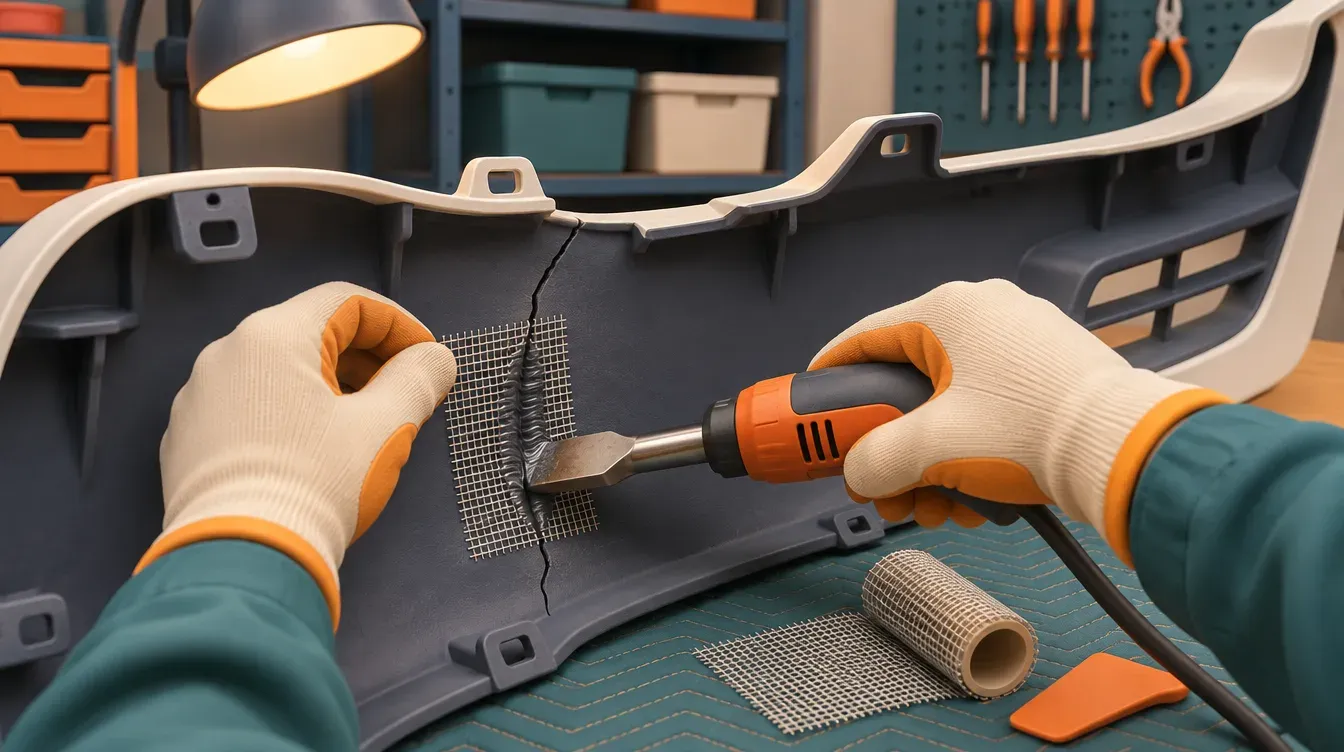
Yes, a cracked plastic bumper can usually be welded. Most bumper covers are made of polypropylene or TPO, a thermoplastic that melts and fuses, and I-CAR says these plastics “work very well” with nitrogen hot air welding. The real question is where the crack is. Near a radar sensor, many carmakers forbid plastic repair and require a new bumper.
A welded or bonded crack repair typically costs $300 to $500, according to Synchrony’s 2023 guide, or $325 to $425, according to Lemonade’s 2025 guide. Both put a new bumper cover at $100 to $1,000 plus $200 to $600 to install and paint. These are published estimates, checked November 2026.
How plastic bumper welding works
I-CAR, the industry training body, describes the nitrogen hot air method step by step:
- Identify the plastic. Look for the ISO code stamped on the back of the bumper, such as PP or TPO, and match the welding rod to it. If there is no code, the carmaker may list what its parts are made of.
- Clean first. Soap and water, then a plastic cleaner, before any sanding. Once the plastic is sanded, no solvents, because trapped solvent can bubble the repair later.
- Align and tape the front. The crack is pulled into line and held with aluminum tape.
- Weld the back. The back is sanded and a wide plastic ribbon is melted into it. At an edge, a second ribbon in a “T” adds strength.
- Groove and weld the front. A V-groove is cut along the crack and a narrow ribbon is welded in level with the surface.
- Finish. The weld is sanded, any low spots are filled with a plastic repair filler, and the area is primed and painted.
The nitrogen keeps oxygen out of the weld, which I-CAR says gives “a contaminant-free weld with less smoke, which creates a stronger weld.” I-CAR’s hands-on plastic repair course has students practice four methods on bumper pieces: two-sided adhesive repair, adhesive tab repair, airless welding and nitrogen hot air welding. Some shops bond a crack with two-part plastic adhesive instead of welding. Lemonade describes shops fixing cracks and punctures “by sanding down the area and patching them with adhesives.”
Not every plastic can be welded. I-CAR notes that a fusion weld “can only be done on thermoplastics.” If the code on the back shows a plastic that won’t weld, ask the shop about an adhesive repair or a new cover.
Why body filler is the wrong fix
Metal body filler on a bumper is a common shortcut and a common failure. I-CAR explains: “Body filler and glaze is not meant to flex the way that plastic does, therefore the material would crack.” Bumper repairs need flexible plastic repair materials, which I-CAR lists as “two-part epoxies, urethanes, or acrylics,” and most plastics also need an adhesion promoter.
If a quote or a past repair used ordinary filler on a bumper crack, expect it to crack again. The body filler guide explains what filler is meant for.
Where you can’t weld: the sensor zones
Modern bumpers hide radar sensors for adaptive cruise control, automatic emergency braking and blind-spot monitoring. A 2022 FenderBender article by a plastic repair trainer explains that radar sensors are mounted behind the bumper cover and send their signals through it, so anything that changes the thickness in that area, including “plastic welding rod, metal reinforcing mesh, adhesives, fillers, and refinish coatings,” can affect the signal. Small round parking sensors that poke through the bumper are a different case. The same article says repairs near those are “not a problem.”
Here is what several carmakers say, as published by the carmaker or quoted by I-CAR and Repairer Driven News:
| Carmaker | Rule on plastic bumper repairs |
|---|---|
| Toyota | “Any cracks or holes in the irradiation area mean the bumper must be replaced.” A hole under 1.97 in. (50 mm) could be repaired if it is not near a sensor. |
| Honda | A crack, dent or gouge in the radar wave emission range means “the bumper must be fully replaced.” |
| Hyundai | “Plastic repairs to the front and rear bumpers are NOT recommended,” because the altered surface may affect corner radar. |
| Ford/Lincoln | Does not approve “fillers, reinforcement tape, hot staples, plastic welding or sonic-weld repairs on ADAS-equipped bumper fascias.” Substrate damage means a new OEM bumper. |
| Porsche | In the radar area, “Cracks/breaks in bumpers must not be repaired by plastic welding.” |
| Tesla | “Repairs in the radar area are not allowed.” Repairs outside the radar area are allowed. |
Toyota adds a broader rule: if a shop “cannot 100 percent guarantee” that coating thickness will match factory specifications near ADAS, Toyota recommends replacing the bumper. A 2025 FenderBender article quotes a 3M engineer who says repair guidelines differ “from one manufacturer and model to the next,” which is why the shop needs the procedure for your exact car.
If a sensor itself is damaged, the cost goes up fast. AAA’s 2023 study put front radar sensor replacement at $500 to $1,300, on top of the bodywork. Calibration is covered in ADAS calibration after a collision.
When welding makes sense
A plastic weld is a good fix when:
- The crack is in a part of the bumper with no radar sensor behind it, or the carmaker’s diagram shows it is outside the restricted zone.
- The plastic is a thermoplastic and the code on the back can be matched.
- The cover still holds its shape, and its mounting tabs are intact or repairable.
- The bumper is expensive or hard to find, so saving the original part is worth the labor.
Replacement makes more sense when the crack is in a sensor zone, the cover is torn in several places or missing pieces, the carmaker bans plastic repair on that bumper, or a new aftermarket or OEM cover costs about the same as the repair once paint is added. Bumper repair vs replacement goes through how shops make that call, and bumper repair cost has the full price picture.
Broken tabs and brackets
If a bumper sits crooked after a bump, check the mounting tabs behind it as well as the visible surface. A 2025 FenderBender article notes shops use plastic adhesives, nitrogen welders and plastic welding bits to fix “tears, holes and other damage,” and that tab repair can avoid parts replacement. I-CAR’s hands-on course includes an “adhesive tab repair with pinning” exercise. Ask whether the tabs can be repaired before you pay for a whole new cover.
Can you weld a bumper yourself?
A crack is not a beginner job. Getting a lasting repair means identifying the plastic, cleaning it correctly, welding both sides, and refinishing a flexible part so the paint does not crack. Scuffs and light scratches are more realistic at home. See DIY bumper scuff repair. Never repair, fill or add thick paint over the radar area yourself.
What to do next
Find out what sits behind the crack. Check your owner’s manual for adaptive cruise, emergency braking or blind-spot monitoring, and look at where the sensors are. If the crack is clear of them, ask a shop whether it can weld or bond the crack and what it will charge against a new cover, painted. If it is in a sensor zone, expect a new bumper and ask about calibration. Back to the body damage guide, or see fender repair prices and car door replacement cost if the hit reached other panels.
| Scenario | Typical range (estimate) | What drives it |
|---|---|---|
| Crack or puncture repaired (welded or bonded) and refinished | $300–$500 (Synchrony, Apr 2023); $325–$425 (Lemonade, Aug 2025) | Lemonade says the price depends on whether the area needs repainting |
| New bumper cover, part only | $100–$1,000 (Synchrony, Apr 2023); $100–$1,000 (Lemonade, Aug 2025) | Luxury cars, trucks and SUVs cost more |
| Install and paint a new bumper cover | $200–$600 to install (Synchrony, Apr 2023); $200–$600 to install and paint (Lemonade, Aug 2025) | Plus any sensor brackets, clips and calibration |
| Replace a front radar sensor, on top of bodywork | $500–$1,300 (AAA, Dec 2023; single-source estimate) | Only if the sensor itself is damaged |
Ranges are estimates from the sources listed on this page, not quotes. Rows marked single-source estimate rest on one publication. Sensor costs apply only when a sensor is damaged or must be replaced.
Frequently asked questions
Can a cracked plastic bumper be welded?
Usually, yes. Most bumper covers are thermoplastics such as polypropylene or TPO, and I-CAR says these work very well with nitrogen hot air welding. The technician matches the welding rod to the plastic code stamped on the back of the bumper, welds the back, then grooves and welds the front. The exception is any crack near a radar sensor, where many carmakers require a new bumper.
Is it cheaper to repair or replace a cracked bumper?
Repair is usually cheaper. Synchrony puts a crack or puncture repair at $300 to $500, and Lemonade puts it at $325 to $425. A new bumper cover costs $100 to $1,000 for the part, plus $200 to $600 to install and paint, by both sources. Replacement can win when the bumper is badly torn or the crack sits in a sensor zone.
Full guide: Bumper Repair vs Replacement: How Shops Decide
Can I fix a cracked bumper myself?
A scuff, yes. A crack is harder. A lasting crack repair needs the right plastic repair adhesive or a plastic welder matched to the bumper's plastic, plus adhesion promoter and flexible materials. I-CAR warns that ordinary body filler cracks on a bumper because it does not flex. Never repair or add thick paint near a radar sensor.
Full guide: DIY Bumper Scuff Repair (and the Sensor Zones to Leave Alone)
Why won't my insurer pay to weld my bumper?
Sometimes the carmaker forbids it. Hyundai says plastic repairs to bumpers are not recommended because the altered surface may affect corner radar, and Ford does not approve plastic welding on ADAS-equipped bumper covers. Honda and Toyota require a new bumper for cracks in the radar area. A shop following those rules has to replace the cover.
Sources
- I-CAR RTS, "Nitrogen Hot Air Welding" (validated 2024) — accessed November 24, 2026
- I-CAR RTS, "Body Filler On Bumpers" (validated 2023) — accessed November 24, 2026
- I-CAR RTS, "I-CAR Repairers Realm: Plastic Repair Series - Part Two: Plastic Bumper Repair" (validated 2026) — accessed November 24, 2026
- Toyota Collision Pros, "Toyota Bumper Repair with ADAS" — accessed November 24, 2026
- Repairer Driven News, "Honda releases position statement on bumper cover repairs for AcuraWatch 360" (May 13, 2024) — accessed November 24, 2026
- I-CAR RTS, "Bumper Cover Repair With ADAS: Hyundai - UPDATE" (Jan 17, 2025) — accessed November 24, 2026
- I-CAR RTS, "Bumper Cover Repair With ADAS: Ford/Lincoln - UPDATE" — accessed November 24, 2026
- I-CAR RTS, "Bumper Cover Repair With ADAS: Porsche - UPDATE" (Jun 28, 2024) — accessed November 24, 2026
- I-CAR RTS, "Bumper Cover Repair With ADAS: Tesla" (Apr 28, 2020) — accessed November 24, 2026
- FenderBender/ABRN, "Bumper repair: Stay away from the sensors" (Mar 22, 2022) — accessed November 24, 2026
- FenderBender/ABRN, "Let these five points guide you in auto body plastic repairs" (Jun 12, 2025) — accessed November 24, 2026
- I-CAR, Hands-On Skills Development white paper (plastic repair course) — accessed November 24, 2026
- Synchrony, "How Much Does It Cost to Replace or Repair a Car Bumper?" (Apr 11, 2023) — accessed November 24, 2026
- Lemonade, "Bumper Repair Explained" (updated Aug 6, 2025) — accessed November 24, 2026
- AAA Newsroom, "Fixing Advanced Vehicle Systems Makes Up Over One-Third of Repair Costs Following a Crash" (Dec 14, 2023) — accessed November 24, 2026