DIY Dent Removal: What Works and What's a Myth
Home dent removal can work on a small, shallow, round dent where the paint is unbroken. Creases, body lines, cracked paint and dents near safety parts are a different job. Here is what each method can do, which hacks to skip, and when to stop.
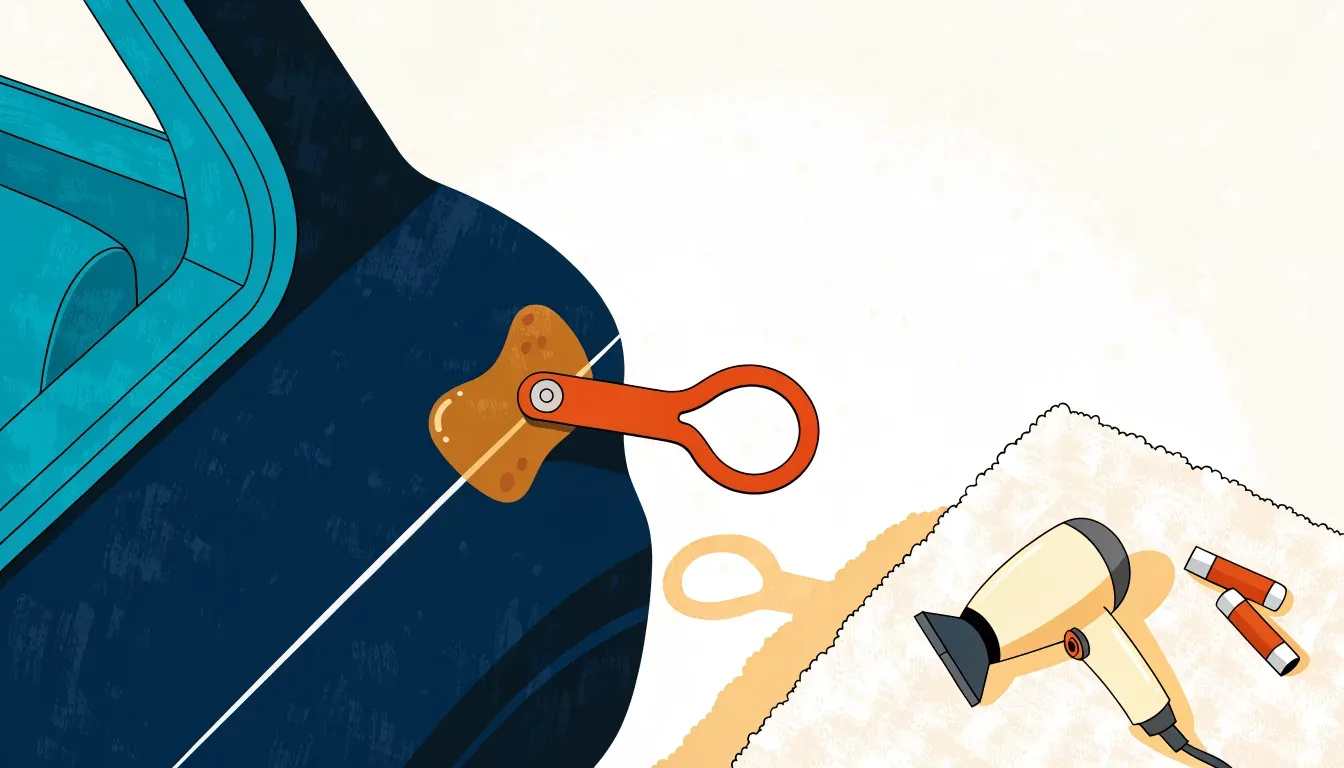
Key takeaways
- DIY dent removal has a real chance only on small, shallow, rounded dents with the paint intact, on a panel you can reach or pull from the front.
- Plastic bumper dents are the easiest home fix: warming the plastic often lets it move back. Metal dents need a pulling tool and patience.
- Skip dry ice and boiling water. Caliber Collision warns dry ice can leave chemical residue and boiling water can cause serious burns.
- Stop if the paint cracks, the dent has a sharp crease or sits on a body line, or you would need to drill a hole to reach it. Each of those makes a pro repair harder or impossible.
DIY dent removal works on a narrow kind of dent: small to medium, shallow and rounded, with the paint unbroken, on a flat part of a panel. On that kind of dent, a suction cup, a glue-pull kit or gentle heat on a plastic bumper can make it much less visible. It will not fix sharp creases, dents on body lines, dents with cracked paint, or anything near sensors and safety parts. Most viral hacks fall somewhere between unreliable and harmful.
This guide sorts the methods into what works, what is a myth, and when to put the tools down.
First, read the dent
Look at the dent in low, angled light and answer four questions before you buy anything.
| Question | Good sign for DIY | Bad sign |
|---|---|---|
| Is the paint intact? | No cracks, chips or flaking | Any crack or chip in the dent |
| What shape is it? | Round and soft-edged | A sharp crease or fold |
| Where is it? | Flat middle of a door, hood or fender | On a body line, panel edge or near a sensor |
| What is the panel made of? | Plastic bumper cover, or steel | Aluminum, or you don’t know |
The paint question matters most. Caliber Collision’s guide points out that paintless repair, DIY or professional, “can only be done if the paint is still intact,” and that cracked or chipped paint has to be repaired to avoid rust. A crease matters next. Caliber says shop paintless repair is only possible if the dent “doesn’t involve sharp creases or folds in the metal.”
The metal matters more than most people think. I-CAR, the collision industry’s training body, says straightening aluminum or ultra-high-strength steel without heat “will often cause the part to crack,” and that heat should only be used if the vehicle maker allows it. Your owner’s manual or a dealer can tell you whether a panel is aluminum. If you can’t find out, treat it as a shop job.
What actually works
Heat on a plastic bumper cover
Plastic bumper dents are the best DIY candidates. Synchrony’s 2024 guide says dents in plastic, even larger ones, “are generally easy and affordable to fix at home” with heat and effort. Its method:
- Clean the area so you can see the dent clearly.
- Warm the dent with a hair dryer until it is warm to the touch. Keep it moving.
- For a small dent, spray cool compressed air over the warm plastic. Synchrony says the dent should pop out on its own.
- For a larger dent, attach a suction dent puller and pull firmly outward.
- Where you can reach behind the bumper, push gently from the back while the plastic is warm. Caliber Collision describes this as the usual home method: heat the area, then apply pressure to the back of the panel. Wear gloves, because the plastic gets hot.
Before you heat a bumper, check what sits behind it. Many bumpers carry radar and parking sensors. DIY bumper scuff repair explains where not to work.
Suction pullers on large, shallow dents
A suction cup puller, or a cup plunger, grips a smooth area and pulls the panel back out. It suits a broad, shallow dent on a flat panel. Synchrony’s step for metal dents is to suction the dent outward, with one honest goal: “The goal is to make the dent smaller, not eliminate it.” A suction cup cannot grip a small ding and cannot pull a crease.
Glue-pull kits
A glue-pull kit glues plastic tabs to the dent, pulls them with a small lifter or bridge, and releases the glue afterward. This is a home version of a real professional technique. I-CAR describes glue pull repair as a method that grew out of paintless dent removal and is now a mainstream panel-straightening technique. Its advantages, in I-CAR’s words: it “does not require coatings, such as paint and E-coat, to be removed,” and it does not disturb corrosion protection on the back of the panel.
I-CAR also lists the limits. Some small dents, “such as those that are less than a quarter in size or adjacent to two body lines, are difficult to achieve a successful pull.” Professionals use several tab shapes, lifting tools and special knockdown hammers to tap down the high spots that pulling creates.
Synchrony’s 2024 bridge-puller method, in short:
- Clean and dry the dent the way the kit’s instructions say, so the glue can bond.
- Glue the puller head to the deepest point of the dent and let the glue cool for the time the directions give. Synchrony says that is usually about 4 to 8 minutes.
- Turn the bridge puller’s dial slowly to move the metal, and stop when the metal is back in its original position.
- Release the tab by warming the glue, as Synchrony describes, then wipe away the residue.
- Check in angled light and repeat with a smaller tab on what is left.
Stop if the paint cracks. Rivian’s paintless dent repair position statement, reported by I-CAR, has technicians check for micro-cracking with a 30x magnifier before and after a repair, because “if micro-cracking is present, the panel must be sanded down to the substrate and refinished.” At home you won’t have a magnifier, so look closely after each pull.
What’s a myth, or a bad idea
- Boiling water. Caliber Collision says simply pouring hot water on a panel “won’t typically cause a dent to disappear,” and warns that splashing can cause serious burns. A hair dryer gives the same mild heat with less risk.
- Dry ice. The idea is to shock the metal with cold. Caliber says it does not recommend this “as the dry ice can leave chemical residue on the exterior panel.” Dry ice also burns bare skin.
- Hammering it out. Caliber notes that a hammer’s hard edges damage paint, and that even a rubber mallet “can cause more damage to the car body if done improperly.” Professionals use shaped tools and work from behind the panel.
- Drilling a hole to reach the back. I-CAR’s curriculum is plain: “When performing PDR, do not drill access holes. If holes must be cut to access the panel backside, PDR is not an acceptable option.” Holes in a structural part can create weak spots where none were meant to be.
- Pulling out foam to get access. I-CAR says foam “should not be removed when performing PDR,” because it is hard to reinstall.
- “Any dent can be fixed without paint.” Lemonade’s 2025 guide warns that viral videos make it look easy, “but you can easily turn a $100 repair into a $500 nightmare.” Caliber adds that a failed home attempt can add creases, after which paintless repair “may not be viable anymore.”
Safety
Wear safety glasses. OSHA requires eye and face protection at work against “chemical, environmental, radiological or mechanical irritants and hazards,” and a tab that lets go or a plunger that loses suction can snap back fast. Caliber lists cuts, bruises and burns among the injury risks of home dent removal. Keep heat gentle and moving, and never use an open flame.
Stop and take it to a shop
Put the tools down and get a professional opinion when:
- The paint has cracked, chipped or flaked, before you start or during a pull. That is now a paint repair, and bare metal will rust.
- The dent has a sharp crease or sits on a body line or panel edge. These are hard even for professionals.
- The panel is aluminum or you can’t tell. I-CAR warns that cold straightening often cracks aluminum and ultra-high-strength steel.
- Reaching the back would mean drilling, cutting, removing foam or removing trim near airbags or wiring.
- The dent is on a bumper near radar, a camera or parking sensors.
- The dent is on a pillar, rocker panel or roof rail, or came with other crash damage. I-CAR says vehicle-maker repair procedures “are service specifications, not recommendations.”
- Two or three careful attempts made no progress. More force is how dents get worse.
A paintless dent repair technician is often the cheapest professional route for a small dent with intact paint. Paintless dent repair explains how it works and its limits, and dent repair cost compares PDR with a conventional body shop repair. If the dent needs filling, read the body filler guide first.
What to do next
Check the paint in the dent under bright, angled light. If it is intact and the dent is round and shallow, a gentle suction or glue pull is a fair first try. If the dent is a small door ding, door ding repair shows the options. If you are on the fence, run it through the DIY-or-shop decision guide. Every home-repair guide is on the DIY hub. To compare what each kit contains, see dent puller kits compared.
| Scenario | Typical range (estimate) | What drives it |
|---|---|---|
| DIY dent kit | $15–$50 (Lemonade, Sep 2025); $40–$99 for a bridge-puller kit (Synchrony, Dec 2024) | Plus your time; risk of making it worse |
| Small ding or shallow crease, paintless repair | $100–$150 (Synchrony, Dec 2024); $50–$150 for small dents (Lemonade, Sep 2025) | Paint unbroken |
| Typical paintless dent repair | $75–$300 (Lemonade, Sep 2025) | Single-source estimate |
| Conventional repair: filler, primer and paint | $300–$1,500 (Synchrony, Dec 2024) | Single-source estimate; days to a week in the shop |
Ranges are estimates from the sources listed on this page, not quotes. Your price depends on the vehicle, the damage and local labor rates.
Frequently asked questions
Does a plunger really pull out a car dent?
Sometimes, on a large, shallow, rounded dent on a flat panel, a cup plunger or a suction dent puller can pop it back. It will not move a sharp crease or a small, deep ding, and it can lose grip suddenly, which Caliber Collision lists as an injury risk. Synchrony's 2024 guide sets the right goal: make the dent smaller, not perfect. If two or three careful pulls do nothing, stop.
Can you remove a dent with a hair dryer?
Heat helps most on plastic bumper covers. Synchrony's 2024 guide says to warm a plastic dent until it is warm to the touch, then use cool compressed air or a suction puller to pop it out. On steel panels, heat alone rarely moves the metal. Keep the heat gentle: a hair dryer, not a torch, and never enough to blister the paint.
Is a glue puller kit safe for my paint?
The glue pull method itself is a professional technique. I-CAR says it does not require removing paint or e-coat and does not disturb corrosion protection on the back of the panel. The risk at home is cracked paint from pulling too hard, and small dents near body lines that I-CAR says are hard to pull successfully. Stop at once if the paint cracks.
Full guide: Paintless Dent Repair: How It Works, What It Costs and Its Limits
How much does it cost to have a small dent fixed instead?
Lemonade's 2025 guide puts small dents at $50 to $150 and a typical paintless dent repair at $75 to $300. Synchrony's 2024 guide puts a small door ding at $100 to $150 by paintless repair, and a conventional fill-and-paint repair at $300 to $1,500. These are estimates, checked in November 2026. A home attempt that cracks the paint pushes you into the higher bracket.
Full guide: Dent Repair Cost: Paintless (PDR) vs Conventional Body Shop Repair
Sources
- I-CAR RTS, "Glue Pull Repair (GPR)" (Jan 10, 2020, validated 2026) — accessed November 24, 2026
- I-CAR RTS, Ask I-CAR: "What does I-CAR say about drilling holes to perform PDR repairs?" — accessed November 24, 2026
- I-CAR RTS, "Back-To-Basics: Cold Straightening" (Jul 16, 2021, validated 2026) — accessed November 24, 2026
- I-CAR RTS, "Rivian Position Statement: Paintless Dent Repair" (Jan 10, 2025) — accessed November 24, 2026
- I-CAR RTS, "Always Follow Vehicle Maker Procedures" (Jul 7, 2016, validated 2026) — accessed November 24, 2026
- Synchrony, "How To Fix Car Dents: Options and Costs To Consider" (Dec 19, 2024) — accessed November 24, 2026
- Lemonade, "How Much Does it Cost to Repair a Car Dent?" (updated Sep 30, 2025) — accessed November 24, 2026
- Caliber Collision, "Does Hot Water Really Take Out Car Dents?" (undated) — accessed November 24, 2026
- OSHA, Eye and Face Protection — accessed November 24, 2026